
A Comprehensive Guide to Bulk Process Equipment
When we talk about bulk process equipment, we are describing the specialized industrial machinery designed to handle large quantities of materials, specifically dry bulk solids, powders, granules, and even certain liquids. In my experience, these systems aren’t just machines; they are the functional veins and arteries of an industrial plant. This field is broadly known as bulk material handling.
The primary functions of this equipment include storage, transfer, feeding, and processing. Whether you are in food processing, chemical manufacturing, mining, pharmaceuticals, or agriculture, the goal is the same: to move material from point A to point B while maintaining its integrity and ensuring the final product meets exact specifications.
Solving the Challenge of Inconsistent Flow
One of the biggest operational pain points I see in facilities today is inconsistent material flow. If your powder clumps or your granules don’t move smoothly through the hopper, your entire line stops. Manual handling is another major risk; relying on operators to physically dump bags into mixers leads to ergonomic injuries, dust exposure, and inevitable human error. Bulk process equipment automates these dangerous and tedious tasks, replacing manual labor with reliable, repeatable mechanical or pneumatic force.
Core Types of Bulk Process Equipment
Selecting the right equipment starts with understanding how your material behaves. Not all powders are created equal, some flow like water, while others are sticky and prone to bridging.
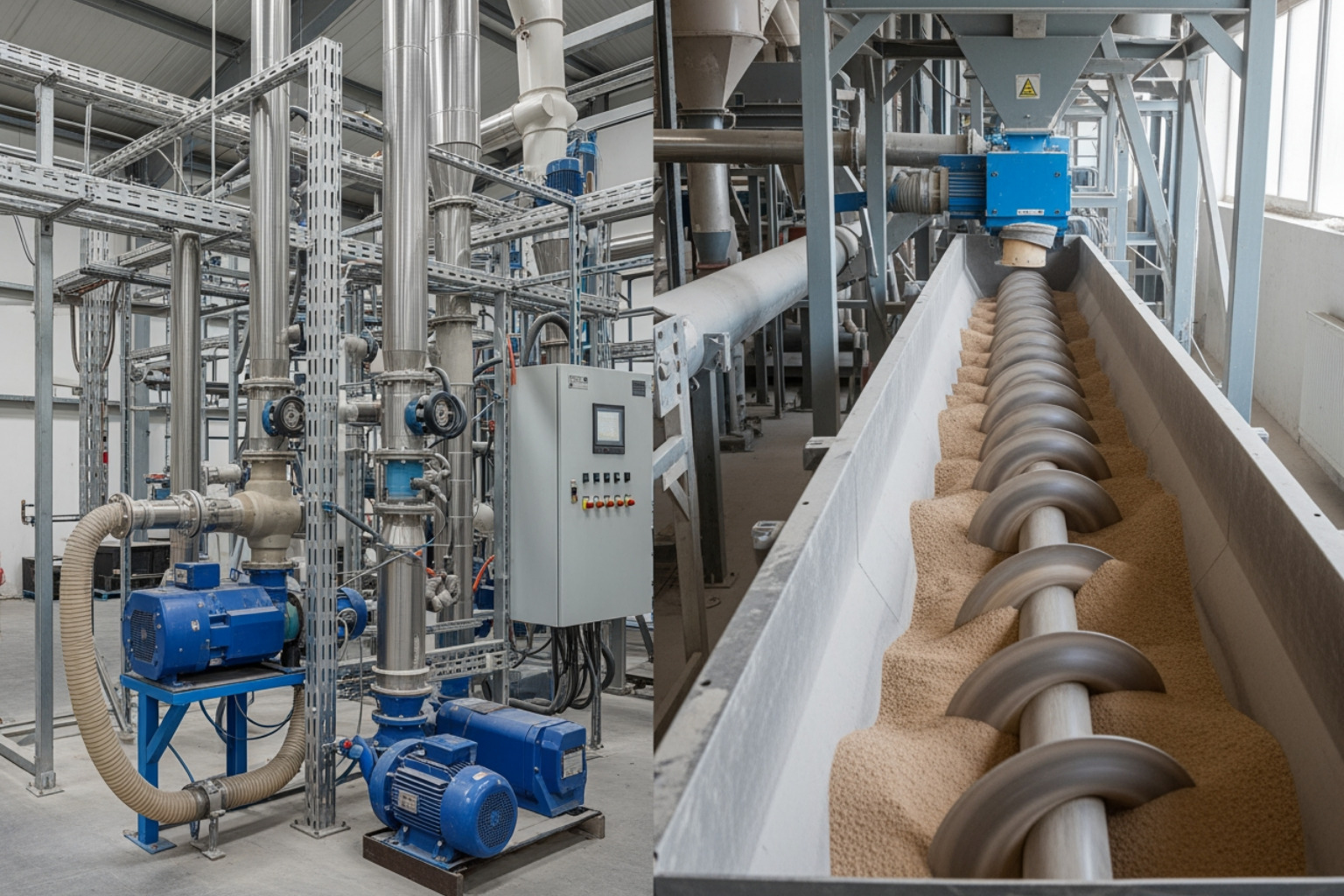
Pneumatic and Mechanical Conveying
Conveying is the heart of material transfer.
- Pneumatic Conveying: This uses air pressure or vacuum to move materials through enclosed pipes. It is ideal for powders and fine granules where dust containment is a priority.
- Mechanical Conveying: This involves physical contact, such as screw conveyors, drag conveyors, or belt systems. For example, mechanical conveyors can transport large amounts of product horizontally, vertically, or at steep inclines, making them incredibly versatile for heavy or abrasive materials.
Dust Collection and Vibratory Systems
Dust is more than just a nuisance; it is a safety hazard and a sign of wasted product. Effective dust collection systems use a capture, convey, and collect formula to keep the air clean. Meanwhile, vibratory systems, including feeders, screeners, and tables, use high-frequency vibrations to prevent blockages and ensure consistent dosing. High-performance vibrating motors can deliver massive force (up to 40,700 lbs in some 8-pole configurations) to keep even the most stubborn materials moving.
Size Reduction
Sometimes materials arrive in a form that is too large for the next process stage. High-capacity pulverizers, such as the Model F Pulva Sizer, can offer up to 75% more capacity than standard models while maintaining precise particle size control. These are essential for industries like recycling or chemical manufacturing where uniform texture is non-negotiable.
For handling the beginning of the process, Bulk Bag Unloading Systems are critical for safely and efficiently introducing raw materials into these conveying streams.
Mixing and Blending Solutions
Achieving a homogeneous blend is often the most difficult part of processing. If your ingredients aren’t mixed perfectly, your product quality suffers.
- High Shear Batch Mixers: These are a game-changer. Some high shear mixers can cut processing times by up to 90% compared to conventional stirrers. They use a multistage mixing action (intake, initial shear, and hydraulic shear) to eliminate fish eyes and agglomerates.
- Jumbo Quick Mixers: For high-volume batch mixing (up to 25,000 lbs), vertical auger systems with dispersion paddles can ensure a uniform mix in just minutes.
Integrating these mixers into automated process lines eliminates the human factor, ensuring that every batch is identical to the last.
Storage and Discharge Systems
Storing dry bulk solids requires more than just a big tank. Silos and hoppers must be designed to address bridging (where material forms an arch over the outlet) and ratholing (where only a small center channel flows).
- 60-Degree Hopper Cones: I often recommend a 60-degree slope for hoppers to promote continuous flow for semi-free-flowing materials.
- Discharging: When you’re working with FIBCs (Flexible Intermediate Bulk Containers), professional Bulk Bag Discharging systems use agitation and dust-tight seals to ensure the bag empties completely without making a mess.
Optimizing Efficiency with Automated Bulk Process Equipment
The transition from manual to automated systems is where the most significant ROI is found. When I look at plant performance, the difference is night and day.
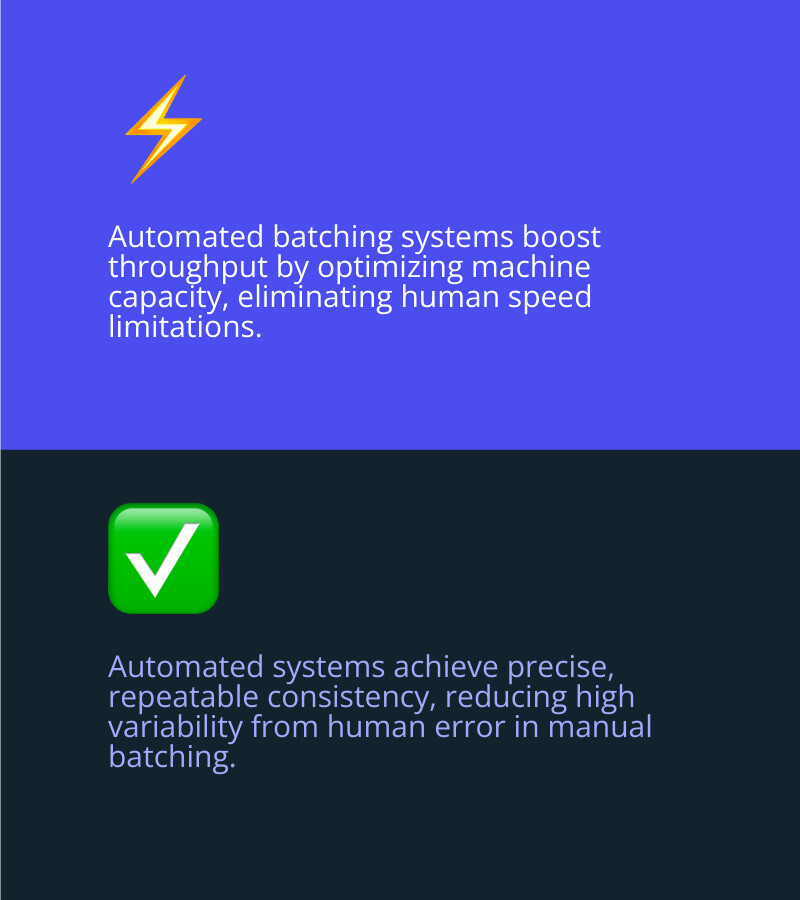
| Feature | Manual Batching | Automated Batching |
|---|---|---|
| Throughput | Limited by human speed | Optimized for machine capacity |
| Consistency | High variability (human error) | Precise and repeatable |
| Labor Dependency | High (requires constant attention) | Low (monitored by exception) |
| Scrap/Waste | High (overpours/spills) | Minimal (precision dosing) |
| Data Tracking | Paper-based/Manual entry | Real-time digital logging |
By implementing Bulk Bag Packaging Systems, you can close the loop on your production line, ensuring that the efficiency gained in mixing isn’t lost during the final packaging stage.
Precision Weighing and Batching with Bulk Process Equipment
Accuracy in weighing is the difference between profit and loss. We typically evaluate two main methods:
- Gain-in-Weight (GIW): The receiving vessel is placed on load cells, and ingredients are added one by one. This is cost-effective for many applications.
- Loss-in-Weight (LIW): The supply hopper itself is weighed, and the system measures how much material leaves. This is generally more accurate for continuous processes and micro-ingredient batching.
Using micro-ingredient batching systems, an industry standard pioneered by innovators in the field, allows for lightning-fast loading. For instance, some weigh lorry systems can load a 9-compartment truck in just 8 minutes, which is up to 5x faster than the national average. This precision reduces raw material waste and ensures that expensive additives are used exactly as intended. A Bulk Bag Unloading and Weighing System integrates these two critical functions into one seamless step.
Handling Dry Bulk Solids and Powders with Bulk Process Equipment
Handling powders requires a deep understanding of particle size and moisture sensitivity. For example, clay powders can be notoriously difficult to discharge due to their tendency to clump. Specialized Clay Powder Bulk Bag Discharge setups use heavy-duty agitation to break up clumps.
When choosing a hopper, you shouldn’t just pick one off the shelf. My Bulk Bag Hopper Selection Guide explains how to match the hopper geometry to the specific flow characteristics of your material.
Key Factors for Selecting Bulk Process Equipment
Choosing the right bulk process equipment is a significant investment. You shouldn’t guess; you should test.
Capacity and Compatibility
Does the equipment handle the volume you need today, and what you’ll need in five years? Material compatibility is also vital. For food-grade or corrosive chemical applications, you should specify 304 or 316 stainless steel with continuous-welded seams ground smooth to prevent material buildup and bacteria growth.
Customization and Compliance
Off-the-shelf solutions rarely fit perfectly into an existing plant layout. Custom-engineered solutions allow you to navigate low headroom, tight floor space, or unique integration requirements. Furthermore, ensure your equipment meets regulatory standards (like ATEX for explosion venting or FDA for food safety).
I highly recommend utilizing a Bulk Solids Test Facility. Testing your specific material on pilot-scale equipment allows you to simulate multistep process lines and solve unique processing issues before you spend a dime on full-scale installation.
Maintenance and System Integration
A common question I get is: “Should I buy a new system or retrofit my old one?”
Retrofit vs. Full System Upgrade
If your mechanical equipment (the steel and motors) is still in good shape, but your batches are inconsistent, a controls upgrade might be the answer. Retrofitting legacy systems with modern PLC-based automation can provide the benefits of a new system, better data tracking and higher accuracy, at a fraction of the cost. However, if your conveyors are constantly breaking down, a full system upgrade is the only way to truly reduce downtime.
Proper maintenance is also simplified by smart design. For example, clam-shell auger tubes and tool-less removable components allow for rapid cleaning and interventions, which is essential for facilities with frequent product changeovers. For a deep dive into the logistics, see Bulk Bag Handling from Filling to Unloading.
Integrating Bulk Process Equipment into Complete Systems
The real magic happens when individual pieces of equipment are integrated into a cohesive system. Modern automation allows your storage silos to talk to your conveyors, which talk to your mixers, which talk to your packaging line.
- Process Control: Automation upgrades allow for real-time monitoring of every gram of material.
- Efficiency: You can Unlock Efficiency with Automated Bulk Bag Unloading by ensuring the downstream process never has to wait for material.
- Packaging: Automated Bulk Bag Filling ensures that finished product is weighed and densified correctly, maximizing shipping efficiency.
Frequently Asked Questions
What are the benefits of automating bulk material handling?
Automation significantly reduces labor dependency and removes workers from hazardous environments (like dust-heavy or high-temperature zones). It also increases throughput by eliminating the stops and starts associated with manual material transfer.
How do automated systems reduce batching errors and scrap?
Human operators, no matter how skilled, will eventually make a mistake, adding too much of one ingredient or forgetting another. Automated systems use load cells and PLC logic to ensure that every ingredient is added within a tight tolerance. If a weight is off, the system can pause and alert the operator before the batch is ruined, drastically reducing scrap.
What factors influence the choice between loss in weight and gain in weight batching?
The choice usually comes down to required precision and the nature of the process. Gain-in-weight is excellent for large batches where the total weight of the vessel is manageable. Loss-in-weight is preferred for continuous feeding (like extruders) or when you need extreme accuracy for very small, expensive micro-ingredients.
Conclusion
At Sterling Systems & Controls, I believe that your success depends on more than just buying a machine; it depends on the right integration of technology and design. We specialize in providing custom-engineered, automated solutions for material weighing, batching, and process control.
Whether you are looking to solve a specific bottleneck or need a single-source provider for Complete Process Systems, our decades of experience allow us to tailor a solution to your specific objectives. By focusing on outcomes like reduced batching errors, increased throughput, and lower labor dependency, we help you turn your bulk material handling from a headache into a competitive advantage.
Last updated on August 3rd, 2026 at 11:43 am