
Unlock Efficiency with Automated Bulk Bag Unloading
The Shift from Manual Labor to Smart Automation
Automated bulk bag unloading transforms how process industries handle bulk materials, replacing labor-intensive manual methods with efficient, safe, and precise systems. These systems use mechanical lifts, dust-tight connections, and controlled discharge mechanisms to empty bags containing powders, granules, or pellets without the hazards and inefficiencies of manual dumping.
Quick Comparison: Manual vs. Automated Unloading:
| Factor | Manual Unloading | Automated Unloading |
|---|---|---|
| Product Loss | 1-2% per bag | <0.01% per bag |
| Throughput | 400 bags/8-hour shift | Up to 1,300 bags/hour |
| Operator Safety | High injury risk (lifting, dust, lacerations) | Minimal physical contact, enclosed systems |
| Dust Emissions | Significant exposure | Near-zero with integrated collection |
| Labor Required | 1-2 operators per station | 1 part-time operator for multiple stations |
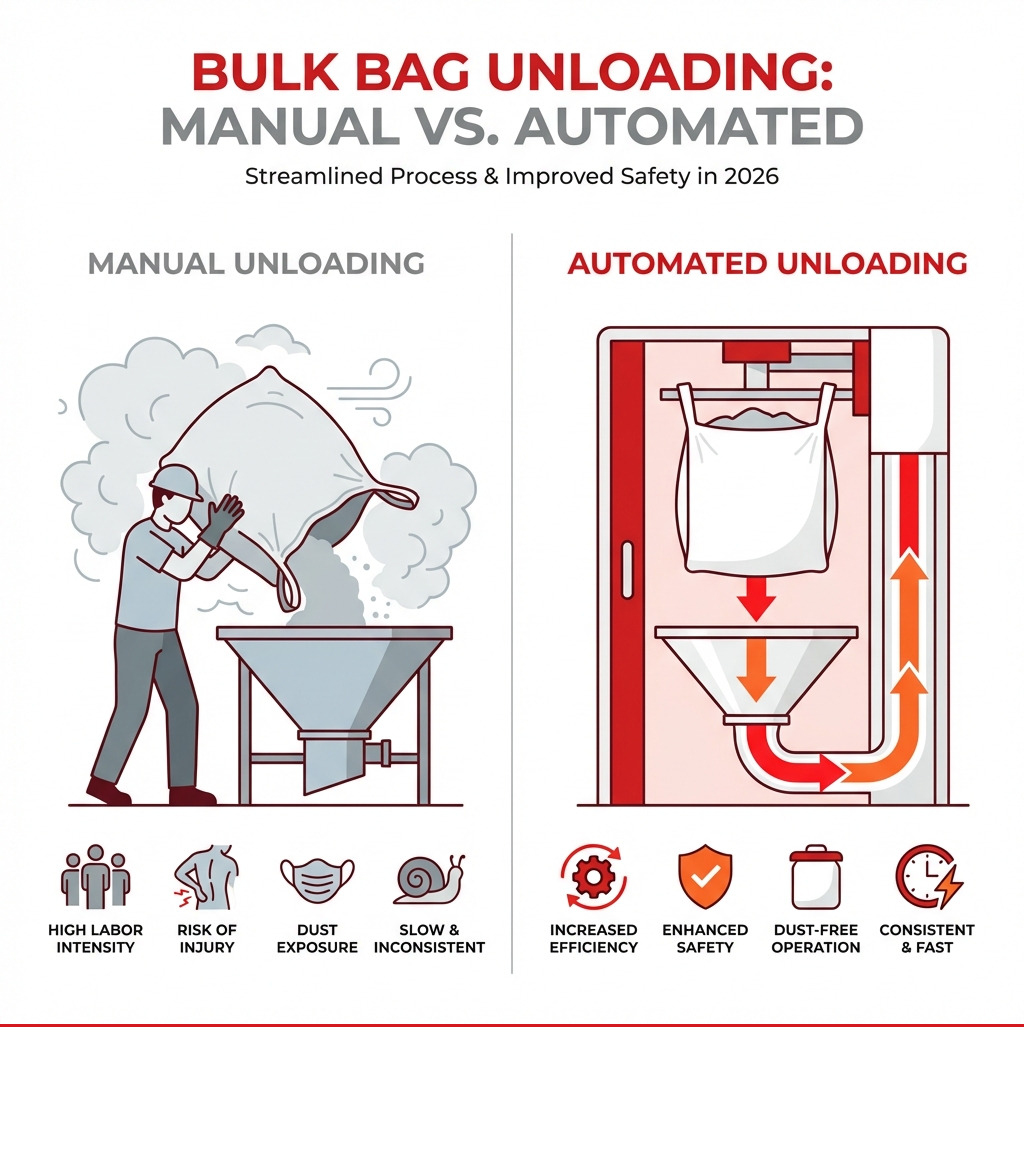
For decades, manual bag dumping has been the standard in food processing, chemical manufacturing, and pharmaceutical production. Operators would cut open 50-pound bags, dump contents into hoppers, and flatten empty bags a repetitive task that causes back injuries, lacerations, and chronic exposure to airborne dust.
The financial impact is significant. Manual unloading can leave 1-2% of product in each bag. For an operation handling 400 bags per shift, this can add up to over $100,000 in lost product annually. Manual methods also create contamination risks, inconsistent flow rates, and high workers’ compensation claims.
Modern automated systems solve these problems. They achieve 99.99% emptying efficiency, process materials faster, protect workers from hazardous tasks, and integrate seamlessly with downstream equipment like mixers, conveyors, and batching systems. As one industry analysis noted, “the great resignation has made jobs involving repetitive, injury-prone tasks extremely hard to fill and retain” making automation not just efficient, but essential.
Why Automate? The Transformative Benefits of Automated Bulk Bag Unloading
The decision to automate bulk bag unloading is a strategic one, yielding benefits that impact every facet of a processing operation. From the factory floor to the bottom line, automation transforms challenges into opportunities for growth and efficiency.
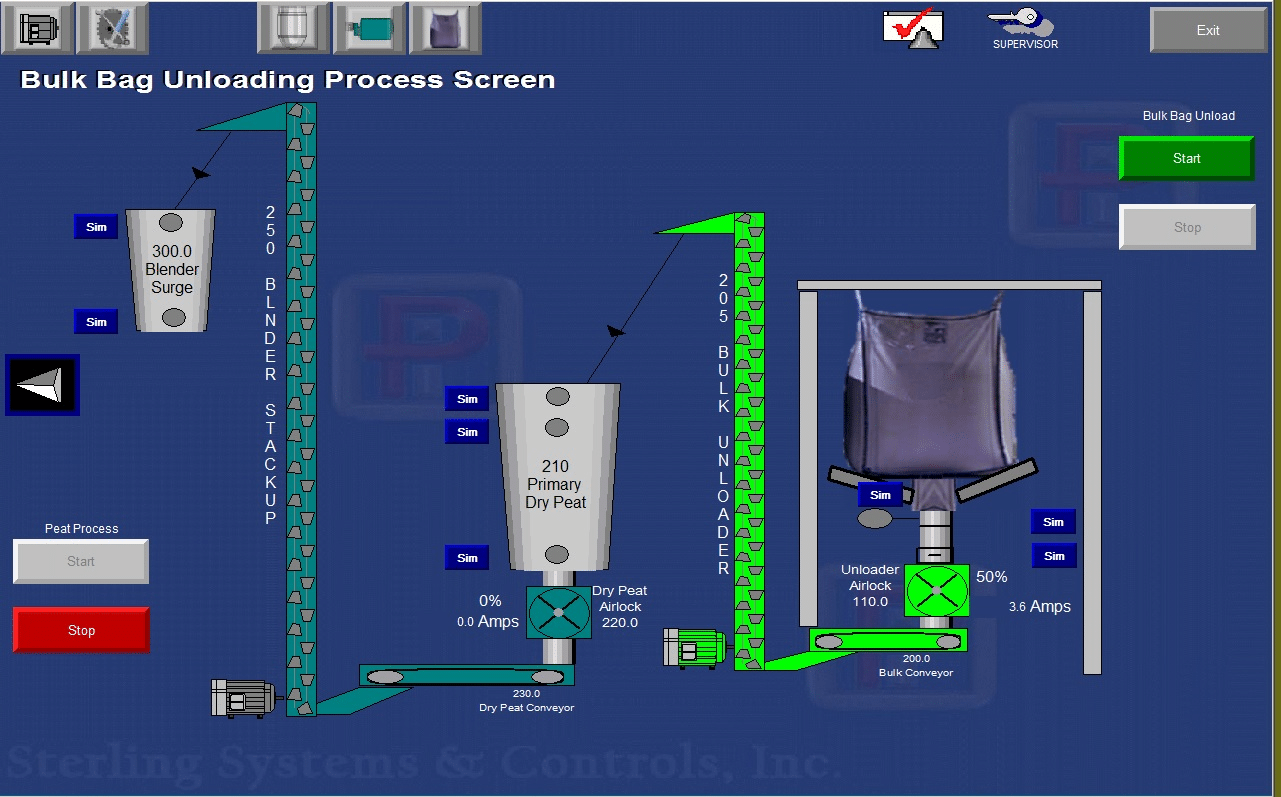
When an operator can safely oversee the unloading process from a control panel, removed from the physical strain and hazards of manual handling, the results are immediate improvements in ergonomics and operational consistency. This shift allows for higher throughput, significant labor cost savings, and dramatically reduced material waste.
Boosting Operational Efficiency and Throughput
Manual bulk bag handling is limited by human speed and endurance, creating bottlenecks and unpredictable output. In contrast, automated bulk bag unloading systems are designed for relentless efficiency. Semi-automatic systems can achieve capacities of up to 360 bags per hour, while fully automated robotic systems can unload up to 1,300 bags per hour (32.5 tons per hour). This remarkable throughput ensures a consistent flow of material to your production line, drastically reducing downtime and optimizing your overall process. Maintaining such high, consistent flow rates is a game-changer for operations aiming to scale up.
For a deeper dive into how these systems revolutionize material flow, explore our insights on Bulk Bag Handling Systems.
Enhancing Workplace Safety and Reducing Injuries
One of the most compelling reasons to invest in automated bulk bag unloading is the profound impact on workplace safety. Manual bag dumping is fraught with ergonomic hazards like repetitive strain injuries from lifting heavy bags, laceration risks from cutting, and dust inhalation.
Automated systems virtually eliminate these dangers. Enclosed systems protect team members from direct contact with materials and airborne particulates. Robotic arms or mechanical hoists handle the heavy lifting, removing manual intervention in hazardous zones and reducing forklift-operator interactions. This transforms a high-risk task into a safe, controlled, and nearly hands-off operation, fostering a more positive and productive work environment.
Understanding dust control is paramount for safety. Learn more about Essential Dust Control Measures for Safe and Efficient Manufacturing.
Realizing Significant Cost Savings and ROI
The financial benefits of automated bulk bag unloading contribute to a rapid return on investment (ROI). The most immediate saving comes from reduced product loss. Manual methods typically leave 1-2% of product in each bag. For an operation handling 400 bags per shift, this can accumulate to a loss of $128,000 annually.
In stark contrast, automated systems boast emptying efficiencies over 99.99%, reducing product loss to less than 0.01%. In the same scenario, this represents a material saving of over $118,000 per year.
Beyond material recovery, automation leads to significant labor cost savings, helps address labor shortages, and allows skilled workers to be redeployed to higher-value activities. Improved safety also translates to fewer workplace injuries, which means reduced workers’ compensation claims and lower insurance premiums. While the ROI timeframe varies, many businesses see a positive return within 1-3 years, making it a sound financial decision.
For a detailed look at how these systems can integrate with precise weighing, visit our page on Bulk Bag Unloading and Weighing Systems.
A Guide to Automated Bulk Bag Unloading Systems and Technologies
When considering an automated bulk bag unloading solution, it’s important to understand the available technologies and how they can be customized to your operational needs. Our goal is to provide a system that integrates perfectly with your existing infrastructure.
| Unloader Type | Headroom Requirement | Loading Method | Footprint | Best-Use Application |
|---|---|---|---|---|
| Hoist & Trolley | High | Integrated Hoist | Medium | Versatile, high-volume operations |
| Forklift Loaded | Medium | Forklift | Large | Existing forklift infrastructure |
| Low Profile | Low | Forklift | Medium | Space-constrained environments |
| Split-Frame | Medium | Forklift/Hoist | Medium | Isolating vibration, specific processes |
| Container/Tote | Varies | Forklift/Crane | Small | Rigid containers, batch processing |
Common Types of Automated Unloading Systems
Automated bulk bag unloading systems offer various configurations to address specific challenges. We work with you to determine the best fit for your facility in Sterling, Illinois, or anywhere across the United States and Canada.
- Hoist and Trolley Systems: These feature an integrated hoist and trolley to lift the bag, making them ideal for facilities without forklift access or where minimizing forklift traffic is a priority. They often require higher headroom but offer excellent control.
- Forklift-Loaded Models: These systems are designed for bags to be loaded using a forklift and are a common choice for facilities with robust forklift operations.
- Low-Profile Designs: For environments with limited overhead space, these unloaders are engineered to fit into tight quarters with compact designs.
- Split-Frame Unloaders: These designs separate the upper bag support frame from the lower discharge section, offering flexibility for specific process requirements.
- Container/Tote Unloaders: While not for flexible bags, these systems handle rigid containers or totes, providing similar automated discharge benefits.
For a comprehensive overview of the various options, refer to our detailed information on Bulk Bag Unloading Systems.
Key Features to Consider When Selecting a System
Selecting the right automated bulk bag unloading system involves evaluating features that optimize performance and safety. Our custom-engineered solutions consider every detail:
- Bag Support Frame: The frame’s structural integrity is crucial for safely supporting heavy bulk bags (typically 2,000 to 4,000 pounds).
- Flow Promotion Devices: For materials that bridge or cake, features like bag agitator paddles, side puncher paddles, and vibrators are essential for consistent flow.
- Spout Clamping Systems: To prevent dust and control flow, systems use iris valves or clamp rings to create a dust-tight seal around the bag spout.
- Dust Collection Ports: Integrated dust collection is vital for maintaining a clean, safe environment by capturing fine particulates.
- Access Chambers: These allow operators to safely untie bag spouts without direct exposure to dust.
- Loss-in-Weight Controls: Integrating load cells allows for highly accurate material dispensing for precise batching.
- Construction Materials: Systems can be fabricated from carbon steel for general use or stainless steel for sanitary or corrosive environments.
We pride ourselves on offering custom solutions. Learn more about our approach to Custom Bulk Bag Unloader designs.
Handling Diverse Bulk Materials
Automated bulk bag unloading systems are versatile enough to handle a vast spectrum of materials. Our systems can be configured to ensure smooth discharge for everything from free-flowing powders to more challenging substances.
- Free-flowing Powders, Granules, and Pellets: These materials flow easily by gravity, but dust containment remains a critical consideration.
- Non-free-flowing Materials: Products that bridge or compact (e.g., flour, pigments) require specialized flow promotion, such as bag conditioners, agitator paddles, and vibrating discharge pans.
- Sticky Substances: For difficult materials, advanced designs with smooth contact surfaces and aggressive agitation prevent buildup and ensure complete discharge.
- Abrasive Materials: For abrasive products, construction materials are chosen to maximize durability and minimize wear.
Our expertise extends to designing specialized solutions for the food industry, where material purity and sanitary conditions are paramount. Find more about Bulk Bag Unloading Systems for Food.
Advanced Integration, Purity, and Automation
The true power of modern automated bulk bag unloading systems lies in their sophisticated integration, attention to product purity, and advanced automation capabilities.
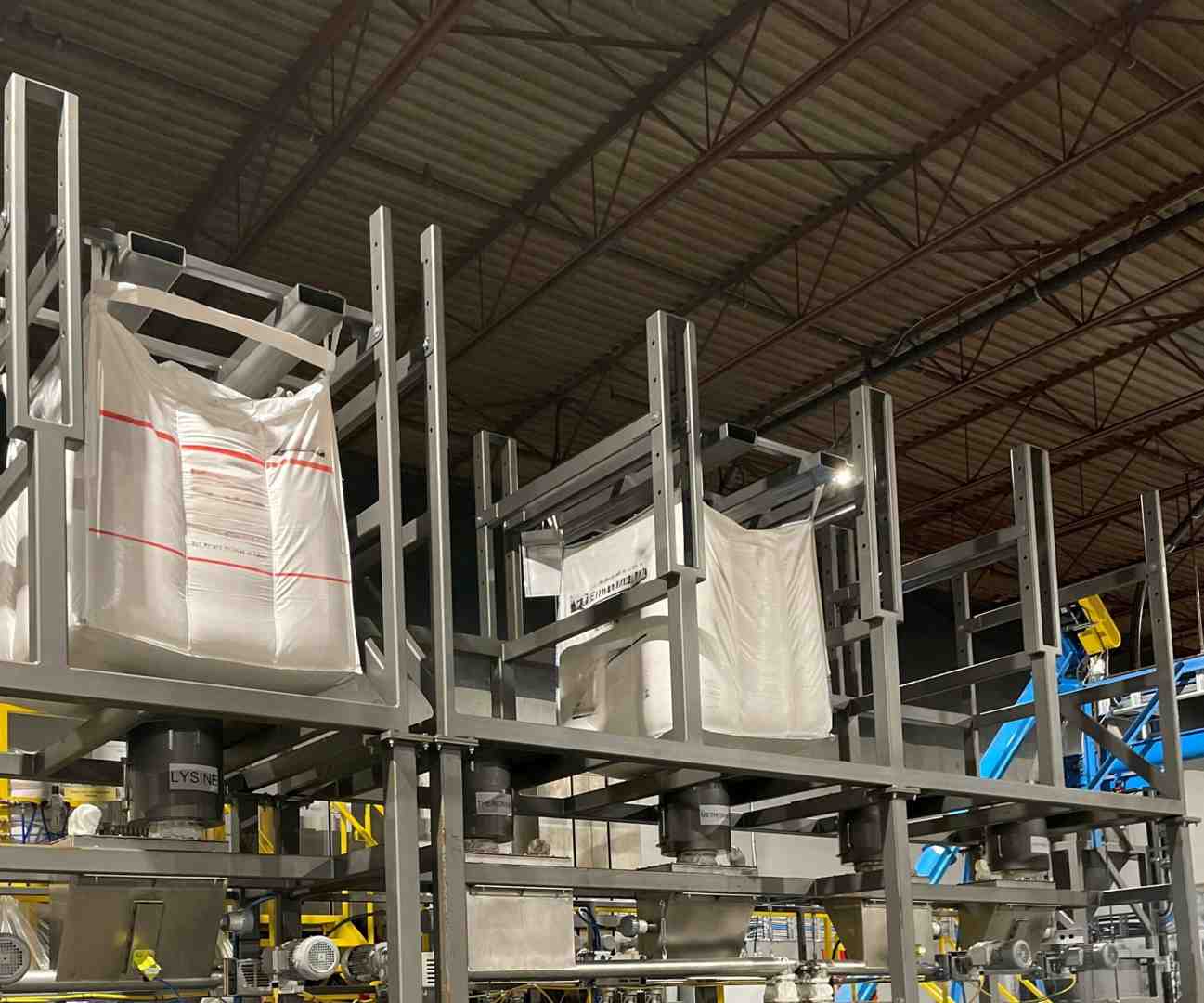
With robust PLC controls, seamless system integration, and comprehensive data logging, these systems transform material handling into a highly optimized and automated process.
How Automated Bulk Bag Unloading Systems Ensure Product Purity
Maintaining product purity is non-negotiable in industries like food, pharmaceutical, and chemical processing. Automated bulk bag unloading systems excel in this area through several key design principles:
- Sealed Connections and Dust-Tight Operation: The primary defense against contamination is a sealed system. Inflatable neck seals, iris valves, and clamp rings create dust-tight connections between the bag spout and the hopper, preventing cross-contamination.
- Construction Materials: For sensitive applications, components are often constructed from stainless steel, which is easy to clean and corrosion-resistant. Sanitary designs with polished surfaces prevent bacterial growth in food-grade facilities.
- Enclosed Systems and Negative Pressure: Many unloaders operate within an enclosed environment with integrated dust collectors that create negative pressure. This draws any escaping dust into the collector, ensuring it doesn’t contaminate the product or the surrounding area.
For critical information on maintaining a pristine processing environment, read our article on Dust Containment for Ingredient Batching Systems.
The Role of Automation in Modern Unloading Systems
Automation is the backbone of efficiency in modern bulk material handling. In automated bulk bag unloading, it orchestrates a seamless process from start to finish.
- Automatic Bag Positioning, Cutting, and Opening: Advanced robotic systems can automatically position, cut, and empty bags, eliminating manual intervention to make the process faster and safer.
- Emptying and Compacting: Once emptied, bags are often automatically compacted into a storage container, significantly reducing waste volume. Some systems can compact 1,500-2,000 empty bags before the container needs changing.
- High Emptying Efficiency and Uptime: Robotic systems achieve extremely high emptying efficiencies (99.99%) and boast near-100% uptime. This level of automation addresses labor shortages by handling repetitive, physically demanding tasks.
- Advanced Controls: Programmable Logic Controllers (PLCs) and Human-Machine Interfaces (HMIs) provide precise control over every step of the unloading process.
While this discussion focuses on unloading, the principles of automation extend to the entire material handling chain. Explore how automation is revolutionizing the other end of the spectrum with Automating Bulk Bag Filling.
Integrating Unloaders with Existing Process Equipment
A key advantage of our custom-engineered systems is their seamless integration with your existing equipment. A bulk bag unloader is a vital link in a larger production chain, not a standalone component.
Our systems are designed to connect effortlessly with:
- Conveyors: Unloaders can feed material directly into flexible screw, pneumatic, or tubular cable conveyors for a continuous, contained flow.
- Mixers and Blenders: For precise ingredient introduction, unloaders can discharge directly into industrial mixers, often with controlled feed rates.
- Weigh Batching Systems: Integrating unloaders with weigh batching systems allows for highly accurate, loss-in-weight dispensing of bulk materials.
- Centralized Control Systems: Your automated unloader can be fully integrated into your plant’s existing control architecture for centralized monitoring, data logging, and process automation.
As a single-source solutions provider, we specialize in ensuring all components of your material handling system work together harmoniously, from unloading to micro-ingredient weighing. For examples of such integration, see our case study on a Micro Ingredient Weighing System with Bulk Bags.
Implementation Roadmap: Costs, Maintenance, and Environmental Factors
Starting on the journey to automate bulk bag unloading involves considering the initial investment, ongoing costs, maintenance, and environmental impact. We guide you through each step to ensure a successful implementation in your facility in the United States or Canada.
Understanding ROI and Cost Implications
The decision to implement an automated bulk bag unloading system is driven by a strong return on investment (ROI). While there is an initial capital expenditure (CAPEX), the operational savings quickly add up.
- Initial Capital Expenditure (CAPEX): This includes the cost of the unloader, facility modifications, installation, and integration. The investment varies based on system complexity and features.
- Operational Expenditure (OPEX): Ongoing costs include energy consumption, maintenance, and consumables, but these are often significantly offset by savings.
- Labor Savings: Reducing manual bag handling allows operations to reallocate personnel, address labor shortages, and lower overall labor costs.
- Material Recovery Value: Dramatically reducing product loss (from 1-2% down to <0.01%) leads to substantial material savings, often totaling six figures annually.
- Long-Term Value: Automated systems improve product quality, reduce waste disposal costs, improve safety records, and increase production capacity. The typical ROI is often within 1 to 3 years.
Ready to explore the financial benefits for your specific operation? Request a Quote from us today.
Maintenance Requirements and Potential Challenges
While automated bulk bag unloading systems are designed for reliability, they require proper maintenance for optimal performance and longevity.
- Preventive Maintenance Schedules: Regular inspections, lubrication, and checking for wear on moving parts will prevent unexpected breakdowns.
- Component Wear: Key components like seals, valves, and filters will experience wear and require periodic replacement. Keeping common spare parts on hand minimizes downtime.
- Troubleshooting Flow Issues: Operators should be trained to identify and safely address minor blockages or bridging with challenging materials.
- Operator Training: Proper training for operators and maintenance staff is essential for safe operation, routine checks, and troubleshooting.
- Sourcing Spare Parts: Partnering with a reputable supplier like Sterling Systems & Controls ensures easy access to genuine spare parts and expert technical support.
Our commitment extends beyond installation. Learn more about our comprehensive Services to support your operations.
Addressing Dust Control and Environmental Impact
Automated bulk bag unloading systems offer significant environmental advantages, particularly in dust control and waste reduction.
- Integral Dust Collectors and Negative Pressure Systems: These systems use integrated dust collectors to create negative pressure, capturing airborne particulates at the source. This protects worker health, prevents environmental contamination, and maintains product purity.
- Reduced Airborne Particulates: By containing dust, automated unloaders drastically reduce airborne particulates in the workplace, contributing to cleaner air and regulatory compliance.
- Empty Bag Compaction: An integral compactor processes emptied bags, reducing their volume significantly. Some systems can compact 1,500-2,000 bags before the waste container needs changing. This leads to:
- Waste Volume Reduction: Less bulky waste means fewer waste pickups and reduced storage needs.
- Lower Disposal Costs: A smaller volume of waste translates directly to lower disposal fees.
By minimizing dust and managing waste, automated unloaders demonstrate a commitment to environmental stewardship while improving operational efficiency.
For more detailed strategies on minimizing dust, explore our insights on Reducing Dust in Bulk Bag Unloader.
Frequently Asked Questions
How fast can an automated system unload bags?
The speed of an automated bulk bag unloading system depends on the level of automation and material characteristics. Semi-automatic systems can process around 360 bags per hour, while fully automated robotic systems can exceed 1,000 bags per hour. This high efficiency is ideal for operations requiring rapid material introduction.
Can I unload a partial bag and tie it off?
Yes, many systems are designed for this flexibility. They feature components like iris valves or pneumatic pinch valves that securely close a partially full bag’s discharge spout. This allows you to remove and store the bag for later use without spillage, providing greater control over inventory.
What if my material doesn’t flow well?
Non-free-flowing materials are a common challenge that our automated bulk bag unloading systems are designed to overcome. Systems can be equipped with various flow promotion devices to ensure consistent discharge, including:
- Bag agitator paddles: These massage the bottom of the bag to break up compacted material.
- Side puncher paddles: These apply force to the bag’s sides to prevent bridging.
- Vibrating pans or tables: These use vibration to encourage material flow.
Conclusion: The Future of Bulk Material Handling is Automated
We’ve explored how automated bulk bag unloading is more than a technological upgrade; it’s a fundamental shift in material handling. The benefits are clear: improved safety, greater operational efficiency, and substantial cost savings through reduced product loss and optimized labor.
Looking ahead, the future of bulk material handling will involve even greater automation. We anticipate more integration with IIoT (Industrial Internet of Things) devices for predictive maintenance and real-time performance monitoring. This will lead to smarter, more autonomous systems that adapt to production demands with minimal human intervention.
The success of any automated system hinges on its ability to meet your unique needs. That’s why customization is key. At Sterling Systems & Controls, we provide custom-engineered, single-source solutions designed to align with your process objectives. We partner with you to deliver an automated bulk bag unloading system that solves today’s problems and positions you for future success.
Ready to transform your material handling? Explore our custom Bulk Bag Unloading Systems and find how we can help you open up new levels of efficiency and safety.
Last updated on April 1st, 2026 at 11:34 am