
From Bag to Batch: The Ultimate Bulk Bag Hopper Selection Guide
Why Bulk Bag Hoppers Are Critical to Your Material Handling Process
A bulk bag hopper is the receiving vessel that sits beneath a suspended bulk bag (FIBC) to catch and contain discharged material before it moves to downstream processing equipment. It’s a key component in any bulk bag unloading system, bridging the gap between bag discharge and your conveyors, feeders, or batching systems.
Quick Answer: What You Need to Know About Bulk Bag Hoppers
- Primary Function: Contain material discharged from bulk bags and regulate flow to downstream equipment
- Common Types: Surge hoppers (simple storage), agitator hoppers (for difficult materials), weigh batch hoppers (for precise batching)
- Key Features: Dust-tight seals, flow control valves, vibration systems, sanitary construction options
- Capacity Range: Typically 37 to 200 cubic feet depending on application
- Integration Points: Screw conveyors, pneumatic systems, rotary airlocks, feeders
If you’re handling dry bulk materials like powders, granules, or pellets in your food, chemical, or agricultural operation, you already know the challenge. Manual scooping is slow and messy. Leaving bags on the floor invites moisture and contamination. Poor discharge control creates dust clouds and material waste.
The right bulk bag hopper solves these problems. It keeps material contained, promotes consistent flow even with difficult products, and integrates seamlessly with your existing process equipment. You can unload bags weighing up to 4,000 pounds safely and efficiently while meeting sanitary standards and controlling dust.
But not all hoppers are created equal. The surge hopper that works for free-flowing pellets will fail miserably with sticky powders that bridge and rathole. The design that’s perfect for a forklift-loaded system won’t fit under your low ceiling. And if you need accurate batching for recipe formulations, you’ll need load cells and controls that most basic hoppers don’t include.
This guide breaks down everything you need to know about selecting and integrating the right bulk bag hopper for your specific application.
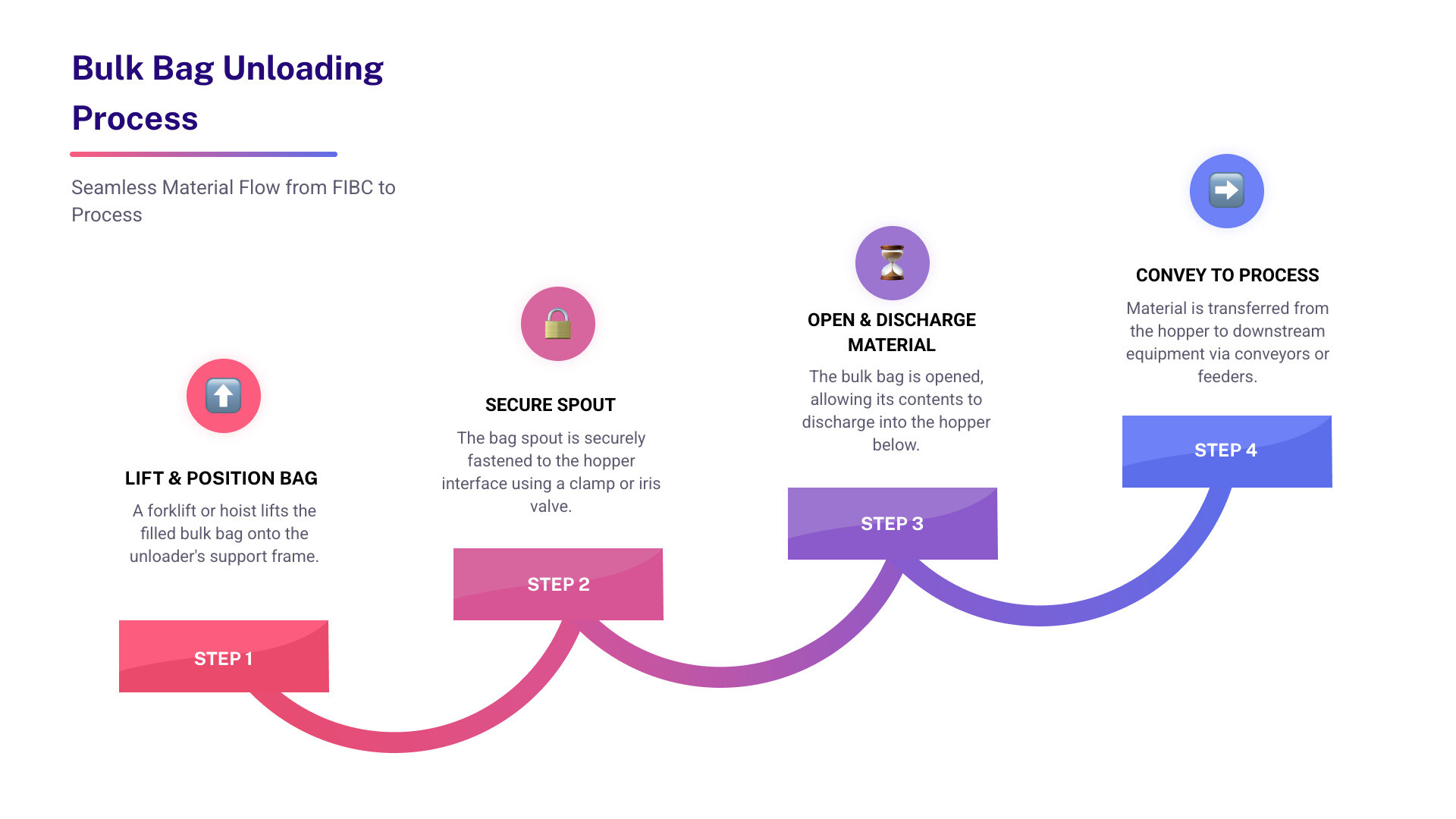
Anatomy of a Bulk Bag Unloading System
When we talk about a bulk bag hopper, we’re often referring to a critical part of a larger system. A bulk bag discharger, also known as an FIBC (Flexible Intermediate Bulk Container) unloader, is a comprehensive piece of material handling equipment designed to safely and efficiently empty bulk bags. It typically consists of several key components working in concert: a support framework, a lifting mechanism, the bulk bag hopper itself, and a discharge interface. Understanding these components is crucial for successful material handling. For a deeper dive into these systems, explore our insights on Bulk Bag Unloading Systems.
The Support Frame and Lifting Mechanism
The foundation of any bulk bag unloading system is its support frame. This frame provides the structural integrity to safely hold a bulk bag, which can weigh up to 4,000 pounds (1814 kg). These frames are often constructed with heavy-duty structural tubing, ensuring durability and stability during operation.
We see various designs to accommodate different plant layouts and operational needs:
- Standard Frames: These are robust, typically fixed structures designed for straightforward bulk bag unloading.
- Cantilever Frames: Offering flexibility, these allow for easier access for forklifts or other equipment.
- 3-Piece Designs: For facilities with low ceiling heights, these modular frames can be assembled in sections, enabling bag replacement at ground level for improved safety and simplicity. This innovative design helps overcome spatial constraints without compromising functionality.
The method of loading a bulk bag onto the frame is also a key consideration:
- Forklift Loading: Many systems are designed with forklift pockets, allowing a forklift to position the bag directly onto the frame. Some even feature adjustable upper frame sections, providing up to 36 inches of height adjustment to suit various bag sizes and forklift capabilities.
- Dedicated Hoist Loading: For operations requiring consistent, repeatable lifting, a dedicated hoist and trolley system can be integrated. These A-frame designs typically have a capacity of 4,000 pounds and ensure precise bag positioning.
- Customer-Supplied Hoist Loading: Our systems can also be designed to integrate with an existing overhead crane or hoist system already in your facility.
Regardless of the loading method, the bulk bag hangers are crucial. They secure the bag’s lifting loops. Some advanced hangers include loop retractors, which draw the corners of the bulk bag upward and inward as material discharges. This action forms the bag into a conical shape, significantly improving material flow and promoting complete discharge, especially for materials prone to bridging or rat-holing.
The Hopper and Discharge Interface
The bulk bag hopper is where the magic happens – it’s the bridge between the bulk bag and your process. Its primary role is material containment and to provide a surge capacity, ensuring a continuous flow of product to downstream equipment even during bag changeovers or slight material flow interruptions.
The design of the hopper’s discharge interface is critical for efficient and dust-free operation. This is where we control the flow of material from the bag into your system. Common interfaces include:
- Spout Clamp Systems: These create a dust-tight seal around the bag’s discharge spout, preventing fugitive dust emissions and material contamination. Our spout clamping systems are designed to elongate the bag, creating a taut, conical shape that accelerates material discharge while maintaining a secure seal.
- Iris Valves: These adjustable valves allow for precise control over the material flow rate, enabling operators to partially discharge a bag or meter material as needed.
- Pinch Valves: Similar to iris valves, pinch valves offer excellent flow control and can completely shut off material flow, often used for more abrasive materials.
- Access Chambers: These enclosures provide a safe and contained space for operators to untie bag spouts, further reducing dust exposure and enhancing safety.
For applications requiring the highest levels of cleanliness, such as food or pharmaceutical processing, our food-grade bulk bag unloading systems incorporate specialized hoppers with polished contact surfaces and clean-in-place (CIP) designs.
How to Select the Perfect Bulk Bag Hopper
Choosing the right bulk bag hopper is paramount to the success of your material handling operation. It’s not a one-size-fits-all solution. Our selection process begins with a thorough understanding of your specific material, bag characteristics, and throughput requirements. For unique challenges, we specialize in custom bulk bag unloader designs.
- Material Characteristics: Is your material free-flowing like pellets or granular products, or is it cohesive, sticky, or prone to compaction like certain powders or flaked materials? This dictates the hopper’s angle and the need for flow aids.
- Bulk Density: The density of your material impacts the required hopper volume and structural strength.
- Flow Properties: Understanding how your material behaves under gravity is key to preventing common issues like bridging (where material forms an arch above the discharge opening) or rat-holing (where material flows only through a narrow channel, leaving product stuck to the hopper walls).
- Bag Specifications: The type of bulk bag you use (size, spouted or unspouted, with or without liners) directly influences the hopper’s interface design.
- Throughput Requirements: How many bags per hour do you need to unload? This helps determine the hopper’s surge capacity and the speed of the discharge mechanism.
Key Design Aspects of a Bulk Bag Hopper
The construction and design of the bulk bag hopper play a critical role in its performance and longevity.
- Construction Materials:
- Stainless Steel: Often chosen for food, pharmaceutical, and chemical applications where hygiene, corrosion resistance, and ease of cleaning are paramount. We can provide polished product contact surfaces to meet stringent sanitary standards.
- Mild Steel: A cost-effective option for less demanding industrial applications, offering durability and strength for a wide range of dry bulk materials.
- Hopper Angle: The angle of the hopper walls is crucial for promoting material flow. Steeper angles (typically 60 degrees or more) are required for poorly flowing materials to prevent bridging and ensure complete discharge. For free-flowing materials, a less steep angle may suffice.
- Discharge Opening Size: This must be appropriately sized to prevent material bridging at the outlet while still allowing for controlled flow. Too small, and you’ll have blockages; too large, and you might struggle with flow control.
- Sanitary Design: In industries like food processing, our hoppers are designed with smooth, crevice-free surfaces, minimal seams, and often feature clean-in-place (CIP) capabilities for quick and effective washing. This ensures product integrity and prevents bacterial growth.
- Polished Surfaces: For the most demanding sanitary applications, internal product contact surfaces can be polished to a specific finish (e.g., mirror finish) to prevent material adhesion and facilitate cleaning.
For a closer look at how these design elements contribute to various unloader configurations, see our guide on A look at various unloader designs.
Matching the Hopper to Your Bulk Bag Type
The type of bulk bag you use is a primary factor in determining the optimal hopper design.
- Spouted Bags: These are the most common type, featuring a discharge spout at the bottom. Our hoppers are typically designed to interface directly with this spout using a spout clamp system, iris valve, or pinch valve for controlled, dust-free discharge.
- Flat Bottom Bags (Unspouted Bags): For bags without a discharge spout, a specialized approach is needed. Bulk bag piercing hoppers are an excellent solution. These hoppers feature integrated cutting knives that automatically cut a square flap into the bottom of the bag, allowing material to discharge into the hopper below. One such system can handle up to 37 cubic feet and cut a 25-inch square flap, making it versatile for various unspouted bags.
- Liner Handling: If your bulk bags contain internal liners, the hopper design must accommodate them to prevent the liner from inverting through the bag spout during discharge. Features like bag support pans help manage the liner and ensure smooth material flow.
- Bag Support Pan: This feature provides additional support to the bulk bag’s bottom, which can be particularly useful for ensuring complete discharge or when dealing with bags that might deform under load.
For comprehensive information on how different bag types integrate with complete material handling systems, refer to our Information on complete handling systems.
Enhancing Flow and Efficiency with Key Accessories
Even with a perfectly designed bulk bag hopper, some materials are just plain stubborn. They bridge, they rathole, they compact. These are what we affectionately call “difficult-to-handle materials.” But don’t worry, we have a whole arsenal of accessories and flow aids designed to coax even the most recalcitrant materials out of their bags and into your process. This material conditioning is essential for consistent and efficient operation. For more on tackling these challenges, check out our insights on Bulk Bag Discharging.
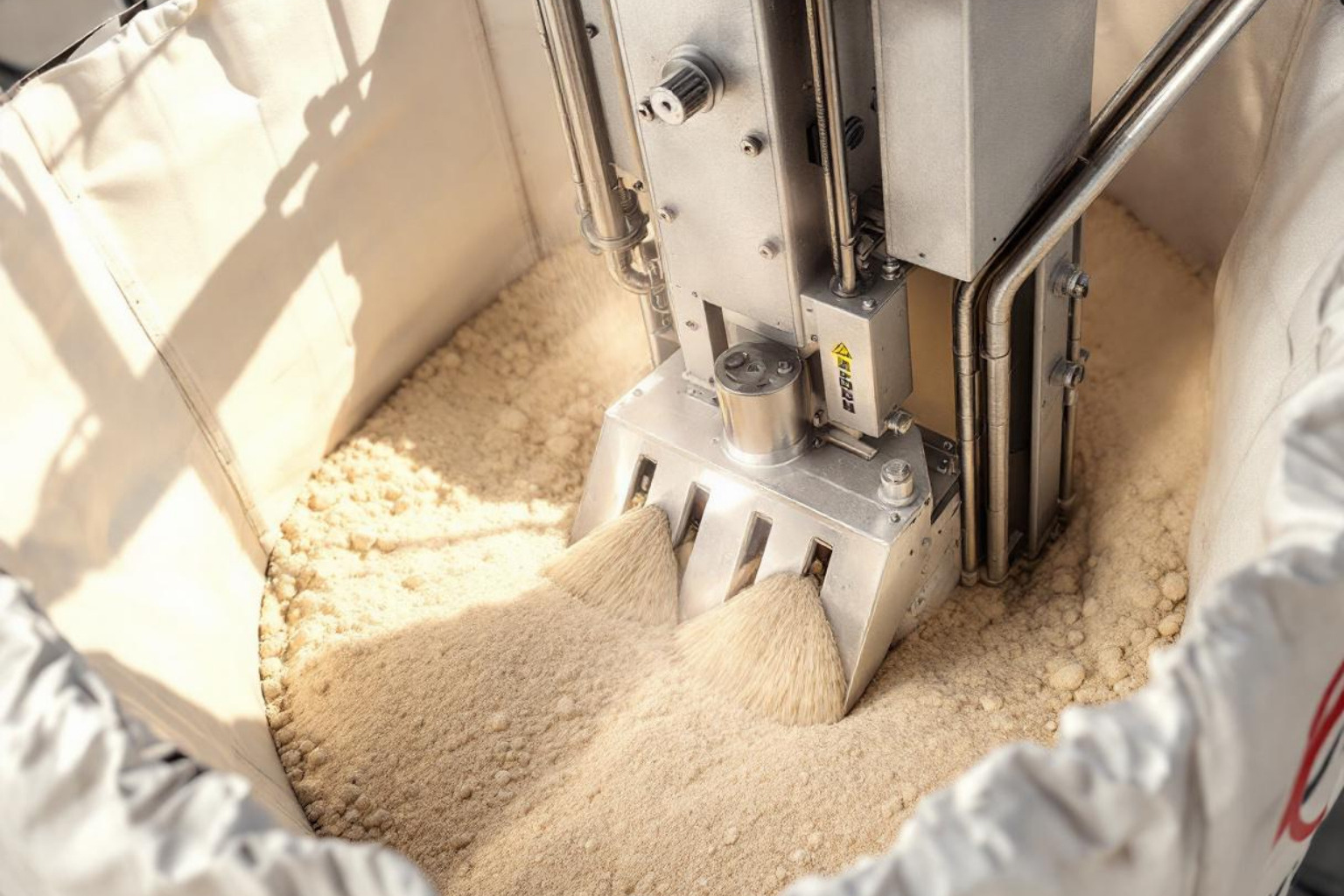
Mechanical Flow Aids
When gravity isn’t enough, mechanical intervention is often the answer. These accessories work directly with the material to break up compaction and maintain flow.
- Paddle Agitators: These are internal mechanical agitators, often paddle-style or ribbon-style, engineered to eliminate material bridging and rat-holing within the hopper, ensuring a consistent supply. They physically agitate the material to keep it moving.
- Vibrating Discharge Pans: A vibratory discharge pan or tray can be mounted beneath the hopper. These systems use vibration to fluidize the material and promote a steady flow, especially effective for powders and granular products that tend to compact.
- Side Puncher Paddles: These external paddles “punch” the sides of the bulk bag to dislodge material that might be clinging to the bag walls or forming bridges.
- Deblocking Rams: For extremely solidified or rock-like material, deblocking rams are powerful hydraulic or pneumatic cylinders designed to fracture hardened clumps into smaller, manageable pieces, ensuring they can pass through the discharge opening.
- Conditioning Rams: Similar to deblocking rams but for less agglomerated material, conditioning rams gently massage or push the material within the bag to prevent bridging and promote continuous flow.
Here’s a quick list of common mechanical flow aids we employ:
- Agitator Paddles (paddle-style, ribbon-style)
- Vibrating Discharge Pans
- Side Puncher Paddles
- Deblocking Rams (for solidified material)
- Conditioning Rams (for less agglomerated material)
Pneumatic and Other Flow Improvers
Beyond direct mechanical action, other ingenious methods exist to improve material flow.
- Fluidized Particle Aeration: This involves introducing controlled bursts of air into the hopper or directly into the material. The air fluidizes the particles, reducing friction and allowing the material to flow more like a liquid. This is particularly effective for fine powders.
- Bag Massagers: These systems use inflatable bladders or massage paddles, often pneumatic or hydraulic, mounted on the sides of the bulk bag. They inflate and deflate, gently massaging the bag to break up compacted material and push it towards the discharge spout. Heavy-duty massage paddles can be powered by hydraulic units.
- Bag Stretching Devices: Some systems incorporate features like loop retractors on bag hangers or other specialized devices that physically stretch the bulk bag into a taut, conical shape as it empties. This action helps to eliminate dead spots, prevent material from clinging to the bag’s corners, and ensures total evacuation, especially when combined with bag activators that raise and lower the bottom edges of the bag. For more insights on how these components work together, explore the Details on a specific unload hopper.
Integrating Your Hopper for System-Wide Efficiency
A bulk bag hopper doesn’t operate in isolation; it’s a critical link in your overall material handling chain. Effective process integration and automation are what transform a simple unloading station into a highly efficient, cost-effective, and reliable system. By seamlessly connecting your hopper to downstream equipment and integrating it with advanced controls, we can significantly boost your operational efficiency. For a broader perspective on how these systems fit together, read about Bulk Bag Handling Systems.
Connecting to Downstream Equipment
Once material is discharged from the bulk bag into the hopper, it needs to be conveyed to the next stage of your process. The hopper’s design must be compatible with your chosen conveying method.
- Screw Conveyors: These are common for transporting dry bulk materials horizontally or at an incline. The hopper’s discharge outlet is designed to feed directly into the screw conveyor’s inlet, ensuring a consistent material supply.
- Pneumatic Conveying: For moving materials over longer distances or to liftd points, pneumatic conveying systems use air to transport particles. The hopper can feed into a rotary airlock, which then introduces the material into the pneumatic line while maintaining pressure differences.
- Feeders: Various types of feeders (e.g., vibratory feeders, volumetric feeders) can be positioned beneath the hopper to precisely meter material into the next process step. Vibratory feeders, for instance, can meter bulk materials at rates from 1,000 pounds per hour to 1,600 tons per hour, depending on the application.
Here’s a comparison of common hopper types and their applications:
| Hopper Type | Primary Function | Ideal Application | Integration Points |
|---|---|---|---|
| Surge Hoppers | Temporary storage, buffer between bag and process | Free-flowing materials, consistent supply to conveyor | Screw conveyors, pneumatic lines, simple feeders |
| Agitator Hoppers | Prevent bridging/rat-holing, maintain flow | Cohesive powders, flakes, materials prone to compaction | Any downstream conveyor/feeder needing consistent flow |
| Weigh Batch Hoppers | Precise measurement of discharged material | Recipe formulation, batching, inventory control | Load cells, PLC controls, batching systems |
We often design combination hoppers that allow for the manual introduction of smaller material volumes (minor ingredients) alongside bulk bag discharge, providing flexibility in your process. For specific applications like feed batching, integrating a bulk bag hopper with a precise feeding system is vital, as detailed in our article on feed batching applications.
Integrating a Weigh Batching Bulk Bag Hopper
For applications demanding high accuracy, such as recipe formulation or inventory control, a weigh batching bulk bag hopper is indispensable. This system integrates the hopper with a weighing mechanism, typically load cells, to precisely measure the amount of material discharged.
We generally implement two main types of weigh batching systems:
- Loss-in-Weight Systems: In these systems, the entire bulk bag unloader and hopper assembly are mounted on load cells. As material is discharged, the system continuously monitors the weight reduction. A controller stops the discharge when the target batch weight (the “loss”) has been reached, providing highly accurate dispensing.
- Gain-in-Weight Systems: Here, the receiving vessel (e.g., a mixer, another hopper, or a conveyor section) is placed on load cells. Material is discharged from the bulk bag hopper until the target weight (the “gain”) is achieved in the receiving vessel. This method is often used when multiple ingredients are being batched into a central vessel.
The real power of these systems comes with PLC interfacing. Our custom-engineered automated solutions ensure that the weighing process is seamlessly integrated into your overall plant control system. This allows for automated batching, recipe management, and accurate data collection, leading to improved process performance and reliable production data throughout your enterprise. For more on this, explore our Bulk Bag Unloading and Weighing System. Even for micro and minor ingredients, precise control is achievable with systems that integrate bulk bags, as shown in our Micro and minor ingredient systems case study.
Safety, Maintenance, and Dust Control Best Practices
In any industrial setting, especially when handling bulk materials, operator safety, plant hygiene, and compliance with regulations are non-negotiable. Our approach to bulk bag hopper design and system integration prioritizes these aspects, ensuring a safe, clean, and efficient working environment. Proper maintenance is also key to ensuring years of trouble-free service from your equipment. For practical advice on keeping things tidy, refer to our article on Reducing Dust in Bulk Bag Unloader.
Dust Containment Features
Dust generated during bulk bag unloading can pose health risks, lead to product loss, and even create explosive environments. Effective dust containment is a cornerstone of our designs.
- Dust-Tight Seals: At the heart of dust control are robust seals at all interfaces, particularly where the bulk bag spout connects to the hopper. Spout clamping systems, for example, create a secure, dust-tight connection.
- Integrated Dust Collectors: Many of our systems incorporate or can be integrated with dedicated dust collection systems. Vented ports on the hopper or access chamber connect to these collectors, drawing away airborne particles during discharge and bag untying.
- Access Chambers: These enclosed spaces provide a contained environment for operators to safely untie the bulk bag spout without exposing the surrounding area to dust.
- Dust Suppression Membranes: Some advanced hoppers include dust suppression membranes that manage the risk of dust escape, further enhancing containment.
These features contribute not only to a cleaner plant but also to better product quality by preventing cross-contamination. For a broader view of how we manage materials, including dust, consider our insights on bulk bag packaging.
Safety and Maintenance Protocols
Safety is engineered into every aspect of our bulk bag handling systems. We understand that operators need to interact with heavy equipment, often at height, and with potentially hazardous materials.
- Safety Interlocks: Our systems incorporate safety interlock switches at guarded areas such as doors, panels, or gates. These interlocks disable mechanical equipment within reach of an operator if the guarded area is opened, preventing accidents.
- Ground-Level Controls: For hoist-loaded systems, we often position hoist controls away from the bulk bag loading area, typically mounted to the rear lower framework. This ensures operators are not standing directly under a suspended bag during lifting, enhancing their safety. Furthermore, designs that allow for bag replacement at ground level simplify handling and improve overall safety.
- Certified Lifting Frames: All lifting devices and frames are designed and certified to meet local lifting codes and safety standards, ensuring that bulk bags are securely supported from top to bottom.
- Routine Inspection Points: We design our equipment with easily accessible inspection points to facilitate routine checks of wear parts, seals, and structural integrity.
- Wear Part Replacement: Like any industrial machinery, bulk bag hoppers and their accessories have wear parts. Our designs emphasize modularity and ease of access for quick replacement of components like seals, valves, or vibrator elements, minimizing downtime and extending the lifespan of your system.
- Maintenance Requirements: Regular cleaning, especially for sanitary applications with CIP features, and periodic lubrication of moving parts are essential. We provide clear guidelines to ensure your system continues to run smoothly for years.
By adhering to these rigorous safety and maintenance protocols, we help you create an operational environment that protects your workforce and your investment. To explore the full range of options for safe and efficient unloading, visit our page on various unloader options.
Conclusion
The journey “From Bag to Batch” is a critical one for many industries, and the bulk bag hopper stands as a pivotal component in this process. We’ve explored how a well-chosen and properly integrated hopper can transform your material handling, moving from messy, inefficient manual operations to automated, dust-free, and precise material delivery.
At Sterling Systems & Controls, our expertise lies in providing custom-engineered automated solutions for material weighing, batching, and process control. We pride ourselves on offering single-source, experienced solutions custom to your unique objectives, integrating diverse process equipment seamlessly. Whether you’re dealing with free-flowing pellets, sticky powders, or materials requiring precise batching, we have the knowledge and technology to design a bulk bag hopper system that meets your specific needs in the United States and Canada.
A properly selected and integrated hopper is truly the key to open uping efficiency in your bulk material handling process. It improves safety, controls dust, ensures consistent material flow, and integrates flawlessly with your downstream equipment, ultimately contributing to significant cost-effectiveness and operational excellence.
We invite you to explore our custom bulk bag unloading solutions to see how we can optimize your operations. For a complete understanding of bulk bag material handling, from filling to unloading, don’t miss our comprehensive overview: From filling to unloading.
Last updated on August 4th, 2026 at 01:07 pm