
The Definitive Guide to Modular Blending Batching Systems
Defining Modular Blending and Batching Systems
Modular blending and batching systems are innovative, pre-engineered, and self-contained units designed for flexible integration into food processing lines. Think of them as “plug-and-play” components that can be rapidly deployed, reconfigured, or expanded as needed. The goal of these systems is to provide agility in production, allowing food manufacturers to adapt quickly to market demands and product innovations without extensive, costly overhauls.
Distinguishing Blending from Batching
While often used together, it’s important to understand the distinct roles of blending and batching:
- Batching: This involves the precise weighing and dispensing of individual ingredients, whether dry powders or liquids, into a container or mixer to create a specific quantity of product. It’s about accurately measuring each component before combination.
- Blending: This is the subsequent process of uniformly combining multiple ingredients (often those that have just been batched) to achieve a homogeneous mixture. The aim is to ensure consistent texture, flavor, and composition throughout the product.
Core Components of a Modular System
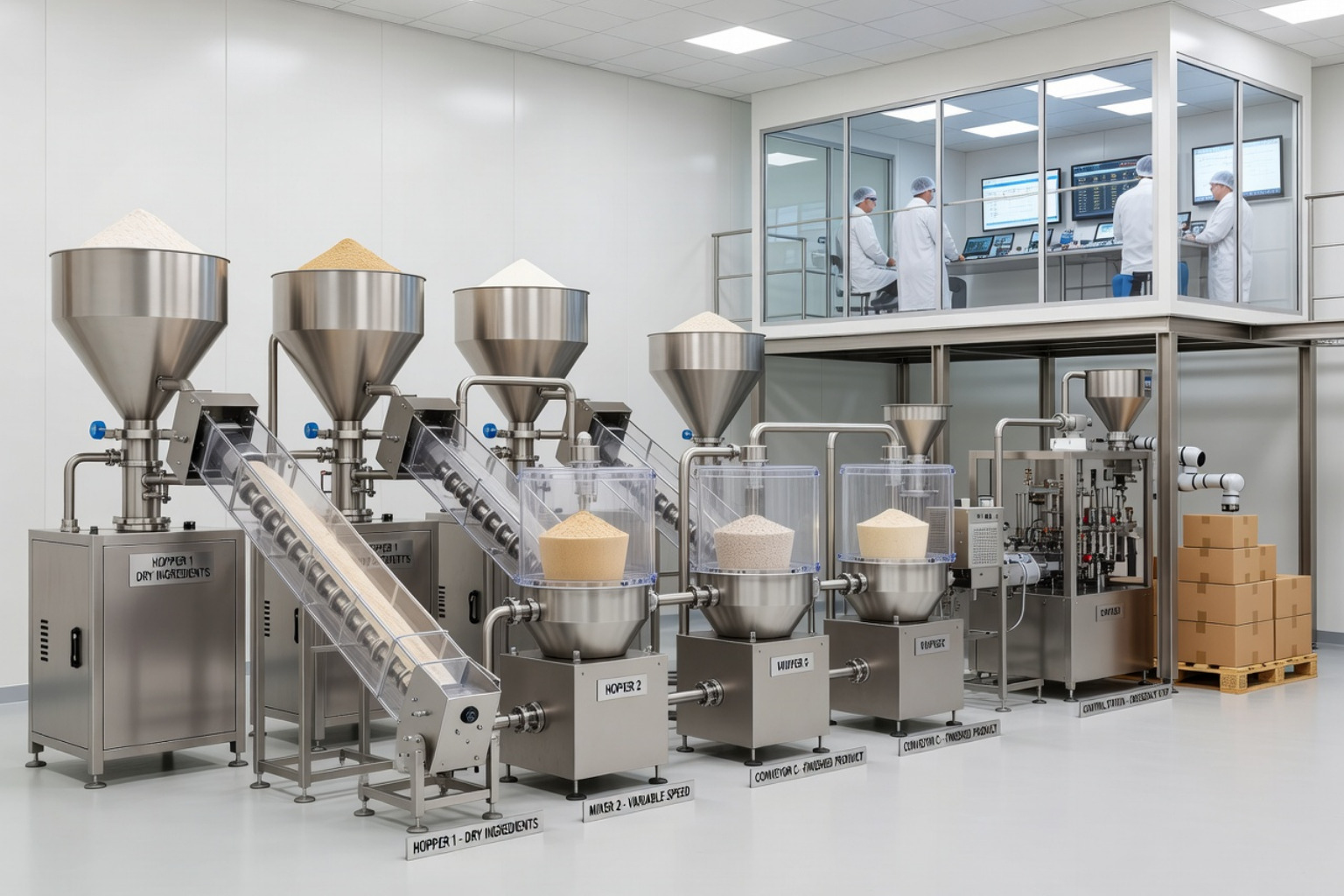
A typical modular system integrates several key components:
- Ingredient Storage: This includes silos, hoppers, or tanks for holding raw materials.
- Material Handling: Conveyors, pneumatic transfer systems, or pumps move ingredients from storage to the processing area.
- Weighing Systems: Load cells and scales ensure precise measurement of each ingredient.
- Mixing Equipment: This can range from ribbon blenders and paddle mixers for dry ingredients to high-shear or low-shear liquid blenders for liquids and slurries.
- Control Systems: Advanced PLCs (Programmable Logic Controllers) and HMIs (Human-Machine Interfaces) automate and manage the entire process, ensuring accuracy and repeatability.
Contrasting with Traditional Fixed Installations
Traditional food processing setups are typically custom-built, site-specific, and characterized by rigid infrastructure. They involve extensive on-site fabrication and installation, which can be time-consuming and expensive. Once installed, reconfiguring or expanding these systems often requires significant downtime and investment.
Operational Pain Points of Traditional Systems
My experience shows that traditional systems often lead to several operational challenges for food processors:
- Difficulty in Reconfiguring Production Lines: Adapting to new product formulations or changing market trends becomes a complex, resource-intensive task.
- High Costs for Expansion or Modification: Any significant change means substantial capital expenditure and engineering effort.
- Prolonged Downtime During Upgrades: Modifications often necessitate shutting down production for extended periods, leading to lost output and revenue.
- Challenges in Maintaining Consistent Product Quality: Without integrated, automated controls, ensuring identical product quality across different batches can be difficult, leading to variability.
What significant advantages do modular blending and batching systems offer food manufacturers?
Modular blending and batching systems address many of the pain points associated with traditional setups, offering a compelling array of benefits that directly impact a food manufacturer’s bottom line and operational capabilities.
Enhanced Flexibility and Scalability
One of the most significant benefits is the inherent flexibility and scalability these systems provide.
- I can rapidly reconfigure modules to accommodate new products, seasonal demands, or specialized runs. Expanding production capacity is straightforward, often involving simply adding or swapping modules rather than undertaking extensive facility overhauls.
- For instance, some systems are designed to be expandable to ten positions, allowing for highly complex blends that would be impractical or cost-prohibitive with traditional blending scales. Similarly, horizontal paddle mixers, with throughputs ranging from 2–200 kg/h per unit, can be scaled by cascading multiple units, effectively multiplying capacity without a complete system redesign.
Significant Cost Reduction and Faster ROI
The financial advantages are substantial:
- Food processors can save up to 30–40% in capital costs compared to fully custom or bundled systems. This is largely due to standardized designs, reduced engineering requirements, and quicker installation times.
- Beyond initial investment, I’ve seen power consumption reduced by 50% to 75% compared to alternative dry/liquid blending processes, leading to ongoing operational savings.
- The return on investment (ROI) can be remarkably fast, sometimes achieved in just 2-3 days, thanks to increased batch capacity. For example, a facility might increase its output from 4-5 batches to 14 or more batches per day, dramatically improving productivity.
Improved Efficiency and Reduced Downtime
Modular systems are designed for peak operational efficiency:
- Streamlined processes and automated controls minimize human error and optimize production cycles, ensuring consistent output.
- Because modules are pre-tested and often skid-mounted, on-site commissioning time is significantly reduced, leading to faster startup and fewer unexpected issues.
- Simplified maintenance and troubleshooting are also key advantages, as standardized components and clear interfaces make it easier to identify and resolve problems.
Agile Recipe Management and Product Innovation
In today’s dynamic food market, the ability to innovate quickly is crucial:
- Modular systems, with their recipe-driven controls and automated ingredient delivery, enable quick recipe changes, minimizing changeover times.
- This agility facilitates rapid prototyping and market testing of new food products, allowing manufacturers to respond swiftly to consumer trends.
- My solutions support diverse product portfolios and customization, giving processors the edge in competitive markets.
Labor Optimization
Automation inherent in modular systems significantly impacts labor:
- It reduces the need for manual handling and constant supervision, freeing up my clients’ staff for higher-value tasks such as quality control, maintenance, or product development.
- Improved ergonomics and safety for operators are also a direct result of reduced manual intervention, leading to a more efficient and safer workplace.
More info about Food Baking Automation Systems
Which food products and applications benefit most from modular blending and batching systems?
The versatility of modular blending and batching systems makes them ideal for a vast array of food products and specific application scenarios where precision, hygiene, and flexibility are paramount.
Diverse Product Categories
I find these systems particularly effective across numerous food sectors:
- Snack Foods: For products like chips, pretzels, nuts, and trail mixes, modular systems ensure precise seasoning and coating application, guaranteeing consistent flavor and texture in every bite.
- Beverages: From soft drinks and juices to energy drinks and dairy-based beverages, accurate liquid and powder ingredient blending is critical for taste, stability, and nutritional claims.
- Dairy Products: Yogurts, ice cream mixes, and cheese sauces demand hygienic and consistent blending of milk solids, stabilizers, and flavorings to achieve desired consistency and shelf life.
- Pet Food: Dry kibble, wet food, and treats require precise nutrient and flavor blending to meet dietary requirements and ensure palatability, making these systems invaluable for consistent quality.
- Bakery & Confectionery: Dough mixes, cake batters, fillings, icings, and chocolate production all benefit from accurate dry and liquid ingredient batching, which is essential for consistent product performance and quality. More info about Food Ingredient Batching
- Sauces, Dressings, and Soups: Liquid and semi-liquid products often require precise emulsification and ingredient dispersion to prevent separation and ensure a smooth, uniform product.
- Nutritional & Health Products: Protein powders, meal replacements, and dietary supplements frequently involve micro-ingredients where accuracy is critical for efficacy and compliance. More info about Minor Ingredient System Foods
Specific Application Scenarios
Beyond product categories, certain operational needs are perfectly addressed by modular systems:
- Micro-Ingredient Batching: These systems excel at handling small, critical ingredients like vitamins, enzymes, colorants, and active compounds with unparalleled precision, ensuring product integrity and potency.
- High-Volume, Consistent Production: For manufacturers needing to produce millions of units with identical quality, modular systems provide the repeatability and control necessary to achieve this.
- Seasonal or Limited-Run Products: The ability to quickly reconfigure lines makes modular systems ideal for short production cycles without requiring significant capital investment in dedicated equipment.
- Co-Packing and Contract Manufacturing: Companies in this sector gain immense flexibility, allowing them to produce a wide range of products for different clients efficiently and cost-effectively.
What advanced features and capabilities define modern modular blending and batching systems?
Modern modular blending and batching systems are defined by their integration of cutting-edge technology, focusing on automation, hygiene, traceability, and seamless connectivity. These features are what truly elevate them above traditional methods.
Sophisticated Automation and Control Systems
At the heart of every advanced modular system lies its intelligent control:
- Recipe-Driven Controls: My systems feature intuitive interfaces (HMI/SCADA) that allow operators to effortlessly select recipes, initiate batches, and monitor processes. These controls often include self-correcting operations, ensuring consistent replication of mixes with minimal operator intervention. More info about Batching Control System
- Automated Multi-Stream Metering: This capability enables the precise, continuous feeding of multiple ingredients simultaneously, optimizing blend accuracy and speed.
- Process Control: Real-time monitoring and adjustment of critical parameters like temperature, pressure, and mixing speed ensure optimal conditions throughout the blending process, leading to superior product quality. More info about Process Control Food Production
Uncompromising Hygiene and Food Safety
Food safety is non-negotiable, and modular systems are designed with this in mind:
- CIP (Clean-in-Place) and SIP (Sterilize-in-Place) Compatibility: These automated cleaning and sanitization cycles minimize manual intervention, reduce the risk of contamination, and ensure maximum hygiene between batches.
- Hygienic Design Standards: Construction from food-grade materials like stainless steel, smooth surfaces, and minimal crevices, often adhering to stringent 3-A and EHEDG standards, prevents bacterial growth and facilitates thorough cleaning.
- Integrated Dust Collection: For powder handling, integrated dust collection systems are essential. They prevent cross-contamination between ingredients, maintain air quality, and ensure a safer working environment.
Robust Traceability and Product Consistency
Ensuring product integrity from start to finish is a key strength:
- Ingredient Tracking: Through technologies like RFID, barcode scanning, and automated batch codes, my systems provide complete traceability from raw material receipt to the final packaged product. This is invaluable for quality control and recall management.
- Data Logging and Reporting: Comprehensive records of every batch are automatically generated, facilitating quality control, regulatory audits, and continuous process improvement.
- Ensuring Product Quality: The precision weighing and blending capabilities ensure consistent texture, flavor, and nutritional profiles, batch after batch, which builds consumer trust and brand loyalty.
Seamless Integration with Existing and Future Infrastructure
Modular systems are built for connectivity:
- Material Handling Integration: They are designed for compatibility with various material handling systems, including conveyors, pneumatic transfer systems, and even automated guided vehicles (AGVs), creating a cohesive production flow.
- Weighing Systems: Integration with various scales and load cells ensures accurate ingredient measurement at every stage. More info about Material Weighing Systems
- Packaging Line Connectivity: Direct interface with downstream packaging equipment allows for a continuous production flow, minimizing bottlenecks.
- Industry 4.0 Readiness: Many modern systems incorporate IoT sensors, data analytics, and cloud connectivity, enabling predictive maintenance, remote monitoring, and overall operational intelligence for a truly smart factory.
As a leader in custom-engineered automated solutions for material weighing, batching, and process control, Sterling Systems & Controls excels at integrating diverse process equipment into cohesive, efficient modular systems. My expertise ensures precision, reliability, and compliance with the highest food safety standards for food manufacturers across the United States and Canada.
How can food processors effectively select and implement a modular blending and batching system?
Selecting and implementing a modular blending and batching system is a strategic decision that requires careful consideration. My approach is to partner with food processors to ensure the chosen solution perfectly aligns with their unique operational needs and long-term goals.
Comprehensive Needs Assessment
Before considering any equipment, I always recommend a thorough assessment of your current and future requirements:
- Current and Future Production Goals: Define your required throughput, typical batch sizes, and anticipated growth over the next 5-10 years. This helps determine the necessary capacity and scalability.
- Space Constraints: Evaluate available floor space, ceiling height, and access points for module placement and maintenance. Modular systems are compact, but planning is still crucial.
- Budgetary Considerations: Balance the initial investment with the long-term operational savings and projected ROI. A higher upfront cost might lead to greater savings and efficiency down the line.
- Ingredient Characteristics: Analyze the physical properties of your ingredients (e.g., dry powder, liquid, viscous, frozen, abrasive) and their specific handling, weighing, and mixing requirements.
Prioritizing Regulatory Compliance and Food Safety
This is paramount in food processing:
- Ensure the system meets all relevant food safety standards, such as those set by the FDA and USDA, and adheres to hygienic design principles like 3-A and EHEDG.
- Verify the system’s CIP/SIP capabilities and ease of cleaning to prevent cross-contamination and ensure product integrity.
- Confirm that robust material traceability features are in place to support your quality control and recall procedures.
Evaluating Supplier Expertise and Support
Choosing the right partner is as important as choosing the right equipment:
- Look for suppliers with a proven track record in custom-engineered solutions specifically for the food industry. Their experience in similar applications can be invaluable.
- Assess their ability to provide comprehensive project management, from initial design and engineering to installation, commissioning, and ongoing technical support.
- Inquire about expert-assisted testing facilities where you can validate system performance with your specific ingredients and recipes before full-scale implementation. This reduces risk and ensures optimal outcomes.
Focusing on Scalability and Future-Proofing
Your investment should grow with your business:
- Choose systems designed for easy expansion or reconfiguration. This allows you to adapt to evolving production needs without having to replace the entire system.
- Consider the integration capabilities with future technologies, such as advanced robotics, artificial intelligence, and new data analytics platforms, to ensure your system remains relevant.
Conducting a Thorough ROI Analysis
Quantifying the benefits helps justify the investment:
- Calculate potential savings in labor, energy consumption, raw material waste, and reduced downtime.
- Quantify the value of increased production capacity, improved product consistency, and enhanced brand reputation.
Implementation Best Practices
A smooth rollout is key to success:
- Phased Rollout: Consider implementing modules in stages to minimize disruption to your existing production.
- Operator Training: Ensure all staff are thoroughly trained on the new system’s operation, maintenance, and safety protocols.
- Validation and Testing: Conduct rigorous testing and validation before full production to ensure optimal performance, product quality, and compliance.
My approach at Sterling Systems & Controls is to partner with food processors to design and implement complete process systems tailored to their unique requirements, ensuring seamless integration and optimal performance for operations in the United States and Canada. More info about Complete Process Systems
Frequently Asked Questions
What is the typical ROI for investing in a modular blending and batching system?
The ROI for a modular blending and batching system can be remarkably fast, often achieved within days or weeks, rather than months or years. This rapid return is primarily driven by several factors: significant reductions in capital costs (up to 30-40% compared to fully custom systems), a dramatic increase in batch capacity (e.g., from 4-5 to 14+ batches per day), reduced power consumption (often by 50-75% compared to older processes), and lower labor requirements through automation.
Can modular systems handle both dry and liquid ingredients simultaneously?
Yes, modern modular systems are specifically designed for this versatility. They can handle a wide array of ingredient types, including dry powders, granular materials, various liquids, viscous materials, and even frozen components. Many systems feature specialized modules for efficient dry/liquid blending, ensuring uniform dispersion and consistent product quality, even with challenging ingredient combinations.
How do modular systems contribute to food safety and regulatory compliance?
Modular systems significantly enhance food safety and simplify regulatory compliance through several integrated features. Their hygienic designs, often adhering to standards like 3-A and EHEDG, minimize areas where contaminants can accumulate. Automated CIP (Clean-in-Place) and SIP (Sterilize-in-Place) capabilities ensure thorough and repeatable cleaning. Furthermore, robust traceability features, such as automated ingredient tracking and detailed batch records, provide precise control, prevent cross-contamination, and facilitate adherence to strict regulatory standards (e.g., FDA, USDA) for auditing and quality assurance.
Conclusion
Modular blending and batching systems are more than just equipment; they are strategic investments that empower food processors to navigate the complexities of modern manufacturing with unparalleled agility and efficiency. By embracing these flexible, scalable, and cost-effective solutions, companies can achieve superior product consistency, accelerate innovation, and significantly reduce operational overhead. As the food industry continues to evolve, modular systems will remain at the forefront, driving the next generation of food production.
Ready to transform your food processing operations with a state-of-the-art modular blending and batching system? Explore our advanced batching and weighing solutions today.