
Step-by-Step Guide to Bulk Bag Handling
Why Bulk Bag Handling Matters in Modern Process Industries
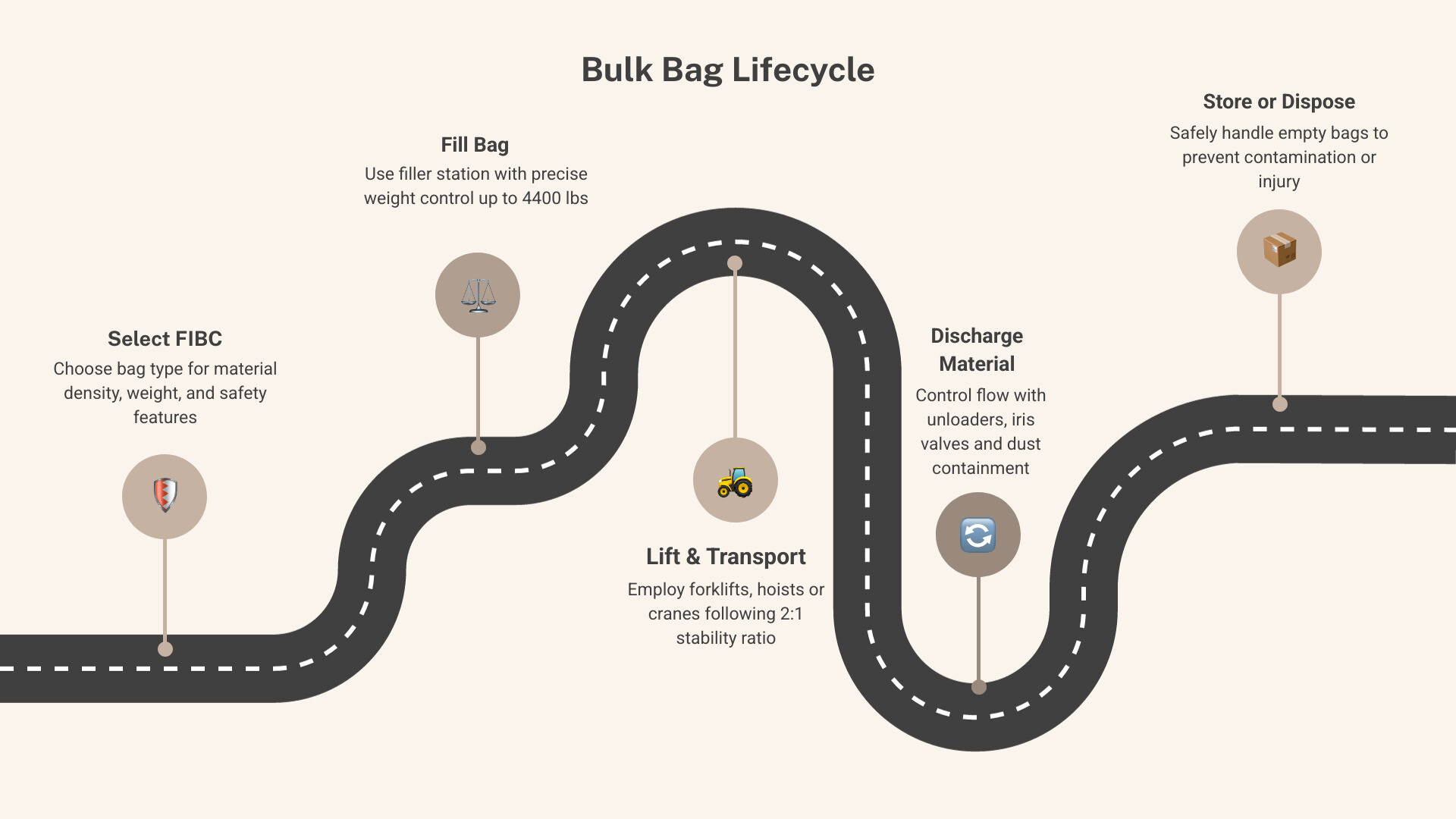
Bulk bag handling is the process of safely filling, lifting, transporting, discharging, and storing large flexible intermediate bulk containers (FIBCs) used to move dry materials in industrial settings.
What does bulk bag handling involve?
- Selecting the right FIBC for your material type and weight
- Filling the bag using a filler station with accurate weight control
- Lifting and transporting using forklifts, hoists, or cranes
- Discharging the material through a controlled unloading system
- Storing or disposing of empty bags safely
Bulk bags, also called FIBCs or super sacks, are the workhorses of dry material handling. They hold anywhere from 500 to 4,400 lbs of product and are used across food processing, chemicals, pharmaceuticals, agriculture, and mining.
But here’s the problem most plant managers know well: handling them manually is slow, risky, and costly.
Workers lifting, cutting, and dumping dozens of heavy bags per shift creates real operational pain. Dust exposure. Inaccurate batching. Inconsistent fill weights. Physical injury risk. These aren’t minor inconveniences — they directly hurt throughput, product quality, and your bottom line.
For production facilities still relying on manual methods, the gap between current operations and what’s possible with automated bulk bag systems is significant. Getting the fundamentals right, from safe lifting technique to dust-tight discharge, makes a measurable difference in plant performance.
This guide walks you through everything you need to know.
Understanding FIBCs and Bulk Bag Handling Equipment
Before I dive into the “how-to,” we need to understand the “what.” Flexible Intermediate Bulk Containers (FIBCs) are typically made from woven polypropylene. While they can theoretically hold up to 5,500 lbs, most materials in the real world won’t exceed a capacity of 4,400 lbs (2 metric tons). Most standard bags I see in the field range from 500 to 3,000 lbs in capacity.
If you are still moving material in 50 lb bags, you are essentially paying a “labor tax” on every pound of product. Moving to Bulk Bag Handling Systems allows you to consolidate your material handling, reducing the number of times a human has to touch the product. This shift is critical for industries handling powders, grains, or granules where consistency is king.
To move this material from the bag into your process, you often need specialized downstream equipment. This is where Screw Conveyors and Industrial Augers for Material Conveying come into play, serving as the bridge between the bag and your mixer or hopper.
Essential Components for Efficient Bulk Bag Handling
A complete system isn’t just a frame; it is a series of engineered components working in harmony. Here is what I consider the “essential kit” for any modern facility:
- Unloaders (Dischargers): These provide the structure to hold the bag and the mechanisms to get the material out.
- Fillers: These stations ensure you aren’t overfilling or underfilling. Modern Bulk Bag Filling Systems use load cells to ensure every bag is filled to the exact weight required.
- Hoppers: These act as the buffer, receiving material from the bag and feeding it into the next stage of the process.
- Stands and Lifting Frames: These provide the necessary elevation and support to keep the bag stable during the discharge cycle.
Specialized Solutions for Bulk Bag Handling
Not every plant has 20-foot ceilings. I often work with facilities where space is a major constraint. In these cases, low headroom Bulk Bag Unloading designs are a lifesaver. These systems use specialized hoist and trolley arrangements that allow you to position a bag even when vertical space is tight.
Additionally, for high-volume operations, multi-fill stations allow for continuous workflow. While one bag is being filled, another can be staged or removed, significantly increasing your bags-per-hour throughput without adding to your labor headcount.
Best Practices for Safe Loading and Lifting
Safety isn’t just about following rules; it’s about protecting your people and your product. A falling 2,000 lb bag is a catastrophe. One of the most important rules I can share is the 2:1 stability ratio: the height of the filled bag should not exceed twice its width or diameter. If your bag is too tall and narrow, it becomes a tipping hazard.
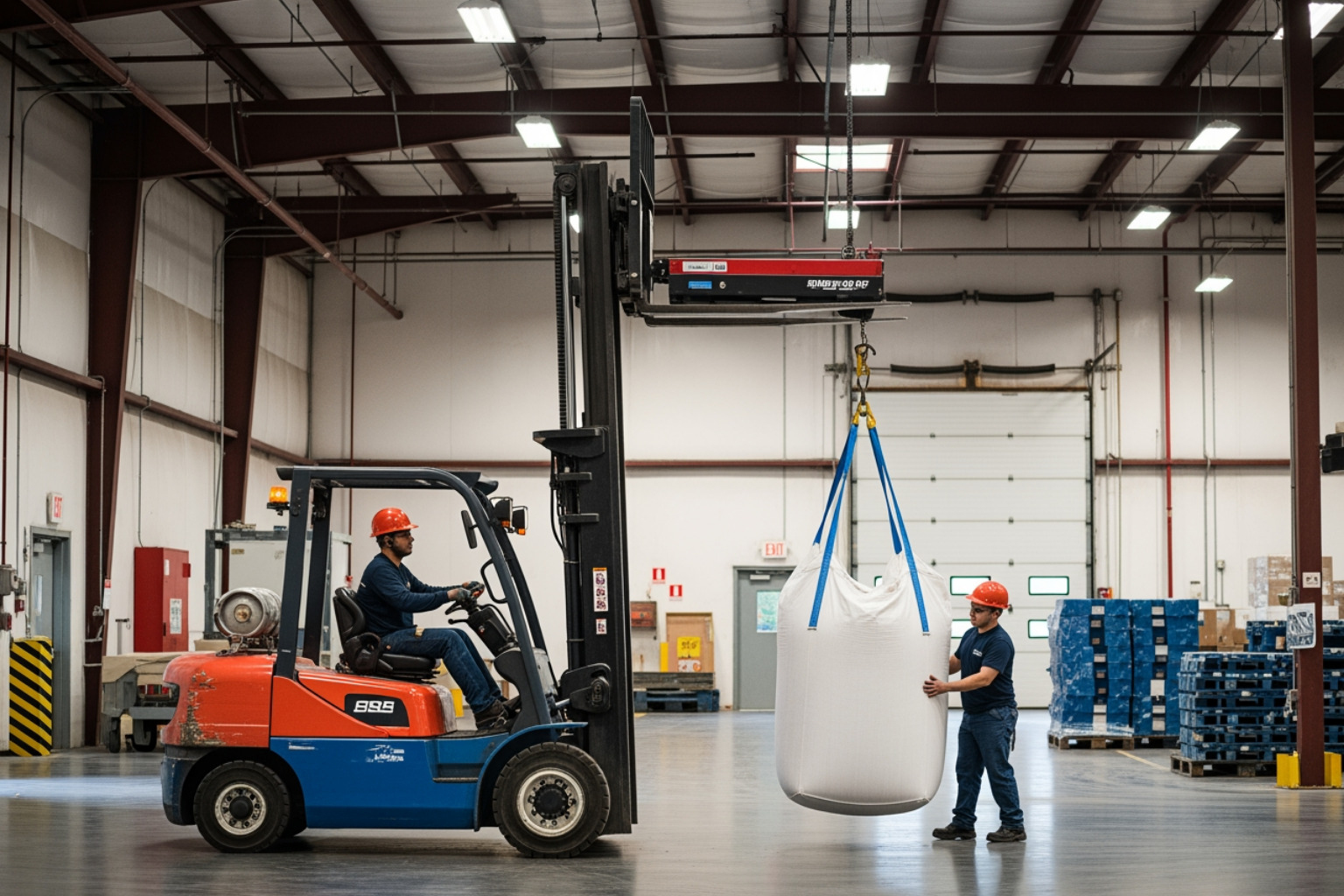
When using a forklift, the tines must be spaced correctly to ensure the lifting loops are vertical. Never “snatch” lift a bag; always lift and lower with smooth, controlled movements. If you are using a crane, ensure the hooks have safety latches and a minimum radius of 5 mm to prevent cutting the loops. For more detailed safety protocols, I recommend reviewing Navigating Bulk Bag Handling: Essential Dos and Don’ts and the Bulk Bag Handling Guidelines – Bagwell Supply.
Critical Dos and Don’ts of Bulk Bag Handling
To keep your floor running smoothly, follow these quick rules for Bulk Bag Handling:
The Dos:
- Do inspect every bag for damage before use.
- Do ensure the discharge spout is closed and tied before filling.
- Do use anti-static bags (Type C or D) if you are working in an explosive atmosphere.
- Do store bags in a clean, dry area away from UV light, which can degrade the plastic.
The Don’ts:
- Don’t ever stand under a suspended bulk bag.
- Don’t exceed the Safe Working Load (SWL) printed on the bag label.
- Don’t reuse a “single-trip” bag; they are not engineered for multiple uses.
- Don’t drag a bag across the floor; this can damage the bottom and lead to leaks.
Optimizing Material Discharge and Dust Control
If you’ve ever stood in a room filled with “fugitive dust” from a leaking bag spout, you know why dust control is a priority. Beyond the mess, it’s a health hazard and a potential combustible dust risk.
Efficient bulk bag handling requires a dust-tight seal. I recommend using systems with inflatable neck seals and telescoping tubes. The telescoping tube keeps the bag spout taut as it empties, preventing the material from pooling in folds and creating “dead spots.” To learn more about keeping your air clean, check out my thoughts on Reducing Dust in Bulk Bag Unloader.
Once the seal is secure, you have to deal with the material itself. Not everything flows like water. For difficult products, Bulk Bag Discharging often requires mechanical help.

Overcoming Challenges in Bulk Bag Handling
The two biggest enemies of material flow are bridging and sticking. Bridging happens when the material forms an arch over the discharge spout, stopping the flow.
To solve this, modern Bulk Bag Unloading Systems utilize:
- Pneumatic Bag Massagers: These are paddles that press against the bottom of the bag to break up clumps.
- Vibratory Units: These apply high-frequency vibration to the hopper to keep material moving.
- Iris Valves: These allow for controlled, partial emptying of a bag, letting you “choke” the flow if it becomes too aggressive.
Improving Plant Performance through Automation
This is where the real magic happens. When I talk to plant managers about automation, the conversation usually starts with labor costs, but it ends with accuracy.
In a manual batching environment, a worker might be responsible for dumping five different ingredients into a mixer. If they get distracted and skip a bag, or if they dump too much, the entire batch is scrap. By Automating Bulk Bag Filling, you remove the “human variable.”
I often compare two types of automated weighing:
- Gain-in-Weight (GIW): The system weighs the receiving vessel as material is added. This is great for high-speed filling.
- Loss-in-Weight (LIW): The system weighs the entire unloader and calculates how much has left the bag. This is incredibly accurate for precision batching.
| Feature | Manual Handling | Automated Handling |
|---|---|---|
| Batching Accuracy | Dependent on operator focus | PLC-controlled precision |
| Throughput | Limited by physical labor | Consistent, high-speed flow |
| Dust Exposure | High risk during bag opening | Contained, dust-tight seals |
| Labor Dependency | High (multiple operators) | Low (one operator/supervisor) |
| Waste/Scrap | Common due to spills/errors | Minimized through controlled flow |
Selecting and Maintaining Your Handling System
When you’re ready to move away from manual labor, don’t just buy a “one-size-fits-all” frame. Your system should be a Bulk Bag Unloading Systems Customized solution tailored to your specific material. For example, the equipment I’d recommend for citric acid is very different from what I’d suggest for clay powder.
Maintenance is also a key factor in ROI. Regularly inspect your hoist cables, check the seals on your dust collection ports, and ensure your load cells are calibrated. A well-maintained Bulk Bag Packaging Systems can last for decades, providing a much higher return than the initial capital expenditure suggests.
Evaluating Retrofit vs Full System Upgrades
You don’t always have to tear everything out and start over. Sometimes, a retrofit is the smartest path. If you have a solid frame but your controls are outdated, a controls upgrade can give you the benefits of modern automation without the cost of new steel.
However, if your goal is a massive increase in throughput, a full Bulk Bag Handling from Filling to Unloading system integration is usually the best bet. This ensures that your filler, conveyor, and unloader are all “talking” to the same PLC, creating a seamless flow of data and material.
Frequently Asked Questions
What is the typical cost of a bulk bag unloader?
While I don’t provide specific quotes here, the industry average for a basic bulk bag unloader starts around $5,000 and can exceed $20,000 for fully automated, stainless steel, or sanitary-grade systems. The complexity of your material and the level of automation required are the main cost drivers.
How can I ensure dust-free operation during discharging?
The key is a three-pronged approach: use an inflatable spout seal to create a mechanical barrier, maintain negative pressure with a dust collection system, and use a “power cincher” or iris valve to close the bag spout before it is removed from the unloader.
What are the maximum weight capacities for standard FIBCs?
Most standard bags are rated for a Safe Working Load (SWL) of 2,200 lbs to 3,300 lbs. While heavy-duty bags can handle up to 4,400 lbs or even 5,500 lbs, you must always verify the rating on the specific bag’s label before filling.
Conclusion
At Sterling Systems & Controls, I’ve seen how the right bulk bag handling strategy can transform a facility. Moving from manual dumping to an automated system isn’t just about saving on labor; it’s about gaining control over your process.
By reducing batching errors, eliminating scrap, and increasing your throughput, you aren’t just moving material — you’re moving your business forward. Whether you need a custom-engineered unloader or a complete turnkey batching solution, focus on the outcomes that matter: accuracy, safety, and efficiency.
If you are ready to stop struggling with manual bags and start optimizing your plant, explore our Bulk Bag Handling Systems to see how a tailored solution can work for you.