
From Grain to Glory: Mastering Feed Mill Automation
Your Introduction to Feed Mill Automation
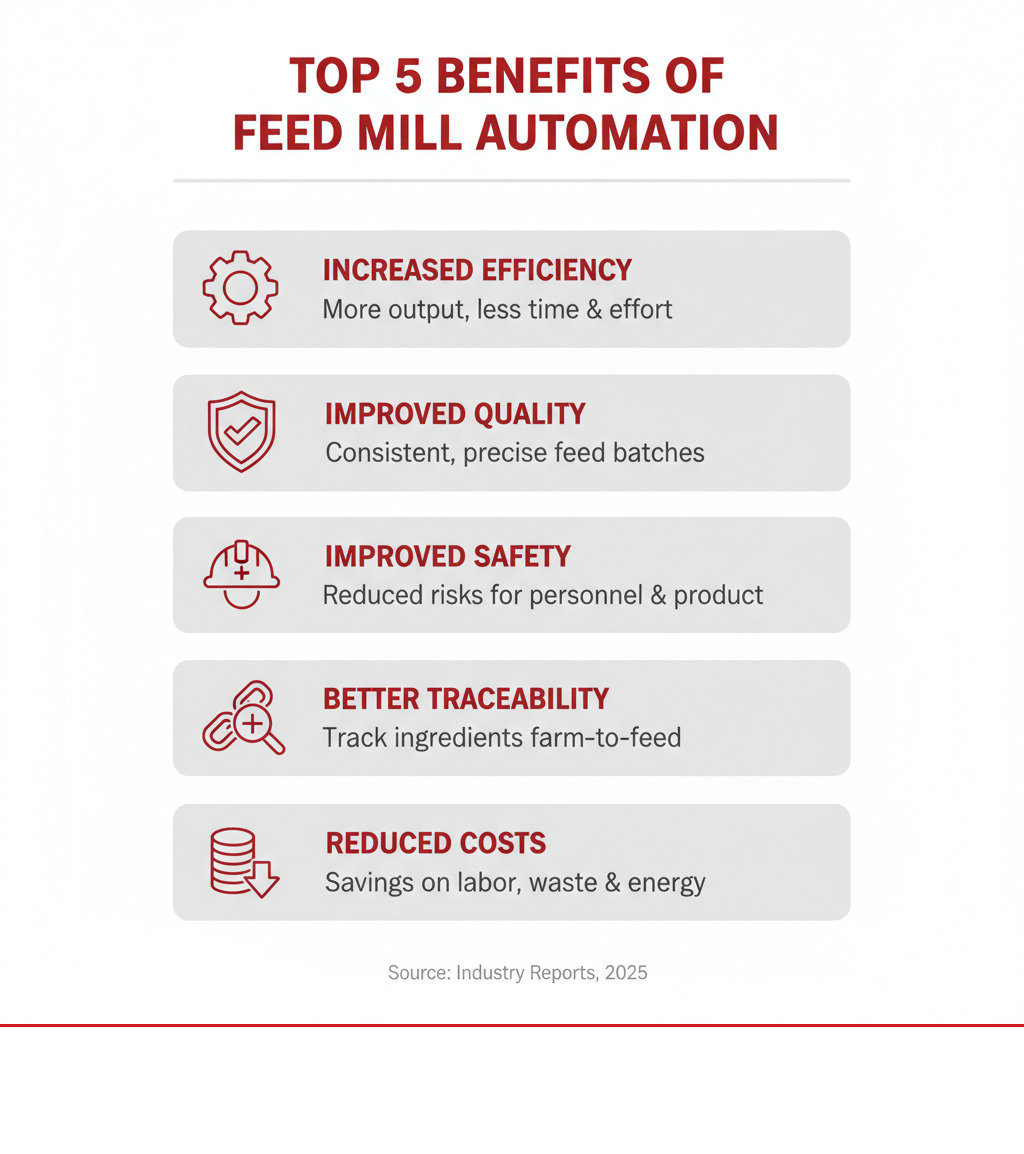
A feed mill automation guide is your roadmap to modernizing operations with technology, changing your feed mill to:
- Boost Efficiency: Make more feed, faster, with less effort.
- Improve Quality: Ensure every batch is perfect and consistent.
- Improve Safety: Protect your team and your products.
- Enable Traceability: Track every ingredient from start to finish.
- Reduce Costs: Save money on labor, waste, and energy.
Welcome to the ultimate feed mill automation guide from Sterling Systems & Controls. As a production manager, you know the pressure: the world demands more high-quality animal feed, requiring greater efficiency and precision.
Traditional methods often cause errors and delays, but feed milling is evolving with new technology. This guide shows how automation helps you meet today’s challenges and prepare for tomorrow. It’s about shifting from manual tasks to smart, controlled processes, changing your feed mill into a more productive, safer, and profitable business.
Why Automate? The Transformative Benefits for Your Feed Mill
Running a feed mill today means facing tighter margins, stricter regulations, and demands for perfect quality. Old methods can’t keep up. Automation isn’t just new equipment; this feed mill automation guide is about fundamentally changing how your operation runs.
Studies show smart factory solutions can increase plant performance by 10% to 30%, and many feed mills see a return on investment in under two years. This is a reality we’ve seen repeatedly.
The benefits are comprehensive: improved product consistency keeps customers happy, automation of dangerous tasks improves safety, and automatic data logging simplifies regulatory compliance. You’ll also reduce labor costs while increasing output.
Automation virtually eliminates costly batching errors and improves supply chain optimization from receiving to shipping. Learn more about the essential role of automation in modern manufacturing. These are transformative changes that redefine your feed mill’s capabilities.
Boosting Efficiency and Productivity
Efficiency drives profitability, and automation is key. By eliminating manual handling and other time-consuming tasks, automated systems free up your team and significantly speed up production.
Automation enables 24/7 operation potential. Systems can run continuously, allowing you to meet demand spikes without overtime or extra shifts.
The result is faster production processes and dramatically increased throughput using existing infrastructure, often without expensive expansions.
Automation also allows for workforce reallocation. With machines handling repetitive work, your team can focus on valuable tasks like quality control and process optimization. You’re empowering your workforce, not replacing it. The Need for Speed in Batching is about achieving smart speed that maintains quality while boosting output.
Ensuring Best Quality and Consistency
In animal nutrition, consistency is everything. Uniform diets lead to better animal performance, and automation is your secret weapon to achieve it.
Precise ingredient measurement is a core benefit. Digital controls add every ingredient in the exact quantity required, with precision down to fractions of a gram for micro-ingredients—an accuracy impossible to sustain manually.
Eliminating human error is a key advantage. Automation removes the variability of manual work, ensuring recipes are followed perfectly every time. This precision ensures consistent feed formulation. Every batch has an identical nutritional profile, leading to better animal health and performance, which improves your reputation.
Micro-ingredient accuracy is especially critical. These tiny but impactful additions are handled with the necessary precision that manual dispensing lacks. The impact is significant, as automated batching systems support optimal nutrition for improved animal gut health and performance—a measurable value for your customers.
Enhancing Safety and Regulatory Compliance
Safety is paramount for your team and the end consumer. Automation dramatically improves safety in both areas.
Automation improves safety by reducing hazardous manual tasks like climbing bins, handling heavy bags, and working near dangerous machinery. It removes people from harm’s way.
Sensor integration for equipment monitoring provides another layer of protection. Systems monitor critical parameters like temperature and pressure, and can shut down automatically if an issue arises, often before an operator would notice. This monitoring also ensures compliance with safety guidelines by automatically enforcing proper procedures.
For regulatory compliance, automatic data logging is a game-changer. The system records all production data, creating a complete, unalterable digital record for easy audits.
Traceability for feed safety becomes simple. In case of a recall, you can trace any product back to its raw ingredients in minutes, protecting animal health and your reputation. Automation helps you meet regulatory requirements with precise control and automatic documentation, saving you time and effort.
The Anatomy of an Automated Feed Mill: Processes and Equipment
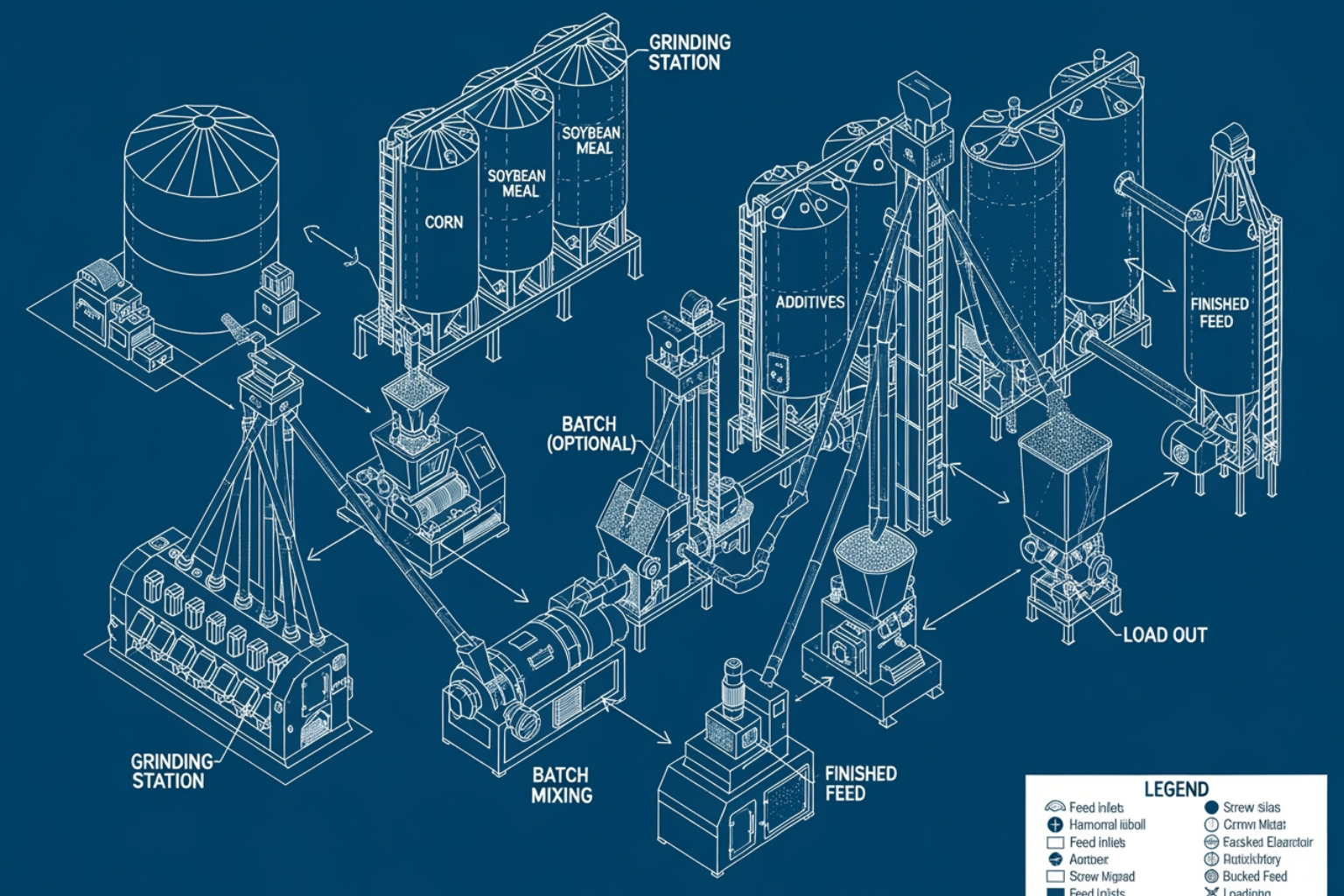
An automated feed mill is like a tuned orchestra, creating high-quality animal feed. Understanding how automation integrates into each process is key to open uping your operation’s full potential and a core part of this feed mill automation guide.
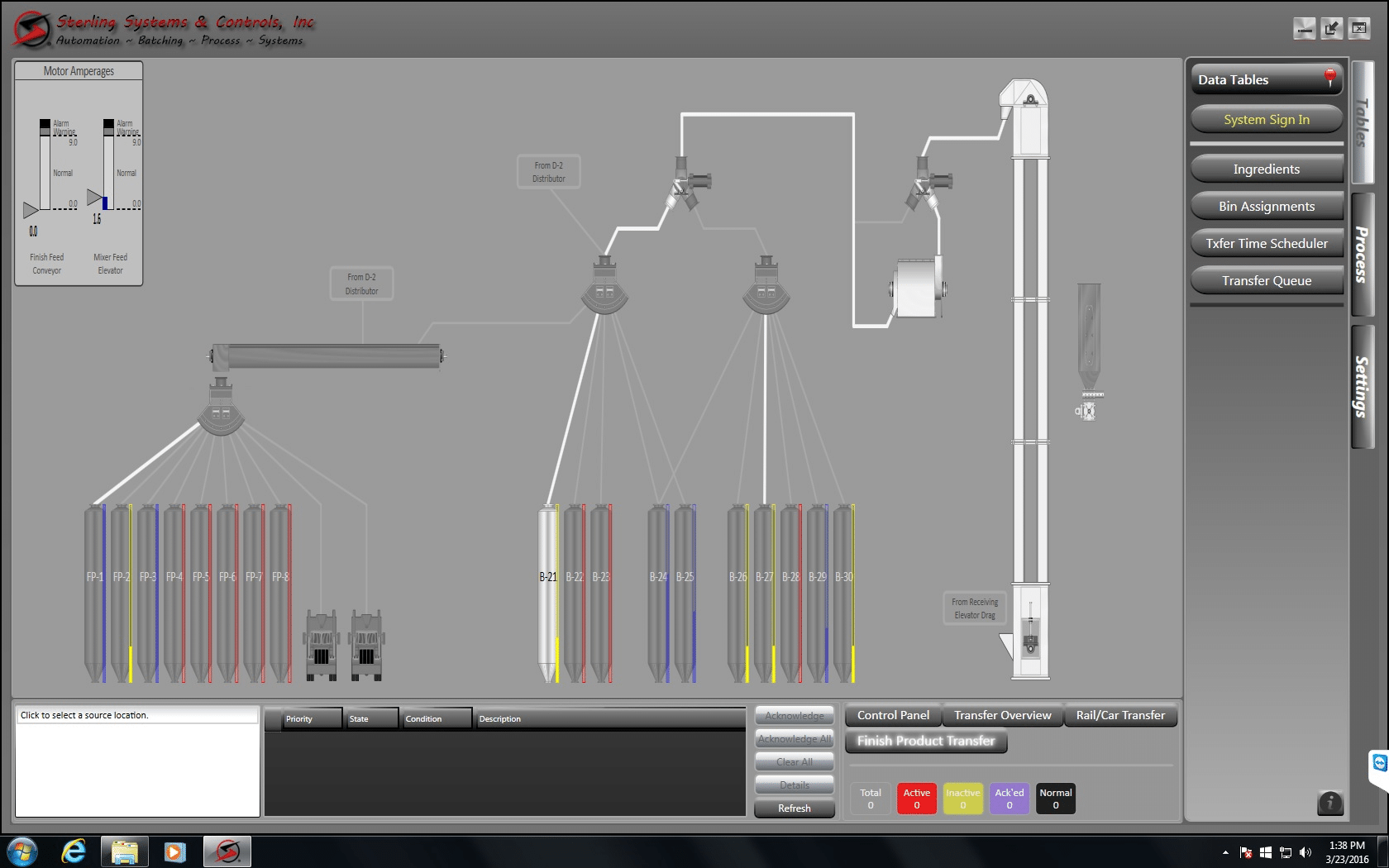
At its core, an automated feed mill relies on four key technologies: PLCs (Programmable Logic Controllers) to run equipment, the HMI (Human-Machine Interface) as a central control screen, Sensors to gather real-time data, and Actuators to perform physical tasks like opening valves or starting motors.
These components are the foundation of automation. For a deeper dive, see this overview of feed milling and pet food manufacturing. Now, let’s examine how automation transforms each stage of the process.
Receiving and Transfer
The receiving process sets the stage for production. Automation ensures it’s precise and efficient. Upon arrival, automated material tracking creates a digital record of the ingredient, source, and quantity, eliminating manual errors. The unloading process is also automated for safe and efficient transfer.
Automation eliminates the dangerous task of manually checking bin levels. Silo and bin level monitoring uses sensors for continuous, real-time inventory tracking. The control system then automatically directs ingredients to the correct storage, preventing cross-contamination and optimizing space. Our specialized solutions for feed mill automation for receiving and transfer streamline this critical first step.
Grinding and Particle Size Reduction
Grinding is a critical process, as particle size directly impacts nutrient digestion. Automated systems manage hammermills and roller mills with best precision. You can program exact micron specifications for different animal feeds, and the system delivers them consistently.
This matters because uniform particles increase the surface area for digestion, improving nutrient absorption and customer value. Automated grinding also improves energy efficiency, lowering your operational costs. Our grinding feed mill automation solutions provide this level of control and consistency.
Batching and Mixing
Batching and mixing is where automation’s value is most apparent, as precision here dictates product quality. Automated systems handle bulk major, minor, and micro-ingredients with digital precision, managing multiple scales simultaneously. Liquid ingredients are also metered accurately for uniform distribution.
Automated recipe management allows you to store hundreds of formulas. Simply select a recipe, and the system executes it perfectly, measuring every ingredient to spec. Real-time monitoring catches and corrects discrepancies instantly.
Automation eliminates the costly errors of manual batching, especially with micro-ingredients. We can automate your entire batching process for powders, bulk materials, and liquids. Explore our solutions for batching feed mill automation for more details.
Pelleting and Conditioning
Pelleting transforms loose feed into dense pellets, improving handling and digestibility. This complex process requires precise control. Automation monitors and adjusts four key parameters: Feeder speed for optimal flow, Steam valve adjustments for conditioning, Mash temperature for gelatinization, and Mill load (amps) to prevent overloading.
Our automated systems make real-time adjustments to feeder speed and steam to maintain target set-points. This maximizes throughput and ensures consistent pellet quality, which directly impacts animal health and your customers’ success. Learn more about our pelleting automation application for feedmills and how control helps in enhancing animal health by controlling the pelleting process.
Loadout
The final stage, loadout, is prone to costly errors in manual operations. Automation eliminates mistakes like loading the wrong product or incorrect quantities. Automated truck filling systems manage the process with precision, and integration with your batching system ensures the correct product is loaded every time.
Technologies like RFID (Radio Frequency Identification) can further improve accuracy by automatically identifying trucks and verifying loads. The operator’s role shifts to supervision rather than manual labor.
This guarantees order accuracy and customer satisfaction. You get complete documentation for delivery integrity, and our systems ensure the correct product is delivered with an accuracy manual operations can’t match. Find out how our solutions for loadout feed mill automation can transform this final critical step.
Your Comprehensive Feed Mill Automation Guide to Implementation
Starting your automation journey can feel overwhelming, but with a solid plan and the right partner, it’s a rewarding investment. Many feed mills see a return on investment (ROI) in less than two years. While the initial investment is significant, long-term savings on labor, waste, and energy, combined with increased throughput, ensure it pays for itself quickly.
Every feed mill is unique, so we often recommend a phased implementation. This approach allows you to automate one process at a time, spreading out the investment and minimizing disruption. A complete overhaul is also an option. The key is to find the right fit for your needs and budget. For more on custom solutions, listen to this podcast on exploring customized control solutions for feed mills.
Here’s how manual operations stack up against automated systems:
| Metric | Manual Feed Mill Operations | Automated Feed Mill Operations |
|---|---|---|
| Cost | High labor, waste | Lower operational, energy, labor costs; Higher initial investment, but quick ROI |
| Speed | Slower, bottleneck-prone | Significantly faster production; Potential for 24/7 operation |
| Accuracy | Prone to human error | Highly precise ingredient measurement and mixing; Near-zero batching errors |
| Safety | Higher risk of injury | Reduced hazardous tasks; Sensor monitoring prevents accidents; Compliance with safety guidelines |
| Traceability | Difficult, manual records | Automatic data logging; Detailed records for every batch; Easy traceability for compliance and quality control |
The Role of Software and Data Analytics
Software is the brain of your automated mill, turning data into actionable insights. Centralized control software provides a command center, typically an HMI screen, to monitor and control your entire facility from one location.
Real-time monitoring allows you to watch operations as they happen, spotting and addressing issues like bearing temperatures or equipment vibration before they become major problems. The system collects vast amounts of data on ingredient usage, batch parameters, and energy consumption. This is compiled into reports for tracking Key Performance Indicators (KPIs), giving you a clear view of performance and areas for improvement.
Data analytics also enables predictive maintenance. By analyzing data patterns, the system can predict equipment failure before it occurs. This allows you to schedule maintenance proactively, reducing downtime and costs. See an overview of automated feed mill control systems for a complete picture.
Integrating with Business Systems (ERP)
True automation extends beyond the production floor. Integrating control systems with your Enterprise Resource Planning (ERP) software creates a seamless flow of information across your entire operation. Seamless data flow means production and inventory data are automatically shared with your ERP, eliminating manual entry and errors.
This leads to smarter inventory management. Real-time data helps with forecasting and purchasing, minimizing stockouts and excess inventory. The system can even automate reordering. Production scheduling becomes more responsive, allowing you to optimize schedules based on real-time data. With sales order integration, production can be triggered directly by customer demand, connecting all parts of your operation. If you have older systems, explore your options for upgrading your legacy software for a feedmill.
Overcoming Challenges and Potential Drawbacks
It’s important to be honest about the challenges of automation. Understanding them upfront helps you plan effectively. The initial capital cost is substantial, but the ROI is often achieved in less than two years due to long-term savings.
Your team will need new technical skills, which is an opportunity for workforce development. We provide comprehensive training and support to ensure your team is proficient with the new technology. Automated systems also require regular maintenance. A well-planned schedule is crucial, and predictive maintenance capabilities help you plan strategically to avoid emergency breakdowns.
Finally, choosing the right partner is critical. You need a provider with deep experience in feed mills who can offer custom-engineered, single-source solutions that integrate all your process equipment. Navigating a feed mill automation migration or upgrade offers practical guidance for this journey.
Future-Proofing Your Operations for Tomorrow’s Demands
The animal feed industry is constantly changing. To keep pace, your feed mill needs to be adaptable. Automation provides a competitive advantage for the future. We design our systems with scalability and flexibility in mind, so they can grow with your business. These programmable and expandable systems adapt to increased demand and process changes, allowing your operations to grow without a complete overhaul.
Automation also addresses the challenge of preparing for operator retirement. As experienced operators retire, their knowledge can be lost. Automation captures this institutional knowledge in digital systems, encoding recipes and best practices to ensure operational continuity.
The ability to adapt to market changes is crucial. Automated systems provide the agility to pivot quickly in response to new formulations, demand spikes, or changes in raw material availability. Learn how we are revolutionizing feed mill operations with advanced automation and helping clients stay ahead.
Sustainability and Environmental Impact
Your environmental footprint matters to customers, regulators, and your bottom line. Automation helps you improve sustainability. Optimizing energy consumption is an immediate benefit. Energy-efficient components and optimized processes reduce electricity and fuel waste, lowering costs.
Reducing resource wastage is another key advantage. Precise measurement and control minimize material loss throughout the production process. Minimizing product waste is also significant. Consistent, accurate batching means fewer rejected batches, reducing landfill waste.
These improvements combine to lower your carbon footprint. By optimizing processes and reducing waste, automation makes your feed mill more sustainable—a win for your business and the environment.
Preparing for Scalability with this feed mill automation guide
A compelling aspect of automation is its ability to scale with your business, whether you’re increasing production, adding a new product line, or acquiring another facility. The value of programmable and expandable systems is clear. We design systems for future expansion, so you can add capacity by building on your existing foundation.
Our modular software design simplifies expansion. You can add new functionalities without disrupting your entire system. Automation helps you in meeting increased production demand gracefully. You can produce more feed in less time to maintain a steady supply without scrambling to hire new staff or overworking equipment.
Adding new processes or equipment is also straightforward. Automation simplifies the integration of new machinery, as the control system adapts and the software scales to keep your operation running smoothly. This feed mill automation guide is about building a future-proof foundation for your operation, turning a good investment into a great one.
Frequently Asked Questions
Considering automation for your feed mill? It’s a big step, and it’s normal to have questions. Here are answers to some common queries about the possibilities discussed in this feed mill automation guide.
What is the first process I should automate in my feed mill?
For your first automation step, we recommend batching. Automating the weighing and batching of ingredients offers a high return on investment (ROI) by directly improving product quality, consistency, and cost control. Reducing errors and waste at this critical stage is the quickest way to see significant benefits. Learn more about our batching feed mill automation solutions.
How does automation improve traceability?
Automation is key for traceability. Systems automatically record every ingredient, lot number, and quantity for each batch, creating a detailed digital trail. This makes it easy to trace products forward to customers and backward to suppliers, which is crucial for regulatory compliance and quality control. You get clear, accurate data at your fingertips.
Can I automate my existing feed mill?
Yes, you can absolutely automate an existing mill. A migration or upgrade can be done in phases to minimize downtime. This typically involves replacing manual controls with modern PLCs and software, and integrating new automated equipment where it will have the most impact. We are experts at navigating a feed mill automation migration or upgrade to bring your current facility into the future.
Conclusion: Take Control of Your Feed Mill’s Future
You’ve reached the end of our feed mill automation guide. As you’ve seen, automation is a strategic decision that transforms your operation from a cost center into a competitive advantage.
We’ve explored its deep impact on boosting efficiency, ensuring unparalleled product quality, and enhancing safety. These improvements lead to increased profitability. By reducing human error and optimizing resources, automation helps you meet today’s demands and adapt to future market changes.
Ready to Start?
Partnering with an experienced provider like Sterling Systems & Controls means you get a custom, single-source solution that integrates all your process equipment to meet your specific goals.
Don’t let outdated methods hold you back. It’s time to open up your feed mill’s full potential. Take the next step with a complete feed mill automation system and lead your operations from grain to glory. We’re ready to help.
Last updated on April 1st, 2026 at 11:37 am