
The Ultimate Guide to Bakery Automation
Why Bakery Automation Is Reshaping Modern Baking Operations
Bakery automation refers to the use of machines, robots, software, and control systems to replace or assist manual tasks in baking production — from ingredient weighing and dough mixing to proofing, packaging, and quality inspection.
Here’s what bakery automation covers at a glance:
- Ingredient batching — precise, repeatable weighing of dry and liquid ingredients
- Dough handling — automated mixing, dividing, shaping, and proofing
- Baking control — recipe-driven oven temperature and time management
- Packaging and palletizing — robotic pick-and-place, slicing, and pallet loading
- Quality inspection — vision systems that detect defects, color, and weight variance
- Software integration — centralized recipe management, ERP connectivity, and real-time KPI monitoring
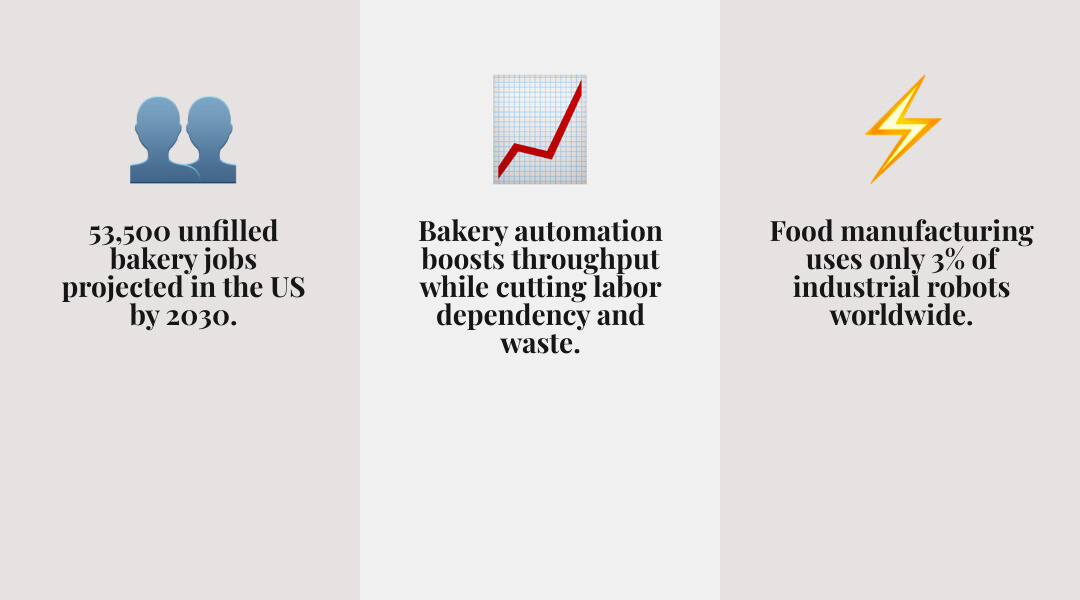
If you run a bakery production facility, you already know the pain. Skilled workers are harder to find every year. The American Bakers Association projects 53,500 unfilled bakery jobs in the US by 2030. Manual processes introduce inconsistency — a gram off on a micro-ingredient, a temperature deviation in the proofer, a missed weight check on the line. These small errors compound into real losses: wasted batches, rework, customer complaints, and missed throughput targets.
At the same time, demand is growing. Markets for bread, pizza, pastries, and snacks are expanding globally. Production lines need to run faster, more reliably, and with less direct labor — without sacrificing the product quality your customers expect.
That’s exactly the problem bakery automation solves.
Food manufacturing currently accounts for only 3% of all industrial robot installations worldwide — which means most bakeries are still leaving significant efficiency gains on the table. The operations that move now are the ones that will be able to scale, compete, and protect their margins over the next decade.
This guide walks through every layer of bakery automation: the equipment, the software, the batching systems, and the implementation decisions that determine whether a project delivers real ROI or falls short.
The Strategic Shift to Bakery Automation
For a long time, the word “automation” felt like a dirty word to some in the baking community. There was this fear that machines would strip the soul out of the bread. But as I’ve seen in my work at Sterling Systems & Controls, the reality is quite the opposite. Automation doesn’t replace the baker’s intuition; it protects it.
When we talk about the strategic shift to bakery automation, we are talking about moving from a reactive environment to a proactive one. In a manual bakery, you’re often reacting to a batch that didn’t rise correctly or a line that’s running slow because someone called in sick. In an automated facility, you’re managing a system designed for excellence.
One of the biggest drivers right now is labor dependency. It’s not just that workers are hard to find; it’s that manual baking is physically demanding. Lifting 50-pound bags of flour, repetitive dough shaping, and managing hot pans all day leads to fatigue and injury. By implementing robotic arms for heavy lifting or automated tray handling, you’re not just saving on labor costs; you’re significantly improving worker safety.
Furthermore, maintaining artisanal quality during industrial scaling is one of the hardest tricks to pull off. I’ve seen bakeries struggle to replicate the perfect crust or crumb once they move from one oven to ten. This is where Food and Baking Automation Enhancing Quality and Consistency comes into play. Automation ensures that the variables-time, temperature, and ingredient ratios-stay exactly where the master baker wants them, every single time.
Scaling Production with Bakery Automation
If you’re still using manual dough handling, you’ve likely hit a ceiling. There is only so much dough a human team can process before physics and fatigue take over. To meet rising market demand, especially in high-growth areas like the pizza market, you need speed. For broader industry context, the International Federation of Robotics is a widely recognized source for global robotics adoption trends across manufacturing sectors.
Modern automated dough handling systems can process up to 4,000 pounds of dough per hour. That’s a level of throughput that manual teams simply cannot touch. Automation solves the bottleneck by creating a continuous flow. Instead of waiting for a batch to be hand-divided, automated dividers and shapers keep the line moving at a constant pace.
Flexible production lines are also a game-changer. In the past, an automated line was a “one-trick pony.” Today, modular systems allow you to switch from baguettes to ciabatta with a few screen taps and a quick accessory change. This flexibility means you can say “yes” to more customers without needing to build a whole new wing on your factory.
Software and AI in Bakery Automation
I often tell my clients that the hardware is the body, but the software is the brain. In May 2026, we are seeing AI play a massive role in how bakeries operate. Centralized recipe management is the foundation. When you update a recipe in your main office in Sterling, Illinois, it should instantly update on the plant floor in Canada. No more paper binders, no more “I thought we used the old version of the recipe.”
Seamless ERP integration allows your production data to talk to your business data. If you’re running low on a specific minor ingredient, the system knows it before the operator does. Real-time monitoring of plant floor KPIs (Key Performance Indicators) gives plant managers the “God view” of their operation. You can see exactly where a bottleneck is forming or if an oven is consuming more energy than it should.
AI is even being used for visual inspection. Advanced vision systems use AI to visually inspect every loaf for rise, symmetry, and crust color. If a loaf doesn’t meet the standard, the system flags it. This level of data-driven decision-making turns a bakery into a high-precision manufacturing facility.
Core Processes and Equipment in Modern Baking
To understand how to automate, we have to look at the core processes. It starts with the ingredients. If your “scaling” involves a guy with a scoop and a floor scale, you’re losing money. Precision ingredient scaling is the first step in Bakery Batching.
From there, we move to automated dough mixing. A Mixer Control Bakery system doesn’t just turn the beaters; it monitors dough temperature and energy absorption to ensure the gluten develops perfectly. Once mixed, the dough moves to dividing and shaping.
High-performance automation solutions for pastry production offer conveyor speeds up to 10 meters per minute, handling everything from puff pastry to pizza dough. This equipment takes the heavy, repetitive work of laminating and sheeting and turns it into a high-speed, high-accuracy process.
Robotic Handling and Packaging Integration
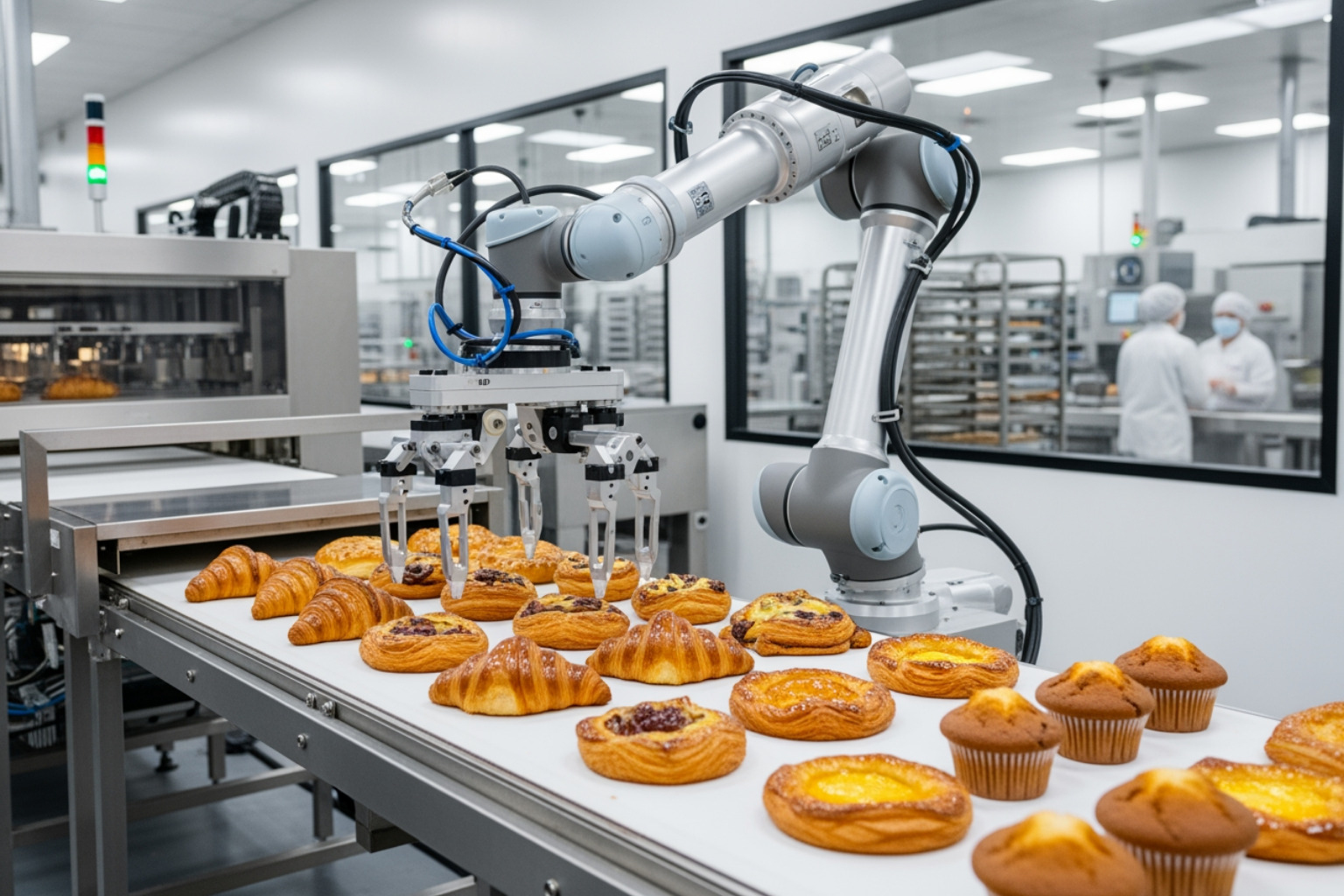
Robotics has moved from the automotive industry straight into the bakery. We now use Delta robots—those high-speed, spider-like machines—for pick-and-place packaging. They can gently grab a delicate pastry and place it into a plastic tray faster than the human eye can follow.
For the heavier stuff, articulated arms handle the “end-of-line” tasks. Robotic stackers and unstackers are a perfect example. They handle pans and lids with a level of gentleness that actually extends the life of your expensive pans. No more banging, no more denting—just precise, robotic movement.
Even the simple act of moving trays can be automated. Automatic tray loading robots can handle up to 180 trays per hour, swapping out baking trolleys in just 15 seconds without stopping the system. This is how you achieve 24/7 production without burning out your staff.
Automated Quality Control and Vision Systems
Quality control used to be a guy at the end of the line looking for burnt loaves. Now, it’s high-speed cameras and sensors. Vision systems can check the “bake color” of every single bun. If the buns are coming out too pale, the system can automatically adjust the oven temperature or belt speed.
Even the finishing steps are being transformed. Automated bread slicers and industrial crust removal systems don’t just slice; they can automatically remove crust waste, keeping your line clean and your product consistent. By reducing product giveaway through automated inspection and precision slicing, you’re directly increasing your bottom line.
Optimizing Plant Performance with Precision Batching
If there is one thing I want you to take away from this guide, it’s this: Your bakery is only as good as your batching. You can have the fanciest oven in the world, but if the ingredient ratios are wrong, the bread will be wrong.
Let’s look at the difference between manual and automated batching:
| Feature | Manual Batching | Automated Batching |
|---|---|---|
| Accuracy | Subject to human error (+/- 2-5%) | High precision (+/- 0.1% or better) |
| Traceability | Paper logs (often incomplete) | Full digital audit trail |
| Speed | Slow, dependent on operator | Rapid, continuous flow |
| Waste | High (spillage, over-pours) | Minimal (controlled dispensing) |
| Labor | High (requires multiple staff) | Low (monitored by one person) |
In a Baking Industry Upgraded Batching Solution, we focus on removing the “oops” factor. When an operator is tired at 4:00 AM, it’s easy to lose count of how many scoops of salt went into the mixer. An automated system doesn’t get tired. It weighs every gram and records every action.
Accuracy and Scrap Reduction
Scrap is the silent killer of bakery profits. Whether it’s dough that didn’t rise or product that was weighed incorrectly and had to be thrown out, it all adds up. Precision in Food Processing How Automated Weighing and Ingredient Batching Improve Quality and Efficiency is about more than just being “neat.” It’s about yield.
We typically look at two types of systems:
- Gain-in-weight: Ingredients are added to a vessel that sits on a scale. It’s simple and effective for many applications.
- Loss-in-weight: The entire supply hopper is on scales, and we measure how much weight leaves the hopper. This is incredibly accurate for continuous processes and micro-ingredients.
Handling minor and micro ingredients (like vitamins, enzymes, or salt) is where the real magic happens. These ingredients are used in tiny amounts but have a massive impact on the final product. A Minor Ingredient System Foods ensures these are dispensed with surgical precision, reducing scrap and ensuring every loaf tastes exactly like the last one.
Implementation Strategies and ROI
I know what you’re thinking: “This sounds expensive.” And yes, bakery automation requires capital expenditure. But the real question is, what is the cost of not automating? If you’re losing 3% of your product to scrap and paying overtime every weekend because you’re short-staffed, you’re already paying for an automation system—you just don’t own one yet.
Calculating the payback period is essential. Most of our clients see a full ROI within 18 to 24 months, depending on the scale of the system. The ROI comes from three main buckets:
- Labor savings: Reducing the number of touches per product.
- Ingredient savings: Eliminating “giveaway” and over-pouring.
- Capacity increase: Running the line faster and for longer hours.
Don’t forget workforce training. Your team shouldn’t fear the robots; they should be trained to manage them. Moving a worker from “flour scooper” to “automation technician” is a win for their career and your retention rates. For more on this, check out Upgrading Bakery Batching System.
Retrofit vs. Full System Upgrade
You don’t always need to tear everything down and start over. Many bakeries benefit from a “controls upgrade.” If your mixers and ovens are mechanically sound but their brains are 20 years old, we can retrofit them with modern PLC controls and software.
Mixer Bowl Batching Upgrades are a great way to start. You keep your existing mixer but add an automated ingredient delivery system. This modular expansion strategy allows you to scale at your own pace while minimizing downtime during installation.
Frequently Asked Questions
What are the primary benefits of automating a bakery?
The big three are consistency, throughput, and cost reduction. You get a product that is identical every time, you can produce much more of it in the same amount of time, and you reduce the costs associated with labor, waste, and energy.
How does automation address the current labor shortage in the baking industry?
Automation takes over the “3D” jobs: Dull, Dirty, and Dangerous. By automating repetitive tasks like tray loading, pan stacking, and ingredient scaling, you reduce the number of people needed to run a line. This allows your existing staff to focus on higher-value tasks like quality assurance and R&D.
Can artisanal bakeries benefit from automation without losing product quality?
Absolutely. In fact, many artisanal bakeries use automation to improve quality. By automating the temperature and humidity in proofing or the precision of ingredient scaling, you remove the environmental variables that often cause “bad batches.” This lets the artisanal baker focus on the recipe and the creative side of the business.
Conclusion
At Sterling Systems & Controls, we’ve spent decades helping bakeries across the United States and Canada transition into the modern era. We don’t believe in “off-the-shelf” solutions because we know no two bakeries are the same. Whether you’re a mid-sized operation in Illinois looking to automate your first line or a large industrial facility in Canada needing a full batching overhaul, we provide custom-engineered solutions that fit your specific goals.
We are your single-source provider for bakery automation, integrating everything from the raw ingredient intake to the final control software. Our goal is simple: to help you bake better, faster, and more profitably.
More info about batching and weighing services
If you’re ready to stop fighting your production line and start growing your business, let’s talk. The future of baking is automated—and it’s a lot more exciting (and profitable) than you might think.
Last updated on August 18th, 2026 at 09:47 am