
Minor & Major Weighing Systems
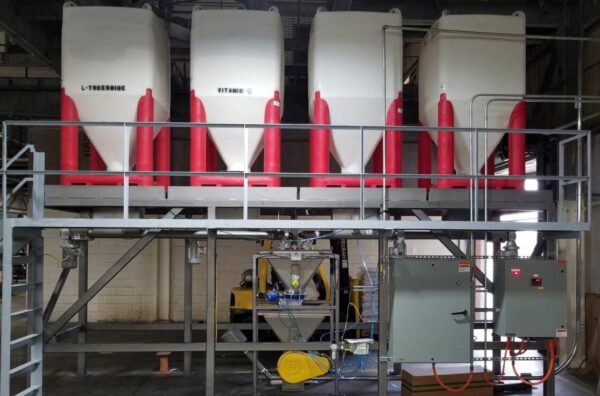
Minor and major ingredients drive cost, texture, and performance. Sterling Systems & Controls engineers minor & major weighing systems that enforce tolerances, verify ingredients and lots, and hand off cleanly to batching or conveying — so results are repeatable shift-to-shift, not just “close enough.”
What Do “Minor” and “Major” Mean?
- Major ingredients: higher throughputs from silos, bulk bags, totes, or tanks. Strategy: fast fill + trim for accuracy without sacrificing rate.
- Minor ingredients: lower flow, finer resolution, tighter tolerances. Strategy: precision feed control with protected weighments.
Both can feed gain-in-weight, loss-in-weight, or weigh-in-place architectures and hand off to mixers, extruders, dryers, or packaging.
System Architecture (Built to the Material & the Mission)
- Weighing modules: weigh hoppers, platforms, or in-place vessels sized for accuracy and rate.
- Feed devices: auger, vibratory, belt, slide-gate/valve, or pump (for liquids) — chosen for the material’s flow behavior.
- Discharge & isolation: slide gates, rotary valves, airlocks, or diverters to protect weighments and ensure clean transfer.
- Controls & HMI: PLC/HMI with recipe logic, alarm handling, and guided operator prompts.
- Data backbone: SQL database (and optional WebCentral) for batch/lot records, reporting, and audits.
Weighing Modes Supported
- Gain-in-Weight (GIW): weigh product as it fills the vessel.
- Loss-in-Weight (LIW): control feed rate by monitoring the feeder’s mass loss.
- Weigh-in-Place: measure in the process location to remove handling steps.
- Check-Weigh/Verification: confirm targets before release or next step.
Accuracy & Throughput Strategies
- Fast-fill & dribble/trim profiles to hit tight targets.
- Tolerance enforcement per ingredient (over/under windows).
- Dynamic filtering & motion detection to stabilize readings.
- Interlocks with conveying so weighments aren’t disturbed.
Integration That Matters (Not Just a Scale)
- Automatic/semi-automatic batching (micro, minor, major, kitchen, hand-prompt).
- Pneumatic or mechanical conveying interlocks and timing.
- Downstream equipment (mixers, extruders, dryers, packaging) for coordinated sequences.
- Plant systems: PLC/SCADA, MES/ERP, and network reporting.
Compliance, Hygiene & Traceability
- Who/what/when/within-tolerance recorded for each weighment.
- Lot verification (entry or barcode/RFID).
- Sanitary builds and cleanable surfaces where required.
- Audit-ready records for GFSI, FSMA, GMP, and customer audits.
Typical Options & Components
- Scales & weigh hoppers • Ingredient bins & refill systems • Bulk bag/tote/silo interfaces
- Feeders (auger/vibratory/belt/valve) • Airlocks/diverters • Dust containment interfaces
- PLC/HMI recipe management • Barcode/RFID lot entry • Label/report printing
- SQL database reporting • Network connectivity & backups
Where It Fits
Food & baking • Pet food & feed • Chemicals & additives • Plastics/compounding • Nutraceuticals • Other industrial powders
Planning to standardize minor/major additions and close your traceability gap? Request a quick application review — we’ll specify the weighing architecture that matches your materials, rates, and compliance needs.
Frequently Asked Questions
What are minor and major ingredient weighing systems used for?
Minor and major weighing systems are used to accurately proportion ingredients in batch-processing environments. Minor systems handle smaller, precision-sensitive materials, while major systems manage larger-volume ingredients that make up the primary portion of a batch. Together, they ensure consistent formulation and repeatable production results.
How does Sterling ensure weighing accuracy in batch applications?
Sterling engineers each weighing system around defined batch tolerances and material characteristics. Depending on the process, systems may use gain-in-weight or loss-in-weight methods to achieve precise control. Automation software monitors weight targets, reduces over- or under-dosing, and maintains repeatability from batch to batch.
Can minor and major weighing systems be integrated into an existing plant?
Yes. Sterling designs weighing systems to integrate with existing mixers, conveyors, upstream receiving systems, and downstream material handling equipment. Systems interface with PLC and HMI platforms and can operate as part of a larger plant automation or batching control system.
Are Sterling’s weighing systems fully automatic?
Sterling provides fully automatic and semi-automatic configurations, including hand-prompt batching stations when appropriate. The automation level is determined by production requirements, material flow, and operational preferences, allowing systems to scale as plant needs evolve.
Which industries commonly implement minor and major weighing systems?
These systems are commonly implemented in feed mills, pet food manufacturing, baking and food processing, and other industrial batch environments where precise ingredient control and formulation consistency are required.