
Material Weighing Systems
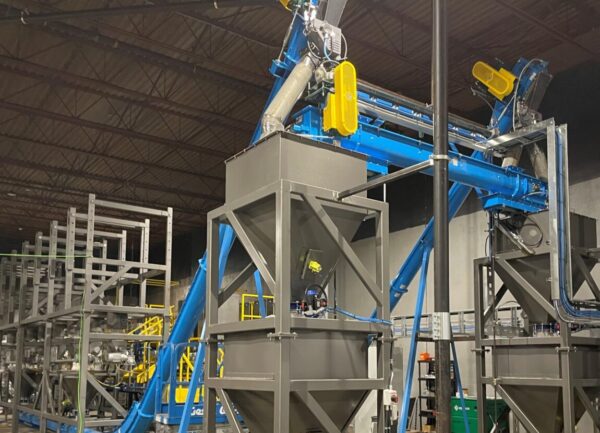
Sterling Systems & Controls, Inc. offers a variety of material weighing systems for many industries and applications. Each system is customized to meet the exact requirements and demands of our customers. Material weighing systems are useful for the automatic batching of multiple ingredients using single or multiple scales. A material weighing system can also be semi-automatic. A semi-automatic material weighing system is used for batching applications and requires operator-assisted feeding of ingredients with automatic operator instructions, weighing and lockouts to ensure no more missed ingredients due to operator interruption or error. These automatic and semi-automatic material weighing systems for ingredient batching ensure batch integrity, quality & consistency.
- Micro Weighing Systems
- Minor and Major Weighing Systems
- Hand Prompt Batching Station
- Kitchen Batching System
- Bulk Bag Unloading & Weighing Systems
- Bulk Bag Filling Systems
Why Precision Material Weighing Matters Beyond Accuracy
In process applications, accuracy is only half the equation. The real ROI comes from repeatability, traceability, and integration. Sterling’s material weighing solutions are engineered to produce identical results shift-to-shift, tie weight data back to formulas and lots, and drive that data into plant systems for visibility and verification — not just scale readout. This is what separates a weighing device from a production-grade weighing system.
Engineered to the Application — Not Forced to Fit
Unlike catalog equipment, systems are built around the physical behavior of the material (cohesive, aerated, hygroscopic, abrasive, fragile) and the production intent (loss-in-weight, gain-in-weight, weigh-in-place, check-weigh, batching handoff, pneumatic feed-forward, etc.). Sterling designs the scale, feeder, discharge geometry, controls, and data handling as one engineered unit — so you don’t inherit mis-matches between “commodity” components.
Designed to Integrate With Batching, Conveying, and Controls
Material weighing rarely lives alone. Sterling systems are commonly tied to:
- Automatic batching (micro / minor / major / kitchen / hand-prompt)
- Pneumatic or mechanical conveying interlocks
- Lot tracking and production reporting (SQL/WebCentral)
- Downstream mixers, extruders, dryers or packaging lines
The system doesn’t just weigh — it participates in the process logic.
Built for Regulated and Audit-Ready Environments
For plants operating under GFSI, FSMA, GMP, or customer audit pressure, Sterling’s weighing systems provide the missing evidentiary layer: who weighed it, what was weighed, when, and within what tolerance — then store it in a structured database. This closes the compliance gap between “we weighed it” and “we can prove it”.
When to Choose a Material Weighing System vs. a Stand-Alone Scale
Use a scale when you only need a reading.
Use a material weighing system when you need any of the following:
- Recipe enforcement or enforced tolerances
- Automatic batching handoff
- Controlled discharge or feed-rate
- Lot linkage and verification
- Networked reporting or traceability
- Interlocks with conveying or downstream equipment
If any of those are true, a scale alone will not close the risk.
Planning to upgrade from “just weighing” to controlled, traceable material handling?
Request a short application review and we’ll define the weighing architecture that matches your process — not one you have to bend your process around.