
Kitchen Batching System
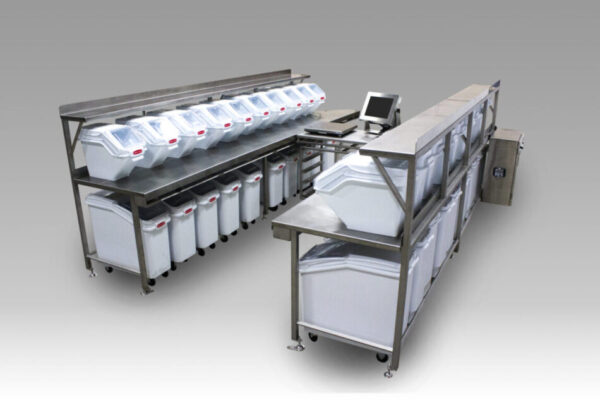
Sterling Systems & Controls, Inc. engineers several types of ingredient batching systems. One of the most widely adopted solutions — especially in food, baking, pet food, and related industries — is the semi-automatic kitchen batching system (“kitchen system”). It delivers the benefits of automation and traceability while keeping an operator in the loop for ingredient addition.
Like the Hand Prompt Batching Station, the kitchen batching system uses the same core control philosophy, touchscreen guidance, and SQL-based database for recipe, batch, and lot tracking. An operator is always present and is responsible for physically loading ingredients into the batch container on the system scale.
How the Kitchen Batching System Works
- Operator is prompted by touchscreen — The system instructs which ingredient to add first and displays the required target weight.
- Ingredient ID is verified — The operator enters an ingredient code or scans a barcode (optional). Until the correct code is confirmed, the system will not allow weighing to proceed.
- Ingredient is weighed under tolerance enforcement — The operator scoops material into the container while the system monitors the weight. Each ingredient has a programmable over/under tolerance.
- Step advances only when the weighment is valid — If the weight is within tolerance, the system records it and prompts the next ingredient.
- Process is interruption-resilient — If the operator stops mid-batch, the system “remembers” the exact step and resumes without losing state.
- Lot tracking and interlocks prevent bad batches — Automatic interlocks ensure correct ingredient, correct amount, and enforce traceability — eliminating bad batches from omissions or interruptions.
Why Plants Choose the Kitchen Batching System
- Reduces batch errors without removing the operator from the process
- Verifies ingredient identity and weight before allowing the batch to advance
- Captures lot data, weights, timestamps, operators into an SQL database
- Interruption-proof logic makes manual batching reliable instead of risky
- Uses the same software foundation as full automatic batching for future upgrade paths
Typical Hardware & Build Elements
- Multiple ingredient bins or totes
- Stainless steel work table(s)
- Mobile stainless steel weigh table with platform scale and HMI touchscreen
- PC-based control panel with weight instrument(s)
Ingredient Bins

Each semi-automatic kitchen batching system is customized to include the maximum number of bins required by your specific formulas. The bin size can vary depending on weight size and desired storage capacity. Two types of bins are often utilized, the floor bin and the shelf bin. The larger floor bin typically provided has a nominal capacity of 2.75ft3 (other sizes available), and includes rugged casters for ease of movement in/out from underneath the batching system tables. The smaller shelf-type bin typically has a nominal capacity of approximately 0.84ft3 (other sizes available) of bulk solid material and sits on the work table top. The bins are manufactured of food-grade plastic material, have clear lids, and integrated material scoops (stainless steel bins are available).
Tables
The semi-automatic kitchen batching system side-by-side racking table design (shown in the picture above; inline table design shown at right) has work tables sized to fit with the number of ingredient bins, and for operator comfort. The tables are manufactured of stainless steel material, typically grade 304, for food-grade compatibility. The ingredient tables are of rugged construction and are designed to be stationary. The moving weigh table is also constructed of 304 stainless steel. However, unlike the ingredient work tables the weigh table is not fixed. It is designed to travel smoothly between the two ingredient work tables. The operator simply moves the weigh table as needed to reach the next ingredient that is required. A roller system attaches the moving weigh table to the ingredient tables. The platform scale and the operator interface touchscreen are mounted to the top of the moving weigh table. The cabling from the scale and touchscreen display are enclosed within a flexible cable carrier and is routed between the moving weigh table and an adjacent ingredient table(s).
Control Panel w/ Touchscreen Display
We know electrical controls and automation technology and can customize a system using standard control and automation components. For the semi-automatic kitchen batching systems we have used a PC (control panel mounted) and an industrial touchscreen monitor (moving weigh table mounted). The control panel encloses the PC and other components to allow for its operation and interface with the monitor and scale. A weight indicator is also included and mounted on the front door of the control panel. A barcode scanner can also be provided for operation with the lot tracking part of the control system to ensure batch validation. RFID can also be provided.
Ready to make manual batching reliable? Let our engineers tailor a kitchen batching system that guides operators, enforces tolerances, and records every lot for audit-ready traceability. Request a quote below or book a quick consult to review your ingredients, batch sizes, and upgrade path to full automation.