
Mastering the Flow: A Guide to Industrial Process Control
What Is Industrial Process Control (And Why It Matters)
Industrial process control is the use of sensors, controllers, and actuators to automatically monitor and adjust manufacturing processes, keeping them consistent, safe, and efficient without constant human intervention.
Here is a quick overview of what it involves:
- What it is: A system that measures process variables (like temperature, pressure, or flow) and automatically corrects them to match a target value
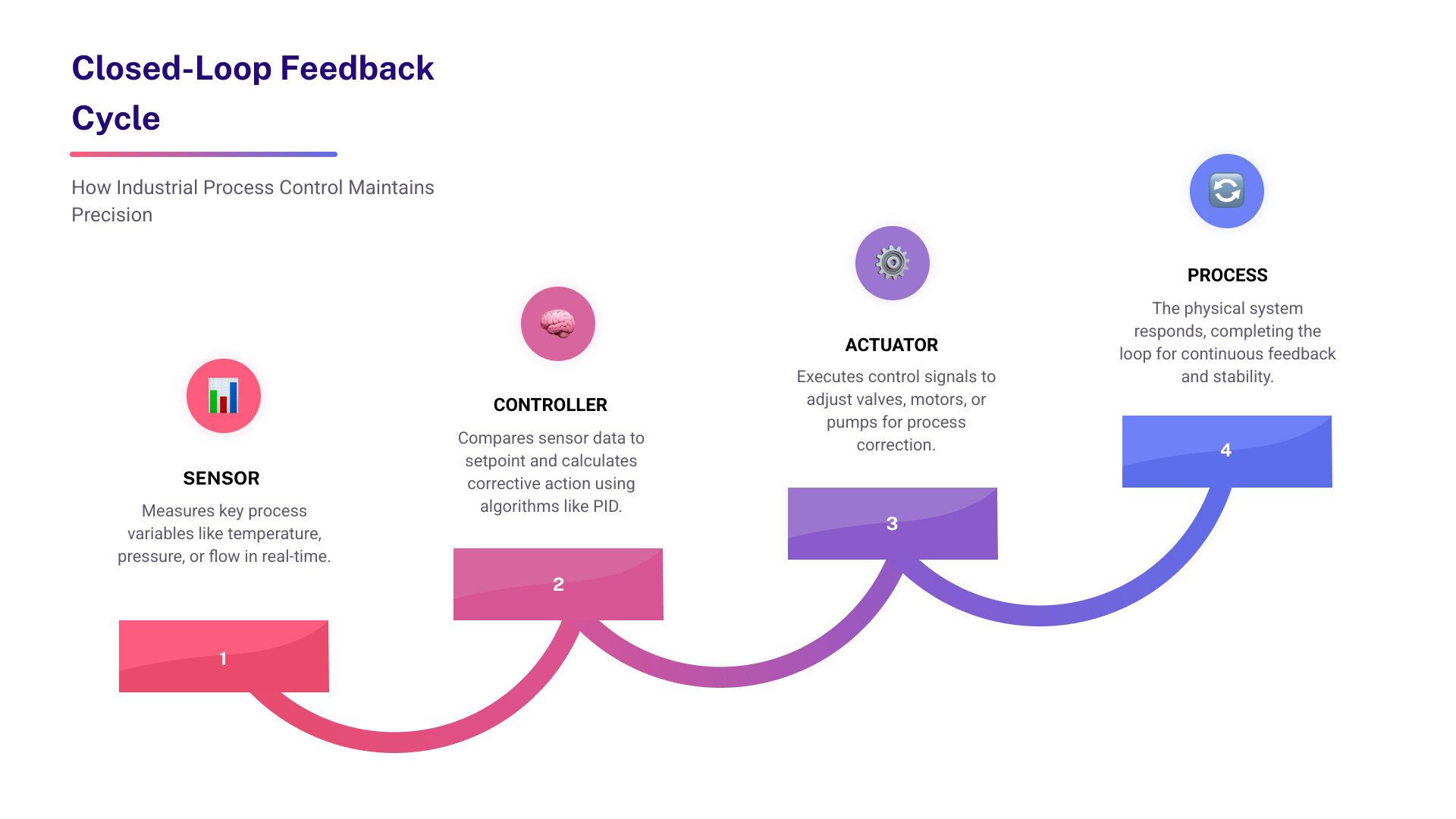
- How it works: Sensors feed real-time data to a controller, which calculates any deviation from the setpoint and signals an actuator to make a correction
- Where it’s used: Chemical plants, food processing, oil refining, pharmaceuticals, power generation, and more
- Why it matters: It reduces waste, cuts energy use, improves product quality, and keeps operations safe
Think of it as the nervous system of a manufacturing facility. Just like your nervous system senses the environment and triggers a response, an industrial process control system senses what’s happening on the plant floor and acts on it, continuously, in real time.
A single facility might run anywhere from a handful of loops to several thousand, all working together to keep production on track. In fact, it’s estimated that around 5 billion control loops running a PID algorithm are operating across the world at any given moment.
Whether you’re managing ingredient batching in a food plant or regulating reaction temperatures in a chemical process, the principles are the same: measure, compare, correct, repeat.
The Core Components of Industrial Process Control
To understand how industrial process control functions, we have to look at the physical “organs” that make up this nervous system. Every system, whether it is a simple temperature regulator or a massive Complete Process System, relies on a specific set of hardware and software components working in harmony.

Sensors and Transmitters
These are the eyes and ears of the system. Sensors detect physical properties like temperature, pressure, flow rate, or liquid level. Transmitters then take that raw signal and convert it into a standardized electrical signal (often 4-20 mA) that a computer can understand. Without accurate sensing, the “brain” of the system is essentially flying blind.
Controllers
The controller is the decision-maker. It receives the signal from the transmitter, compares it against a desired “setpoint” (the target value), and calculates how much of a change is needed. This calculation is performed using control algorithms, the most famous being the PID algorithm.
Actuators and Final Control Elements
Once the controller decides on an action, it sends a command to an actuator. This could be a motor that turns a conveyor belt, a heating element that warms a vat, or a control valve that opens to let more fluid through. These are the “muscles” that do the heavy lifting.
Human Machine Interface (HMI)
While the system is designed to be automatic, humans still need to keep an eye on things. The HMI provides a visual dashboard—often a touchscreen or a computer monitor—where operators can view real-time data, change setpoints, and respond to alarms.
For larger facilities, these components are often overseen by supervisory control systems that coordinate multiple loops simultaneously to ensure the entire plant is running at peak efficiency.
Functional Hierarchy Levels
Modern industrial process control isn’t just a flat network of wires; it is organized into a strict five-level hierarchy (Level 0 to Level 4) that ensures data flows from the shop floor to the front office:
- Level 0 (Field Level): The physical devices like sensors and valves.
- Level 1 (Direct Control): PLCs and DCS modules that execute the immediate control logic.
- Level 2 (Plant Supervision): Monitoring and supervisory systems (SCADA) that provide the HMI for operators.
- Level 3 (Production Management): Systems that manage the workflow, such as Manufacturing Execution Systems (MES).
- Level 4 (Enterprise Scheduling): The business level (ERP) where production is scheduled based on orders and logistics.
Control Loop Interactions
In a complex plant, control loops rarely live in isolation. They interact. For example, if you increase the flow of cold liquid into a tank (Loop A), the temperature will drop, forcing the heater (Loop B) to work harder.
We often use “cascaded loops” to handle these interactions. In a cascade setup, the output of one controller becomes the setpoint for another. This creates a sophisticated web of Industrial Process Control that can handle unpredictable “disturbances”—those annoying outside factors like changes in ambient temperature or raw material consistency that try to knock the process out of whack.
Evolution of Control: From Ancient Floats to Digital Twins
The history of process control is a long journey of humans trying to get machines to behave themselves. It didn’t start with microchips; it started with water and wind.
Ancient inventors like Ktesibios of Alexandria developed float valves for water clocks as early as the 3rd century BC. If you’ve ever looked inside a modern toilet tank, you’ve seen a direct descendant of this ancient technology! Later, during the Industrial Revolution, James Watt’s centrifugal governor used spinning weights to regulate the speed of steam engines, a classic example of mechanical feedback.
The theoretical “big bang” for modern systems happened in 1922 when Nicolas Minorsky published his research on the “Directional stability of automatically steered bodies.” By observing how helmsmen steered ships in rough gales, he realized they didn’t just look at where the ship was (proportional), but also how long it had been off course (integral) and how fast it was veering (derivative). This led to the formalization of the PID algorithm.
For decades, control was handled by local pneumatic panels—walls of gauges and dials that used compressed air to move valves. If you wanted to change a setting, you had to walk to the specific machine. The shift to centralized control rooms and eventually digital systems changed everything, as we detail in our Enhancing process control white paper.
The Shift to Distributed Control Systems
The 1970s brought the microprocessor, which allowed for the birth of the Distributed Control System (DCS). Instead of one giant computer controlling everything (which was a huge risk if that one computer crashed), the DCS spread the “intelligence” across many small controllers.
This evolution improved operations by providing:
- Advanced Alarm Handling: Notifying operators only when something actually needs attention.
- Data Logging: Recording every second of production for later analysis.
- System Redundancy: If one controller fails, another can take over instantly.
- Remote Access: Allowing engineers to troubleshoot a system in Illinois from a desk in Canada.
Comparing Control Strategies: PID vs. MPC
When we design an industrial process control strategy, we generally choose between two main philosophies: Reactive and Predictive.
Reactive Logic: The PID Algorithm
Proportional-Integral-Derivative (PID) control is the workhorse of the industry. It is “reactive” because it only acts after an error is detected.
- Proportional (P): Acts on the current error. If the temperature is 5 degrees too low, it turns the heater on.
- Integral (I): Acts on the accumulation of past errors. It ensures that even small, lingering deviations are eventually eliminated.
- Derivative (D): Predicts the future error based on the current rate of change. It acts like a brake to prevent the system from overshooting the target.
While PID is incredibly reliable, it has a “lack of foresight.” It doesn’t know that a huge load of cold ingredients is about to hit the mixer; it only knows the temperature is dropping now. For those interested in the math, you can experiment with a PID control virtual laboratory.
Predictive Modeling: Model Predictive Control (MPC)
Model Predictive Control is the “advanced” cousin of PID. Instead of just reacting, MPC uses a mathematical simulation model of the process to predict what will happen in the future.
MPC is multivariable, meaning it can look at temperature, pressure, and flow all at once. It considers “constraints”—like the fact that a tank can’t exceed a certain pressure—and optimizes the process to get as close to the limit as possible without breaking it. This allows for much higher efficiency, though it requires significantly more computing power.
| Feature | PID (Reactive) | MPC (Predictive) |
|---|---|---|
| Response | Reacts to past/present error | Predicts future behavior |
| Complexity | Simple, easy to tune | Complex, requires model |
| Variables | Single Input, Single Output (SISO) | Multivariable (MIMO) |
| Constraints | Hard to manage | Built into the optimizer |
| Cost | Low | High |
System Architectures: PLC, DCS, and SCADA
Choosing the right “brain” for your industrial process control system depends on what you are making.
Programmable Logic Controllers (PLC)
PLCs were originally designed to replace physical relay racks in automotive assembly lines. They are masters of “discrete” control—logic that is either on or off. If you need to stop a conveyor when a sensor detects a box, a PLC is your best friend. They are rugged, fast, and perfect for Process Controls for OEMs.
Distributed Control Systems (DCS)
As mentioned earlier, a DCS is designed for continuous, complex processes like oil refining or large-scale chemical production. While a PLC might control a single machine, a DCS manages the entire plant. It prioritizes stability and safety above all else.
SCADA (Supervisory Control and Data Acquisition)
SCADA is more of a software layer than a hardware one. It sits on top of PLCs and DCS units, gathering data from across a wide geographic area (like a pipeline or a city water system) and presenting it to operators. It is the “big picture” tool. To see how these fit together, read about The essential role of controls and automation.
Hardware and Software Integration
The “glue” that holds these systems together is the communication protocol. In the old days, this was 4-20 mA analog signals. Today, we use Industrial Ethernet and digital protocols that allow devices to share massive amounts of data. This connectivity is the foundation of the “Digital Twin,” where a virtual version of your plant runs in real-time alongside the physical one.
Applications Across Batch and Continuous Industries
Industrial process control looks different depending on the “rhythm” of the production.
Continuous Processes
In continuous manufacturing—like oil refining or power generation—the plant runs 24/7. Raw materials flow in one end, and finished products flow out the other without stopping. Here, the goal of process control is “steady-state” optimization. Even a 1% increase in efficiency can result in millions of dollars in savings over a year.
Batch Processes
In batch processing—common in food, feed, and pharmaceuticals—products are made in specific quantities. You mix a “batch” of cookie dough, bake it, and then clean the equipment before the next batch. Control systems here must be flexible, managing recipes and ensuring that every batch is identical to the last. This is where Plantwide Systems and material weighing become critical.
Economic and Operational Benefits
Why invest in high-end Controls & Automation? The numbers speak for themselves:
- Waste Reduction: By tightening control, you produce less “off-spec” product that has to be thrown away.
- Energy Optimization: Advanced algorithms can run pumps and heaters only when necessary, slashing utility bills.
- Safety: Systems can detect a dangerous pressure rise in milliseconds—faster than any human could—and trigger an automatic “trip” to shut the process down safely.
- Throughput: When you reduce the “variability” of a process, you can run it closer to its maximum capacity.
Frequently Asked Questions
What is the difference between feedback and feedforward control?
Feedback control is reactive; it looks at the output (the result) and makes a change if it’s wrong. It’s like driving a car by looking in the rearview mirror—you only know you’ve veered off the road after it happens. Feedforward control is proactive. It measures a “disturbance” (like a change in outdoor temperature) before it hits the process and makes a preemptive adjustment. Most modern systems use a hybrid of both.
Why is PID the most common control algorithm?
PID is popular because it works remarkably well for about 90% of industrial applications without needing a complex mathematical model of the process. It is easy for technicians to understand, easy to “tune,” and there are over 5 billion loops currently proving its effectiveness every day.
How does industrial process control improve ROI?
By reducing the “buffer” or margin of error required for production. If your control is sloppy, you have to aim for a much higher quality setpoint just to ensure the “dips” don’t fall below the legal limit. Tight control allows you to shift your setpoint closer to the limit, saving raw materials and energy while still guaranteeing a quality product.
Conclusion
At Sterling Systems & Controls, we know that industrial process control is about more than just wires and code—it’s about giving your business a competitive edge. Whether you are looking for an Automation Upgrade for an aging line or a custom-engineered solution for a new facility in the US or Canada, we provide the “brains” that make your “brawn” more productive.
The future of the industry is moving toward even greater intelligence. We are already seeing the integration of AI and machine learning, where systems don’t just follow a program—they learn from the data to find efficiencies that humans might miss. You can read more about these exciting trends in The future of process controls and automation.
Ready to optimize your production? Explore material weighing systems and see how precision control can transform your bottom line.