The 7 Steps of Process Automation and Scalability in Manufacturing
Why Scalable Automation Solutions Are the Foundation of Modern Manufacturing
Scalable automation solutions are systems that grow with your business, handling more volume, more complexity, and more variation without requiring you to start over from scratch.
Here is a quick answer to what scalable automation involves:
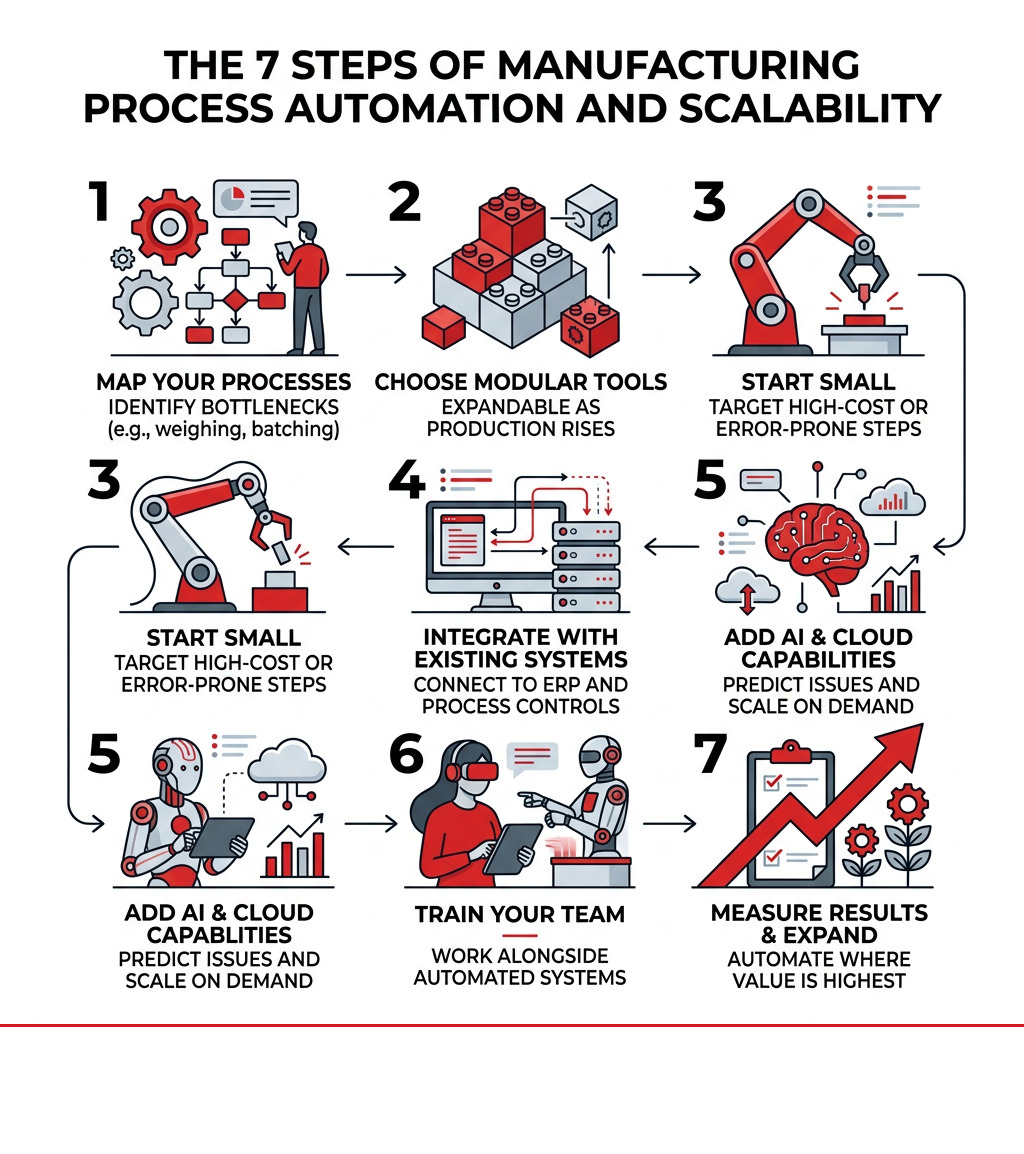
- Map your processes to find bottlenecks in weighing, batching, or material handling
- Choose modular tools that can expand as production volume increases
- Start small with your highest-cost or most error-prone steps
- Integrate with existing systems like ERP and process controls
- Add AI and cloud capabilities to handle errors, predict issues, and scale on demand
- Train your team to work alongside automated systems
- Measure results and expand automation where it delivers the most value
For process manufacturers, the pressure to do more with less is constant. Demand shifts. Ingredients change. Regulations tighten. And skilled labor is harder to find every year.
Manual weighing and batching systems that worked fine at lower volumes start to crack under pressure as you grow. Errors creep in. Quality becomes inconsistent. Costs climb.
Think of it like a rubber band. A good automation system stretches to meet demand without snapping. A rigid or outdated one breaks under the load.
The good news is that scalable automation is no longer reserved for large enterprises. Advances in modular hardware, cloud platforms, and AI-driven controls have made it practical and affordable for small and mid-sized process manufacturers too.
This guide walks through the 7 concrete steps to scale your manufacturing processes, what features to look for in a platform, and how companies like yours are making it work in the real world.
The Strategic Value of Scalable Automation Solutions
When we talk about scalability, we are talking about growth without limits. In the past, many manufacturers viewed automation as a “big company” luxury. You either did everything manually, or you spent millions on a rigid, custom-built line that was hard to change. Today, Scalable automation solutions offer a middle ground that provides immediate relief and long-term flexibility.
Flexibility and Resilience
The modern supply chain is a rollercoaster. One month you are dealing with a 20% spike in orders; the next, you are reformulating a product because a specific raw material is unavailable. Scalable systems allow you to adapt. Whether you are handling small batches of 20 units or ramping up to high-volume continuous production, the software and hardware should stay the same. This resilience ensures that when the market moves, you move with it.
Solving the Labor Shortage
It is no secret that finding skilled operators for material weighing and batching is getting harder. Automation does not just replace tasks; it fills the gaps left by labor shortages. By automating repetitive, heavy, or precision-dependent tasks, you allow your existing team to focus on higher-value work. This reduces worker fatigue and ensures that production continues 24/7 if needed, regardless of the local labor market.
Quality and Consistency
In industries like food, feed, and chemicals, precision is everything. A minor error in a micro-ingredient addition can ruin a whole batch. Scalable automation removes the “human element” of error from the most sensitive parts of your process. This leads to higher quality, reduced waste, and guaranteed regulatory compliance.
| Feature | Manual Production | Scalable Automated Systems |
|---|---|---|
| Growth Capacity | Requires hiring more staff | Scales instantly via software/hardware modules |
| Error Rate | High (Human fatigue/distraction) | Low (Precision sensors and AI error handling) |
| Consistency | Varies by operator | Identical results every time |
| Cost Structure | High variable costs (Labor) | Higher initial investment, lower long-term TCO |
| Data Tracking | Manual logs (Prone to loss) | Real-time digital trails and ERP integration |
For a deeper look at how these systems are built, explore our Controls and Automation Solutions.
The 7 Steps to Manufacturing Process Scalability
Scaling your facility is not about buying the biggest machine available today. It is about building a foundation that supports where you want to be in five years.
1. Process Mapping
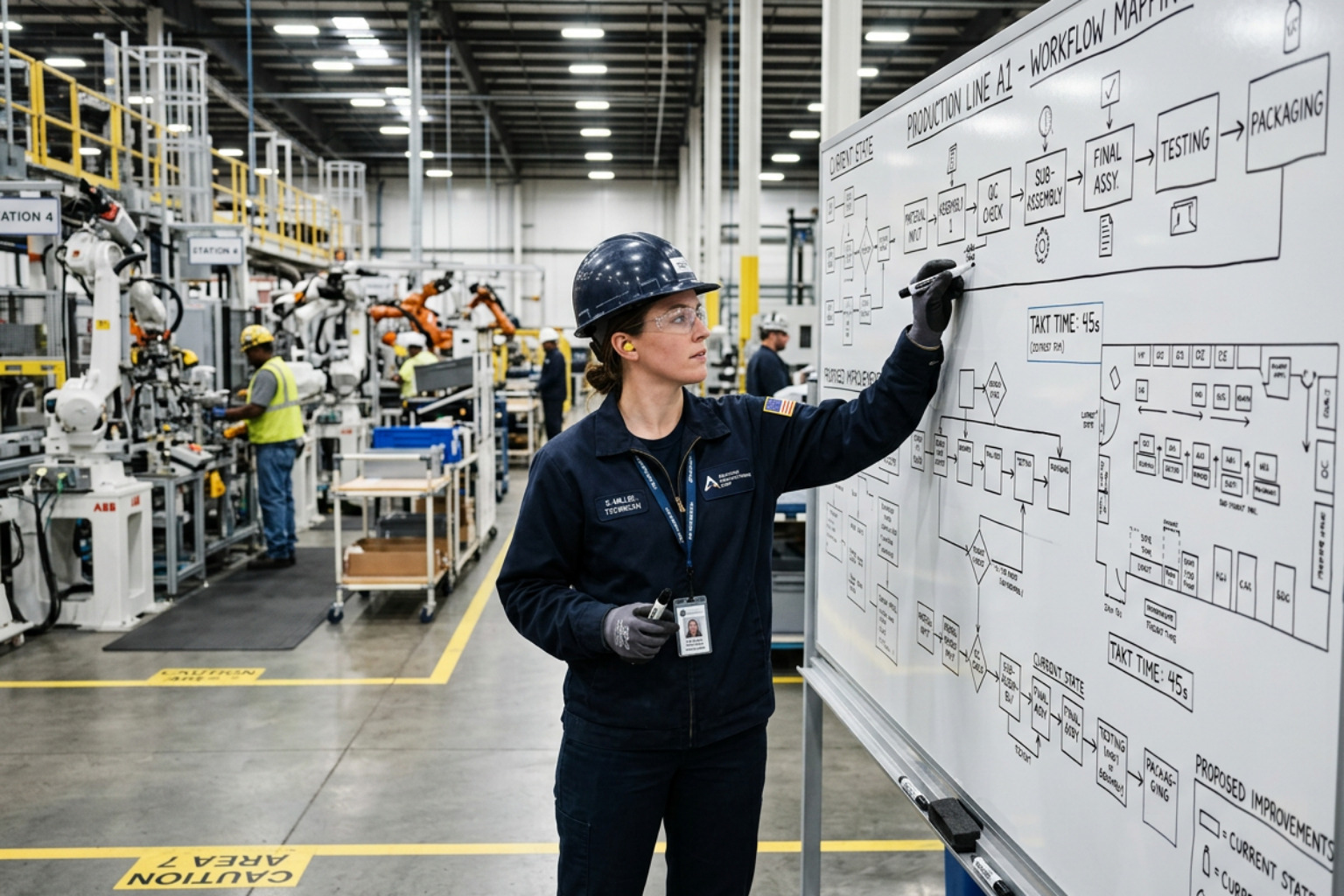
Before you touch a single piece of hardware, we must look at the “as-is” state. Where are the bottlenecks? Usually, they appear in material handling, weighing, or data entry. We look for the “choke points” where production slows down or where the most errors occur. Mapping these workflows allows us to target the most cost-intensive steps first.
2. Tool Selection
The key to scalability is modularity. You want “off-the-shelf” technologies that can be customized to your needs without being “one-off” inventions that no one can fix later. This includes choosing platforms that support multi-tenant SaaS or modular PLC (Programmable Logic Controller) configurations.
3. Pilot Programs (Starting Small)
You do not have to automate the entire plant on day one. Incremental implementation is often the smartest path for SMEs. Start with a single batching station or a specific weighing line. This allows you to prove ROI and get the “bugs” out before expanding. If you are updating an old system, consider an Automation Migration to modernize your existing assets step-by-step.
4. Team Training
Your people are your greatest asset. As you introduce Scalable automation solutions, involve the team early. When operators understand how the system makes their jobs easier—by handling heavy lifting or tedious data entry—they become champions of the new technology.
5. ERP Integration
Automation should not live on an island. To truly scale, your floor-level controls must talk to your business-level software. Integrating Process Control with ERP allows for real-time inventory updates, automated job ordering, and accurate demand forecasting.
6. AI Optimization
Once the data is flowing, AI can take over the heavy lifting of optimization. This includes handling 95% of runtime errors automatically and using predictive maintenance to fix a motor before it fails.
7. ROI Measurement
Finally, measure everything. Are you saving 150,000 working hours like some major enterprises? Or perhaps you’ve seen an 11% YoY growth by reducing waste? Continuous measurement tells you where to invest next.
Essential Features of Scalable Automation Platforms
What makes a platform “scalable” versus just “automated”? It comes down to the architecture.
Modular Setup
A modular system is like building with LEGO bricks. If you need more capacity, you add a module. If you change your product line, you swap a module. This prevents the “rip and replace” cycle that kills profitability.
User-Friendly Design
If only the IT department can run the automation, it isn’t truly scalable. Look for platforms with “no-code” or “low-code” interfaces. This empowers every team—from finance to the shop floor—to use the data and adjust the workflows.
Integration Capability
A scalable platform must have a library of prebuilt connectors. Whether you are connecting to a new scale, a different ERP, or a cloud-based analytics tool, the “handshake” between systems should be seamless. This is the heart of What is Industry 4.0?—a connected, intelligent ecosystem.
For those looking for a Complete cloud-based enterprise automation solution | UiPath offers a robust starting point for digital workflows that mirror physical processes.
Leveraging AI for Scalable Automation Solutions
Artificial Intelligence is the “brain” that allows automation to scale. In the past, if a sensor misread a batch, the whole line stopped. Today, AI-driven runtimes can handle errors automatically, ensuring 24/7 uptime.
- Predictive Maintenance: AI analyzes vibration and heat data from motors and scales to predict failures.
- Reusable Intelligence: Using templates and prebuilt logic to automate 70% faster.
- Data Interconnectivity: Moving data from the process floor to the cloud for Data Interconnectivity and Predictive AI insights.
Platforms like the Enterprise Integration Platform & Automation Software | Celigo demonstrate how AI can unify these fragile workflows into a single, resilient system.
Cloud Infrastructure for Scalable Automation Solutions
The cloud is the “infinite engine” behind modern scalability. By using a multi-tenant SaaS (Software as a Service) model, you can scale from one user to thousands instantly.
- Remote Access: Monitor your plant in Sterling, Illinois, from a laptop in Canada.
- Lower TCO: Reduce Total Cost of Ownership by eliminating the need for massive on-site server rooms.
- Security: Benefit from enterprise-grade security (SOC 2, ISO 27001) that small businesses could never afford on their own.
Cloud-based Plantwide Automation Systems provide a unified view of your entire operation, ensuring data residency and compliance across regions.
Industry Applications and Success Stories
Scalable automation solutions are transforming diverse sectors by making high-tech efficiency accessible to everyone.
Food and Feed Industry
In the food industry, batch sizes can vary wildly. A manufacturer might need to run a small test batch of a new recipe followed by a massive production run of a flagship product. Scalable weighing systems allow for this “pick-up” technology, where automated spindles or robotic loaders handle different volumes with the same precision.
E-commerce and Warehouse Spikes
We have seen e-commerce platforms handle massive order spikes during peak seasons by using cloud-based inventory updates. When the physical automation (conveyors and sorters) is tied to the digital automation (order processing), the “rubber band” stretches to meet the holiday rush without snapping.
Small-Scale Manufacturing Success
One electrical equipment manufacturer with only five employees managed to grow over 11% YoY by implementing low-cost, step-by-step optimization. They didn’t buy a million-dollar robot; they automated their most time-consuming assembly steps and integrated their Automation Software Applications with their job management system.
Massive Time Savings
A database company recently reported saving over 150,000 working hours and generating $1.5 million in cost savings through targeted automation. This shows that whether you are moving physical materials or digital data, the principles of scalability remain the same.
Frequently Asked Questions about Scalable Automation
What does scalable automation really mean?
It means automation that can grow or shrink based on your business needs. Like a rubber band, it stretches to handle more orders or more complex recipes without breaking or requiring a total system redesign.
Why is scalability essential for business growth?
Without scalability, growth becomes painful. You end up “throwing bodies” at a problem, which increases costs and errors. Scalable systems allow you to increase output while keeping your overhead stable.
How can small manufacturers afford automation?
The “all-or-nothing” days are over. Small manufacturers can use off-the-shelf, modular solutions and implement them incrementally. By automating the most expensive or error-prone steps first, the system often pays for itself, providing the capital for the next phase of growth.
Conclusion
The future of manufacturing belongs to the agile. Whether you are operating in the United States or Canada, the ability to scale your production quickly is a massive strategic advantage. Scalable automation solutions are no longer a “future” technology—they are the standard for any business that wants to remain competitive in an era of labor shortages and fluctuating demand.
At Sterling Systems & Controls, we specialize in providing these single-source, custom-engineered solutions. We don’t just sell machines; we provide the expertise to integrate your diverse process equipment into a unified, scalable whole. From material weighing to complex batching and process control, we help you build a system that is ready for today and prepared for tomorrow.
Ready to take the first step toward a more flexible facility? Explore More info about batching and weighing services to see how we can tailor a solution to your specific objectives.
