
Bulk Bag Filling Systems: Your Guide to Efficient Operations
Why Bulk Bag Filling Matters for Your Operation
Bulk bag filling is the process of packaging dry bulk materials like powders and granules into large Flexible Intermediate Bulk Containers (FIBCs), also known as super sacks, which hold 500 to 4,400 pounds of product.
Manual bag filling often creates dust, leads to inconsistent weights, and puts workers at risk. A single spill can mean lost product and significant downtime.
Modern bulk bag filling systems solve these problems through automation. They deliver consistent package weights, contain dust, and reduce physical strain on your team. Whether you’re filling 10 bags per day or 60 bags per hour, there’s a system configuration that fits your needs.
Automated systems can handle materials from free-flowing granules to difficult powders, achieving high filling rates with excellent accuracy. This guide covers how these systems work, the types available, and how to choose the right one for your production goals to improve cost savings and operational efficiency.
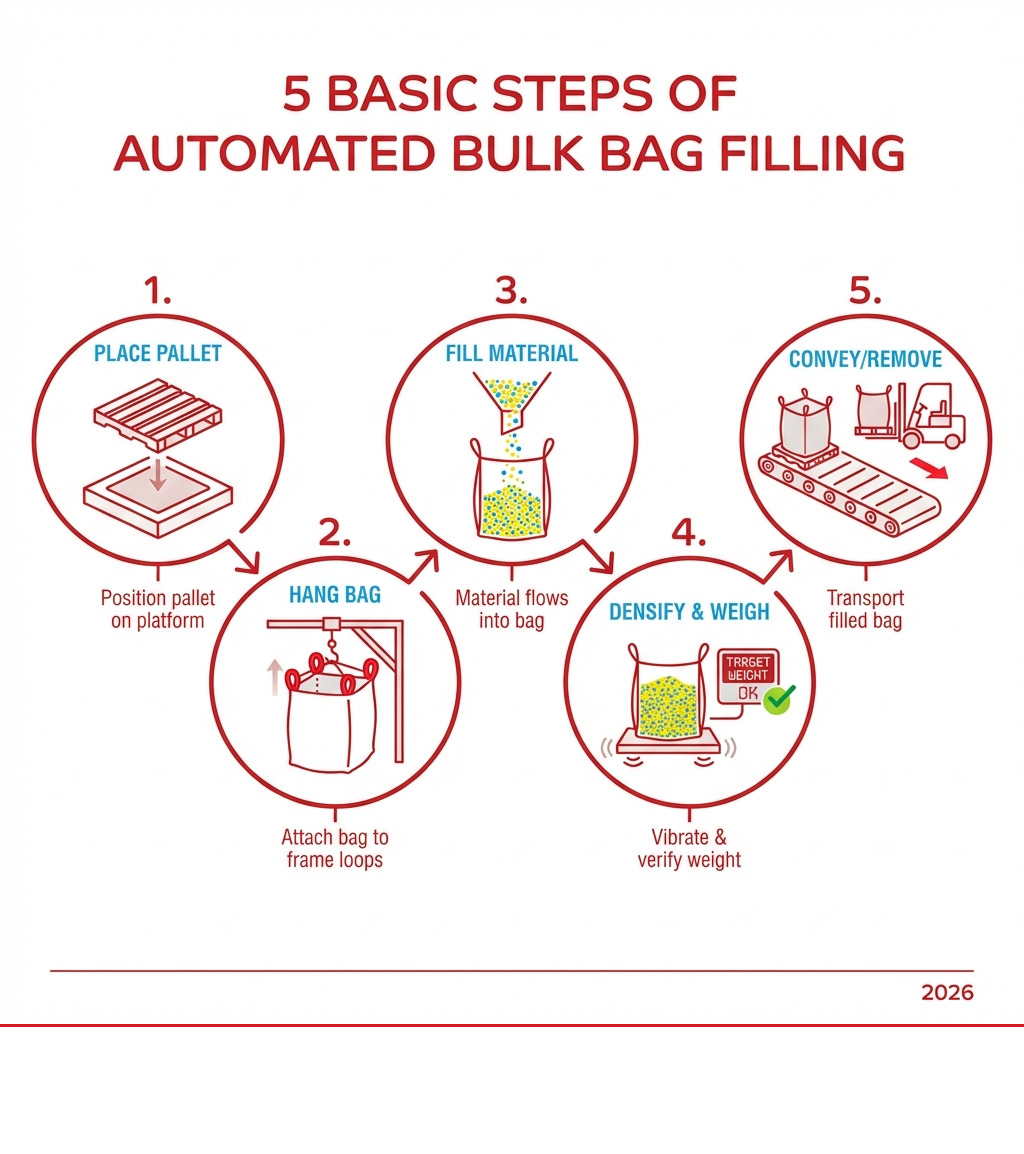
What is a Bulk Bag Filling System and How Does It Work?
A bulk bag filling system is specialized equipment designed to safely package dry bulk solids into FIBCs. These systems handle a wide range of materials, from fine powders to coarse granules, ensuring precise, contained filling.
The process typically involves these key steps:
- Bag Preparation: An operator hangs an empty bag by its loops onto a support frame.
- Material Feeding: Material is fed from an upstream source, like a hopper, into the system’s fillhead.
- Filling and Weighing: The material flows into the suspended bag. An integral weigh scale system monitors the weight to achieve a precise target.
- Densification: A vibrating table settles the material, removing air to create a stable, square-shaped bag.
- Dust Control: Features like inflatable neck seals and dust collection ports contain airborne particles, ensuring a clean work environment.
- Bag Removal: Once filled, the bag is released and removed by a forklift or conveyor.
Our custom-engineered solutions are designed to integrate seamlessly into your existing operations for optimal performance.
The Filling Process, Accuracy, and Dust Containment
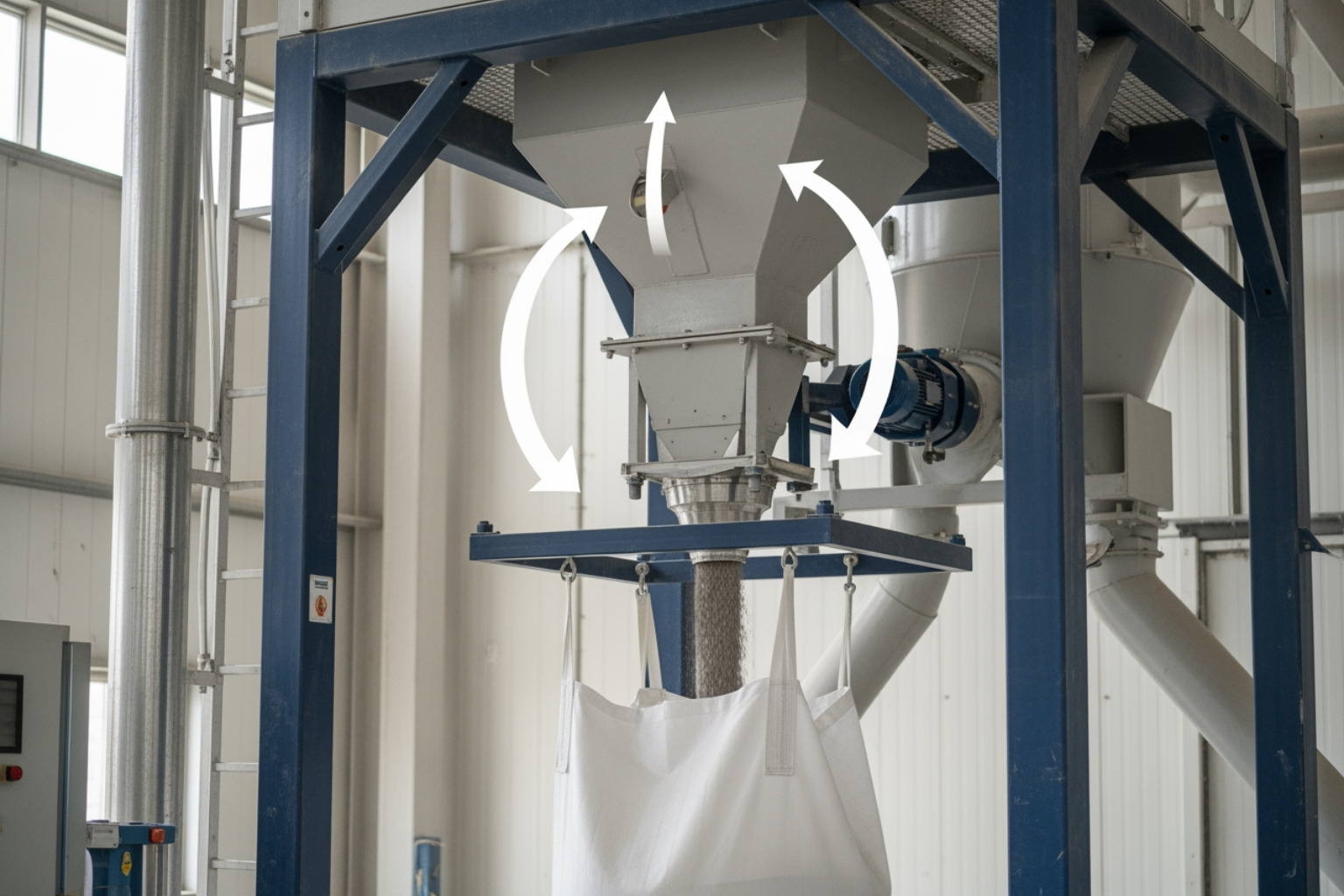
The core of a bulk bag filling operation is transferring material efficiently while maintaining control. Most modern systems are weigh-based, using load cells to monitor the weight and stop the flow at a precise target. Before filling, a blower may inflate the bag to prevent wrinkles and ensure stability. During filling, a vibrating table compacts the material, maximizing fill volume and creating a stable, stackable bag.
Accuracy and dust containment are critical for product integrity and operator safety. Our custom weigh scale systems are designed to achieve an NTEP-certified weigh accuracy of +/- 0.05% of the target bag weight. This precision eliminates material waste from over or under-filled bags.
Key features for containment and accuracy include:
- Weigh Scale Systems: Highly sensitive load cells integrated into the filler’s framework provide real-time weight monitoring.
- Inflatable Fillhead Bladder: Creates a dust-tight seal around the bag’s inlet spout, preventing product leakage and dust escape.
- Dust Collection Port: Connects to a central dust collection system, actively drawing fine particulates from the filling area to ensure a clean workspace.
These features work together to provide precise weight control and maintain a clean, safe working environment. For a deeper dive, you can find More info about how to fill bulk bags.
Types of Bulk Bag Filling Systems
Bulk bag filling systems range from simple manual setups to fully automated lines, classified by their level of automation and material handling method.
- Stand-Alone Fillers: Economical, gravity-fed systems for straightforward filling operations.
- Conveyor Fillers: Versatile systems that use conveyors to move product horizontally or vertically, ideal for facilities without overhead material supply.
- Pneumatic Systems: Robust systems for large-scale operations, using vacuum or pressure to transport materials over long distances.
- Manual, Semi-Automatic, and Fully Automated: The level of automation is a key differentiator, impacting speed, labor, and cost.
This table compares the different levels of automation:
| Feature | Manual Methods | Semi-Automatic Systems | Fully Automated Systems |
|---|---|---|---|
| Speed | Very Low (<5 bags/hour) | Low to Medium (10-20 bags/hour) | High to Very High (20-60+ bags/hour) |
| Labor | High (constant operator presence) | Medium (operator loads/unloads bags) | Low (minimal operator intervention) |
| Accuracy | Variable (prone to human error) | Good (integral weighing options) | Excellent (precise, automated weighing) |
| Cost | Very Low (initial equipment) | Medium (investment in equipment) | High (significant investment in machinery) |
| Dust | High (open filling, spills) | Low to Medium (inflatable seals, dust ports) | Very Low (closed systems, comprehensive dust control) |
| Safety | Low (manual handling, heavy lifting) | Medium (less manual handling) | High (reduced manual interaction, safety features) |
| Integration | Very Low | Moderate (can integrate with some equipment) | High (seamless integration with conveyors, palletizers) |
Manual and Semi-Automatic Fillers
For low to medium-volume operations or those with budget constraints, manual and semi-automatic systems offer a practical balance of human input and mechanical assistance.
Semi-automatic fillers significantly improve upon manual methods. An operator hangs the bag and starts the fill cycle, but the system manages the weighing and densification. Key features include adjustable support frames for different bag sizes, integral weighing for accuracy, and optional vibration for product compaction. Many are forklift-portable, adding flexibility to your plant layout. These systems are a cost-effective step towards more reliable bulk bag filling. More info about filling and packing stations for bulk bags.
Fully Automated Bulk Bag Filling Systems
For high throughput and accuracy with minimal labor, fully automated systems are the solution. They are designed for continuous, high-efficiency operation.
Hallmarks of our fully automated systems include:
- Minimal Operator Intervention: An operator’s role shifts to supervision, reducing labor costs and human error.
- High Throughput: These systems are built for speed, with capabilities ranging from 20 to over 60 bags per hour to meet demanding production schedules.
- Integrated Automation: Features like automatic pallet dispensers, robotic bag placement, and integrated conveyors create a seamless, hands-free packaging line from start to finish.
- Continuous Operation: Designed for reliability, these systems run for extended periods with consistent performance, maximizing uptime.
Our automated solutions integrate construction and controls to improve performance and reduce the total cost of ownership.
How to Choose the Right Bulk Bag Filling System
Selecting the ideal bulk bag filling system requires a thorough assessment of your specific needs. The right choice impacts efficiency, product quality, and your bottom line. A custom solution is often necessary to align with your objectives.
Key Factors for Your Application
To select the best system, we carefully evaluate several key factors:
- Material Characteristics: The most important factor. Is your product a free-flowing granule, a dense powder, or a fluffy material? Its properties (flow characteristics, bulk density, abrasiveness) will determine the design of the feeder, fillhead, and densification method.
- Throughput and Accuracy: How many bags do you need to fill per hour, and what level of weight precision is required? This dictates the necessary level of automation and the type of weighing system (e.g., NTEP-certified for high accuracy).
- Bag Specifications: The system must accommodate your specific bag sizes, types, and capacity (up to 4,400 lbs).
- Facility and Environment: Consider your available headroom and floor space. If you handle combustible dust, an ATEX-compliant design is critical for safety.
Customizing Your Bulk Bag Filling Solution
At Sterling Systems & Controls, we provide custom-engineered solutions to match your unique operational demands. Customization ensures optimal performance, efficiency, and safety.
Key areas for customization include:
- Adjustable Fill Heights: To accommodate various bag sizes, systems can feature manual or powered mast height adjustments.
- Bag Hanging Mechanisms: Options range from simple manual hangers to auto-releasing hangers that speed up bag changeout cycles.
- Compaction Methods: We integrate the right method for your product, whether it’s vibration, tamping, or vacuum de-aeration.
- Downstream Handling: We design for your process, whether it involves forklift removal or fully integrated conveying to palletizers and wrappers.
- Integration with Existing Equipment: Our solutions are designed to integrate seamlessly with your upstream and downstream equipment for a cohesive operation.
This level of customization ensures your system is an optimized component of your overall production process. For more information, explore
Core Components and Features
A robust bulk bag filling system integrates several key components to ensure accuracy, efficiency, and safety.
Primary components include:
- Support Framework: The structural backbone, available in cantilevered designs for forklift access or four-post designs for maximum stability.
- Fill Head: The interface where material enters the bag, designed for controlled flow and dust containment.
- Bag Loop Hangers: Mechanisms (manual or automatic) that suspend the bag securely during filling.
- Weigh Scale System: Uses load cells to measure product weight. Common types include hang-weigh systems (bag suspended from load cells) and base-weigh systems (bag rests on a scale platform).
- Densification Base: A vibrating platform that settles material to maximize fill volume and create a stable, square bag.
- Control Panel: The system’s brain for setting parameters and monitoring the process.
The Fill Head and Spout Interface
The fill head is critical for managing material flow and dust. Key features include:
- Inflatable Seal: Creates a dust-tight seal around the bag’s inlet spout, preventing leakage and protecting the work environment.
- Bag Inflation Blower: Pre-inflates the empty bag to remove wrinkles and ensure it fills to capacity.
- Dust Collection: An integrated port connects to a dust collection system, removing airborne particles from the filling zone.
- Flow Control Valve: Precisely regulates material flow for accurate dosing.
For more information, explore our More info about bulk bag filling systems.
Weighing and Densification
Effective weighing and densification are essential for accuracy and efficiency.
Weighing Systems: Our weigh scale systems are engineered to achieve NTEP-certified accuracy of +/- 0.05% of the target bag weight, minimizing product giveaway. This is achieved using advanced load cells that provide real-time weight measurement.
Densification: This process settles material to create a compact, stable bag. Our systems typically use a high-speed vibrating base to remove trapped air. This improves bag stability for easier handling and stacking, maximizes fill volume, and reduces product waste.
Together, these technologies ensure our bulk bag filling systems deliver both accuracy and efficiency.
Benefits of Automated Systems: From Cost Savings to Safety
Shifting from manual to automated bulk bag filling provides comprehensive improvements in efficiency, financial performance, and workplace safety.
Key benefits of our automated solutions include:
- Increased Productivity: Continuous, high-speed operation (20-60+ bags/hour) boosts production capacity and reduces downtime.
- Reduced Labor Costs: Automation minimizes operator intervention, allowing you to reallocate personnel to more critical tasks.
- Minimized Material Waste: Precision weighing (+/- 0.05% accuracy) eliminates overfilling, while dust containment prevents product loss.
- Improved Workplace Safety: Automation reduces ergonomic risks from manual handling. Features like dust containment and safety interlocks protect personnel.
- Consistent Package Quality: Uniform filling and densification result in stable, square bags that are easier to stack and transport.
- Improved Operational Data: Integrated controls provide valuable data on fill rates, accuracy, and uptime for process optimization.
Industries and Applications
Bulk bag filling systems are vital across many industries, including:
- Food & Beverage: Flour, sugar, spices, coffee, grains
- Animal Feed: Pet food kibble, feed supplements, corn, soy
- Chemicals: Plastic pellets, resins, pigments, fertilizers, carbon black
- Minerals & Mining: Cement, sand, clay, fly ash, iron oxide
- Pharmaceuticals: APIs, vitamin blends, protein powders
- Agriculture: Seeds, fertilizers, potting soil
Our systems are engineered to meet the specific demands of these industries, ensuring reliable packaging.
System Integration and Safety
Modern bulk bag filling systems realize their full potential through seamless integration and a commitment to safety.
System Integration: We design our systems to be integral parts of a cohesive production line, integrating with upstream equipment like mixers and downstream equipment like conveyors, pallet dispensers, and robotic palletizers.
Safety: Safety is paramount. Our systems incorporate numerous features to protect operators, including emergency stops, grounding clamps for static control, safety interlocks, comprehensive dust containment, and ergonomic designs to reduce operator strain.
By integrating these features, our systems improve productivity while maintaining the highest safety standards. For more on the complete lifecycle of bulk bag handling.
Conclusion: Optimizing Your Process with the Right Partner
In modern material handling, efficient and accurate bulk bag filling is essential for profitability, safety, and quality. The right automated system transforms operations by delivering efficiency through high throughput, accuracy via precision weighing, and safety through dust containment and ergonomic design.
Choosing the right solution requires careful consideration of your product, production rates, and facility. It’s about finding a system that is custom-engineered for your specific objectives.
At Sterling Systems & Controls, we are that partner. We specialize in custom-engineered automated solutions for material weighing, batching, and process control. We offer single-source, experienced solutions that integrate diverse process equipment to meet your exact needs. From our locations in Sterling, Illinois, and across the United States and Canada, we are dedicated to helping you achieve superior efficiency and control in your bulk material handling operations.
Let us help you design a system that optimizes your process, reduces costs, and lifts your production standards. Learn more about our comprehensive Bulk Bag Handling Systems.
Last updated on April 1st, 2026 at 11:30 am