
Mastering Material Flow with Bulk Bag Dispensers
Why Efficient Bulk Material Handling Matters
A bulk bag dispenser is a material handling device that allows operators to safely and efficiently unload contents from large flexible intermediate bulk containers (FIBCs) or bulk bags. These systems range from simple portable units that attach directly to a bag’s outlet spout to complex stationary frames with hoists, dust collection, and automated controls.
Quick Overview: Bulk Bag Dispenser Basics
- What it does: Controls the flow of material from bulk bags (also called super sacks or FIBCs) into your process
- How it works: Connects to the bag’s discharge spout using a valve, slide gate, or clamp system to meter material flow
- Key benefit: Eliminates manual cutting and dumping of bags, reducing dust, spills, and worker strain
- Common types: Portable dispensers for occasional use, stationary frames for high-volume industrial operations
- Typical materials: Powders, granules, pellets, seeds, fertilizer, salt, plastic resins, food ingredients, chemicals
If you’re managing production in a food, chemical, or manufacturing facility, you’ve likely dealt with the challenges of emptying bulk bags. Manual methods create dust clouds, waste material, and put unnecessary strain on your operators. As one plant manager at GOYA Foods noted after implementing automated bulk bag handling: “We package more than a billion packets a year now, and we’re much more comfortable.”
The reality is simple: without proper dispensing equipment, material will be spilled, dust will escape, and cleanup becomes a constant burden. The goal isn’t perfection—it’s minimization. A well-designed bulk bag dispenser transforms a messy, labor-intensive task into a controlled, repeatable process that protects both your workers and your bottom line.
Whether you’re handling 500-pound bags occasionally on a farm or processing multiple tons per hour in a pharmaceutical plant, the right dispensing solution makes all the difference in safety, efficiency, and material recovery.
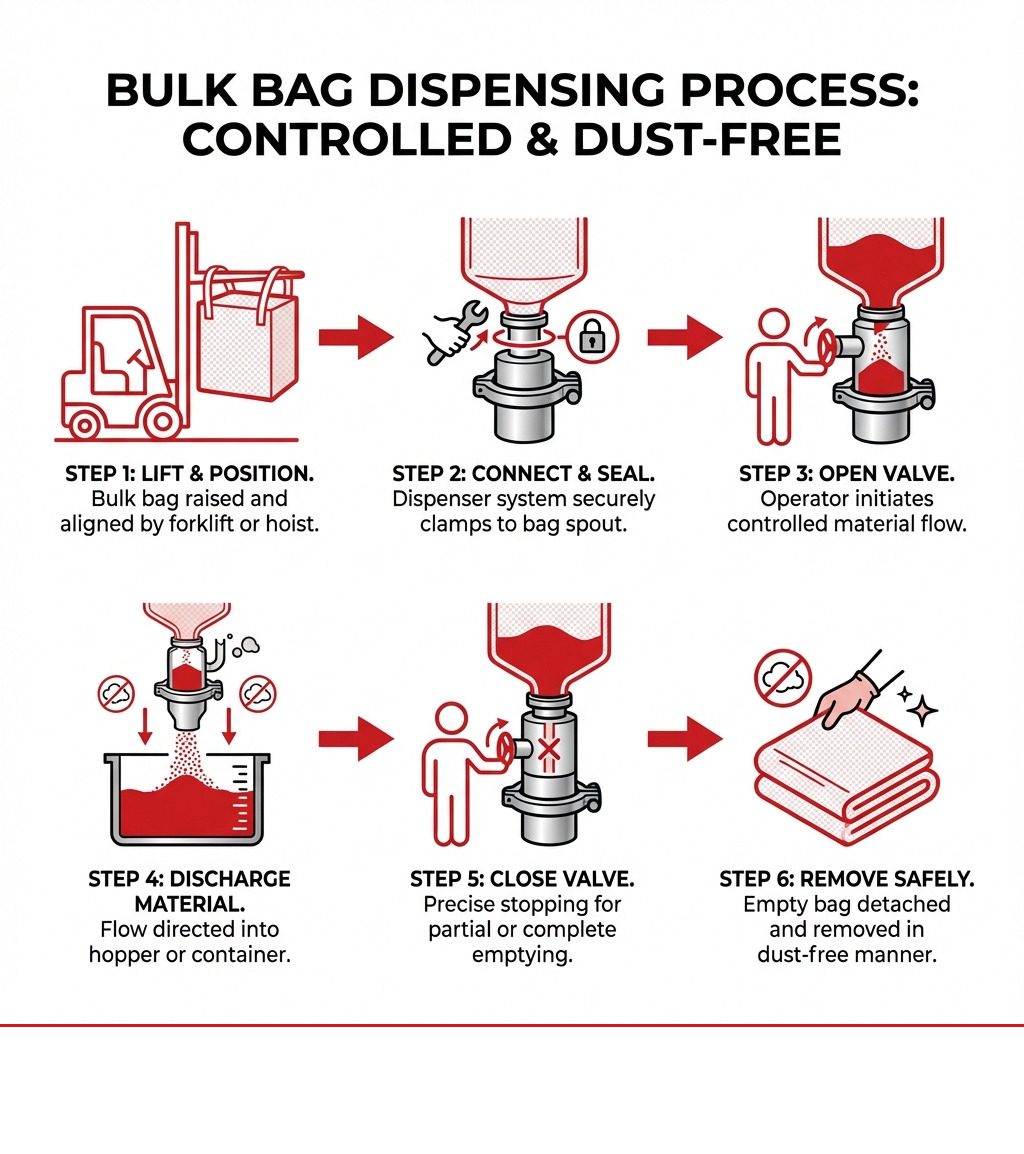
What is a Bulk Bag Dispenser and How Does It Work?
A bulk bag dispenser is essentially a gateway that controls the flow of dry bulk solids from a large FIBC into your process or a smaller container. Imagine trying to pour a 2,000-pound bag of flour into a mixing tank without making a huge mess or wasting valuable product. That’s where a bulk bag dispenser comes in. It’s designed to manage the material flow, ensuring controlled discharge, reducing waste, and significantly improving safety for your operators.
These devices are crucial for any operation that relies on bulk bags for transporting and temporarily storing dry bulk solid materials. Bulk bags, also known as super sacks or jumbo bags, are typically constructed of poly woven material with capacities ranging from 500 to 3,000 pounds, or even up to 4,000 pounds. While they are incredibly efficient for storage and transport, getting the material out of them safely and effectively requires specialized equipment. Our bulk bag dispensers provide that solution, changing a potentially chaotic task into a seamless part of your material handling process.
| Metric | Manual Unloading | Using a Bulk Bag Dispenser |
|---|---|---|
| Speed | Slow, labor-intensive, inconsistent | Fast, controlled, repeatable, automated options available |
| Safety | High risk of dust exposure, spills, manual lifting | Significantly reduced dust, spills, and operator strain |
| Material Waste | High, due to uncontrolled flow and spillage | Minimal, precise dosing and complete bag evacuation |
| Labor Cost | High, requires significant operator intervention | Lower, automated systems reduce manual labor |
| Cleanliness | Poor, dusty environment, frequent cleanup required | Excellent, dust containment and spill prevention |
| Precision | Very low, difficult to accurately measure | High, accurate dosing and batching possible |
The Basic Mechanism
At its core, a bulk bag dispenser works by providing a controlled opening for the material to exit the bulk bag. Most bulk bags come with a discharge spout at the bottom. The dispenser connects securely to this spout, creating a sealed interface. Once connected, a valve system within the dispenser, often a slide gate or an iris valve, is opened to allow the material to flow out under gravity.
For materials that flow freely, simply opening the valve will initiate discharge. However, the true magic lies in the ability to control this flow. Our dispensers are designed for precise metering, allowing you to dispense exactly the amount of material you need. This precision means you can partially empty a bag and then reseal it securely, preserving any remaining material for future use without contamination or spillage. This is a significant advantage over simply cutting open a bag, which often leads to waste and product degradation.
The design features often include:
- Secure Spout Connection: A mechanism to firmly attach the dispenser to the bag’s discharge spout, ensuring a dust-tight seal.
- Valve Systems: These can be simple slide gates for on/off control or more sophisticated iris valves that allow for variable flow rates. Some systems feature pneumatically-actuated flow control valves that cinch the spout concentrically for easy tie-offs and leak prevention.
- Metering Capabilities: The ability to open and close the valve to dispense specific quantities, which is crucial for batching operations.
- Partial Dispensing and Resealing: A key benefit, enabling operators to stop the flow mid-bag and secure the remaining contents. This protects product integrity and reduces waste.
Common Applications and Materials
The versatility of bulk bag dispensers makes them indispensable across a wide range of industries in the United States and Canada. From agricultural operations to heavy industrial processing, these devices handle diverse materials with ease.
- Agriculture: Farmers use bulk bag dispensers for accurately metering seeds, fertilizers, animal feed, and other agricultural products. This ensures consistent application and reduces manual labor.
- Construction: In construction, they facilitate the controlled dispensing of materials like gravel, sand, cement, and aggregates, helping to manage inventory and reduce waste on job sites.
- Food Processing: For food manufacturers, hygiene and precision are paramount. Dispensers handle ingredients such as flours, sugars, spices, and various food additives, ensuring sanitary conditions and accurate batching.
- Pharmaceuticals: The pharmaceutical industry relies on bulk bag dispensers for handling active pharmaceutical ingredients (APIs) and excipients, where precise dosing and dust containment are critical for product quality and safety.
- Chemicals: Chemical plants use them for dispensing powders, granules, and plastic pellets, often dealing with hazardous or corrosive materials where sealed systems are essential for worker protection.
Whether it’s ensuring the consistent flow of plastic pellets in a manufacturing plant or precisely measuring fertilizer for a field, our bulk bag dispensers are engineered to meet the demands of your specific application.
View Video of a Sterling Systems & Controls dispenser in action
Types of Bulk Bag Unloading Systems
When considering a bulk bag dispenser, it’s important to understand that there isn’t a one-size-fits-all solution. The optimal system design depends heavily on your application needs, the specific material properties you’re handling, your required throughput, and your facility’s layout. We specialize in custom-engineered solutions, ensuring you get the perfect fit for your operations.
Portable Bulk Bag Dispenser Models
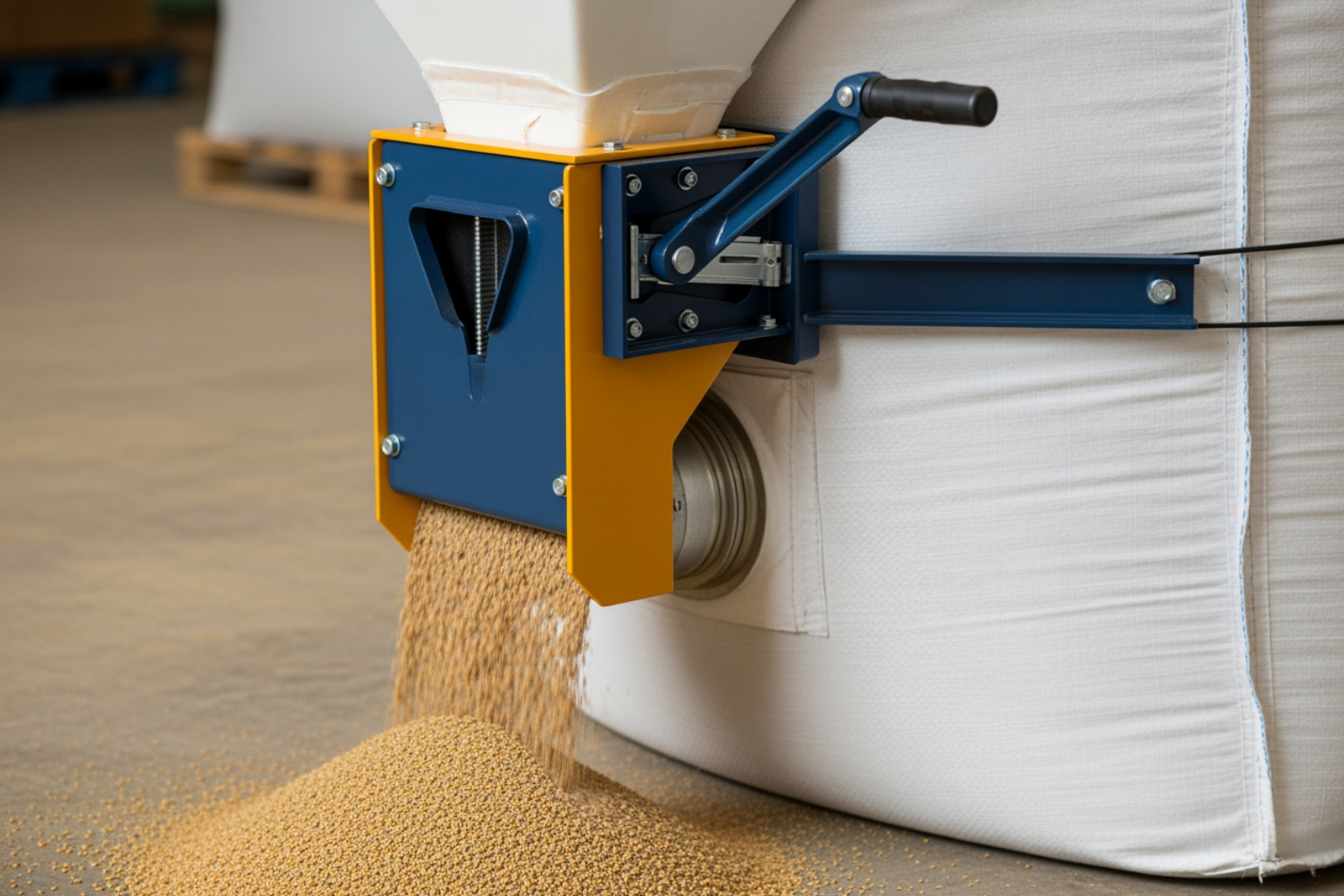
For smaller operations, occasional use, or situations requiring flexibility, portable bulk bag dispenser models offer an excellent solution. These devices are designed for ease of use and direct attachment to the bottom of a bulk bag. They typically feature a robust, often reinforced, tip that penetrates the bag fabric, followed by an internal valve or slide gate to control material flow.
While offering lower throughput compared to larger stationary systems, their portability makes them ideal for tasks such as dispensing animal feed or fertilizer on farms, or managing materials like gravel and sand on construction sites. Many portable units are designed with ergonomic handles, making them user-friendly and reducing physical strain during operation. They are a significant upgrade from manual cutting, providing controlled dispensing and the ability to partially empty and reseal bags.
Stationary Bulk Bag Unloader Frames
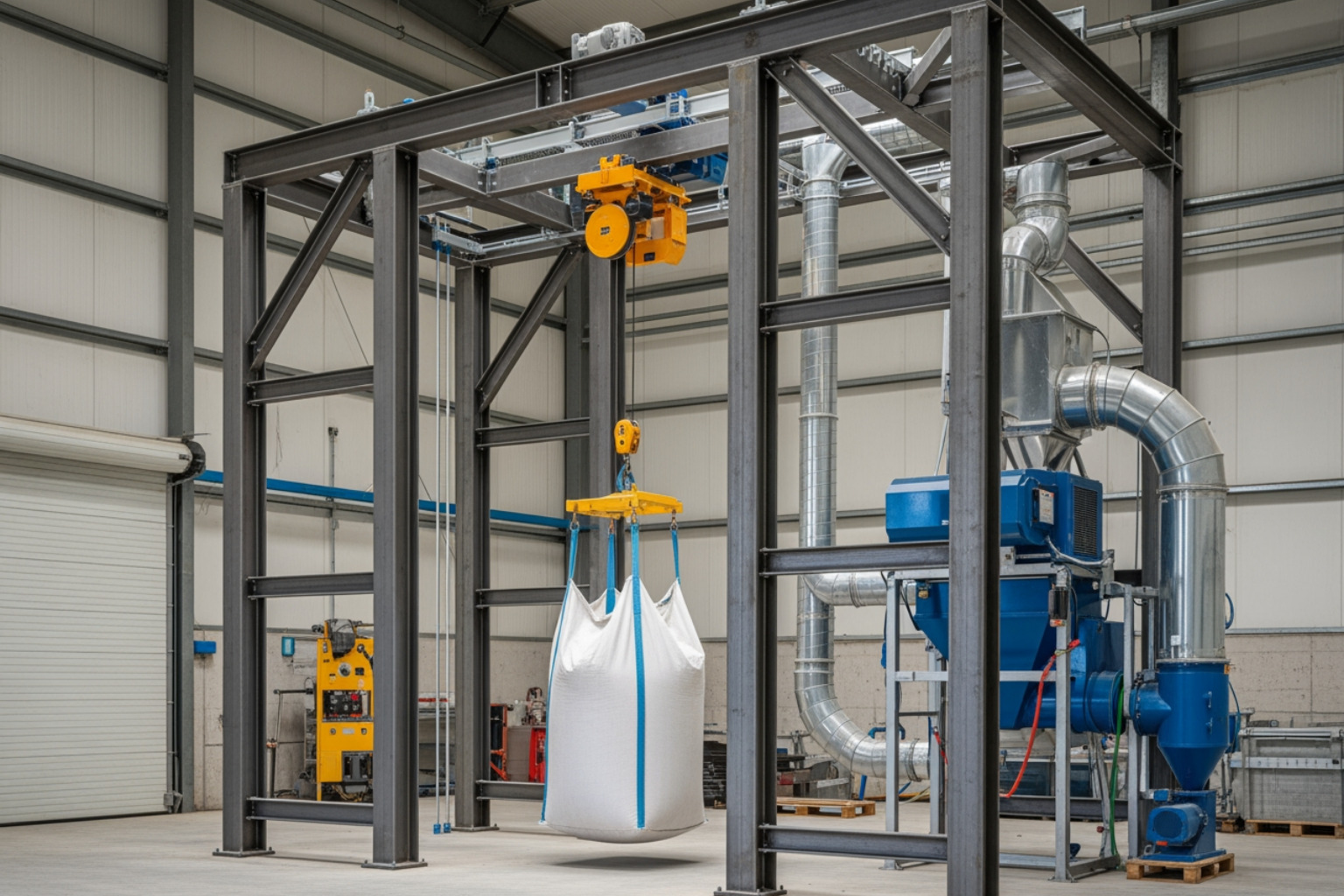
For high-volume processing and integrated industrial applications, stationary bulk bag unloader frames are the workhorses of material handling. These robust systems are designed for continuous or high-frequency use, seamlessly integrating into your production line. They consist of a sturdy frame that supports the bulk bag while it is being emptied, often incorporating advanced features for dust control, flow promotion, and automation.
There are typically two main ways to load a bulk bag onto a stationary unloader:
- Forklift Loaded Models: These systems feature a bag lifting frame that allows a forklift to position the bulk bag onto the unloader. An operator then connects the bag spout to the dispenser.
- Hoist and Trolley Models: For facilities without forklifts or where precise positioning is required, these unloaders come equipped with an overhead hoist and trolley system. An operator uses the hoist to lift the bulk bag by its loops, maneuvers it into position over the unloader, and then lowers it onto the dispensing mechanism. These often feature a 2-Ton hoist and motorized trolley, with capacities up to 4,000 lbs.
Our stationary unloaders are built with integrated safety features, such as interlocks and safety latches, and can be equipped with sophisticated dust collection systems to maintain a clean and safe working environment. They are engineered for durability, often using structural steel and tubular steel for a strong, rigid framework capable of handling bulk bags weighing up to 4,000 lbs.
Systems with Advanced Flow Aids
Some materials, due to their physical properties, present challenges during discharge. Powders can compact, creating “bridging” or “rat-holing” effects where material forms an arch or a narrow channel, preventing consistent flow. For these difficult materials, we integrate advanced flow aids into our stationary bulk bag dispenser systems.
These flow aids are designed to agitate the material within the bag, ensuring a smooth and continuous discharge. Common flow aid technologies include:
- Bag Activators: These devices raise and lower opposite bottom edges of the bag at timed intervals to direct material into the outlet spout. As the bag empties, their stroke increases, creating a steep ‘V’ shape to promote total evacuation.
- Massage Paddles: Using pneumatically actuated paddles or arms, these systems gently compress the sides of the bulk bag to break up compacted material and encourage flow.
- Vibration Systems: Controlled vertical vibrations are applied to the bag or the unloader frame to dislodge material and promote consistent flow, especially for materials prone to densification.
- Bag Stretching Devices: These pull upward on the bag corners as it empties, stretching the bag into a steep cone shape. This helps to eliminate dead spots and ensures complete discharge, even for poor-flowing materials.
By incorporating these specialized features, our bulk bag dispenser systems can guarantee the discharge of virtually any material, no matter how challenging its flow characteristics. This ensures maximum product recovery and minimizes downtime caused by clogged bags.
Key Features and Benefits of a Bulk Bag Dispenser
Implementing a bulk bag dispenser system isn’t just about moving material; it’s about driving significant process improvement, achieving substantial cost savings, enhancing operator safety, and maintaining product integrity. We design our solutions with these critical benefits in mind.
Improved Safety and Dust Control
One of the most compelling reasons to invest in a quality bulk bag dispenser is the dramatic improvement in safety and dust control. Manual bag emptying often releases clouds of dust, which can be hazardous to operator health, contaminate the product, and create an explosion risk in certain environments. Our systems are engineered to mitigate these concerns:
- Dust Containment: Our dispensers create a sealed interface between the bulk bag and your process, preventing fugitive dust from escaping. This is achieved through features like secure clamp rings and sealed connections.
- Access Chambers: Many of our unloaders feature enclosed access chambers that provide a safe, contained area for operators to connect and disconnect bag spouts, minimizing exposure to airborne particles. These chambers are often designed with ample space for ease of operation.
- Dust Collection Ports: Integrated dust collection ports can be connected to a central vacuum system, actively removing any fine particles that might become airborne during the dispensing process. Some systems even include bag evacuation systems that collapse empty bags under negative pressure, eliminating dust release during manual flattening and tie-off.
- Reduced Operator Exposure: By containing dust and automating the discharge process, we significantly reduce the need for operators to be in close contact with bulk materials, leading to a cleaner, healthier, and safer work environment.
- Spill Prevention: The controlled discharge mechanism and sealed connections virtually eliminate spills, keeping your plant floor clean and reducing slip hazards.
Increased Efficiency and Precision
Beyond safety, a bulk bag dispenser dramatically boosts operational efficiency and precision, leading to tangible cost savings.
- Accurate Dosing: Our systems allow for precise metering of material, which is critical for batching operations in industries like food, chemicals, and pharmaceuticals. This ensures consistent product quality and reduces costly over-dosing.
- Reduced Material Waste: By controlling the flow and ensuring complete bag evacuation, bulk bag dispensers minimize residual material left in bags and prevent spillage, maximizing product recovery. This means less material sent to landfills and more product reaching your customers.
- Faster Batching: Automated dispensing systems can rapidly deliver precise amounts of material, accelerating batch cycle times and increasing overall production throughput. We’ve seen examples where automated weigh batching systems significantly increase output and end fatigue, making operators “much more comfortable.”
- Automated Handling: Integrating a bulk bag dispenser into an automated system reduces reliance on manual labor for repetitive, physically demanding tasks. This frees up your workforce for more value-added activities.
- Minimized Cleanup: With effective dust control and spill prevention, the need for frequent and extensive cleanup is drastically reduced, saving labor hours and operational costs.
Versatility and Durability
Our bulk bag dispenser solutions are built to last and adapt to diverse industrial needs.
- Corrosion-Resistant Materials: Depending on the application, we use materials like rugged carbon steel with industrial-grade finishes for durability, or corrosion-resistant stainless steel for applications requiring sanitary compliance (e.g., food and pharmaceutical) or resistance to harsh chemical environments. For certain components, robust composite materials may be used to offer stability against high loads and prevent corrosion.
- Handling Various Bag Sizes: Our systems are designed to accommodate a wide range of bulk bag dimensions and capacities, from 500 lbs to 4,000 lbs, ensuring flexibility for your sourcing needs.
- Adapting to Different Materials: From fine powders to coarse granules, and free-flowing to cohesive materials, our dispensers can be configured with the necessary flow aids and controls to handle almost any bulk solid.
- Longevity of Equipment: We build our equipment with superior workmanship and high-quality components, ensuring a long operational life and reliable performance in demanding industrial settings throughout the United States and Canada.
Frequently Asked Questions
We understand that investing in material handling equipment brings questions. Here are some of the most common inquiries we receive about bulk bag dispensers:
Can a bulk bag be partially emptied and resealed?
Absolutely! This is one of the primary advantages of our bulk bag dispenser systems. Most of our dispensers feature a valve or slide gate that allows operators to precisely control the flow of material. You can open it to dispense the desired amount, then close it securely, effectively resealing the bag. This preserves the remaining material for later use, preventing contamination, moisture absorption, and spillage. This capability is invaluable for applications where full bags are not always consumed in a single batch.
What happens if the material inside the bag is compacted?
Compacted or non-free-flowing materials are a common challenge in bulk material handling, leading to issues like bridging or rat-holing within the bag. For these challenging materials, our stationary bulk bag unloader systems can be equipped with a range of advanced flow aids. These include:
- Bag activators: These mechanically raise and lower the bottom edges of the bag to break up clumps and direct material towards the outlet.
- Massage paddles: Pneumatically actuated paddles gently massage the bag sides to loosen compacted material.
- Vibration systems: Controlled vibrations applied to the bag or the unloader frame help to fluidize and dislodge stubborn material.
These features ensure a consistent and complete discharge, preventing downtime and maximizing product recovery even with difficult materials.
How do you choose the right bulk bag dispenser for your needs?
Choosing the right bulk bag dispenser involves a careful assessment of several factors unique to your operation:
- Material Type: Is your material free-flowing, cohesive, abrasive, or prone to compaction? This will determine the need for specific flow aids and construction materials.
- Required Discharge Rate: Do you need a slow, metered flow for precise batching, or a high-volume, continuous discharge?
- Bag Type: Are you using single-use bags, or reusable bags with specific spout designs?
- Facility Constraints: Consider available headroom, floor space, and whether you have forklifts or require a hoist system for bag loading.
- Safety Requirements: Are dust containment, explosion protection, or sanitary designs critical for your process?
A simple portable dispenser is an excellent, cost-effective choice for occasional use, lower throughput, or mobile applications in agriculture or construction. For industrial, high-throughput processes, an integrated stationary unloader frame with automated controls, dust collection, and flow aids will provide superior efficiency, safety, and precision. We recommend consulting with our experienced engineers to discuss your specific process goals and material characteristics. Our team in Sterling, Illinois, and across the United States and Canada, can help you select or custom-design the ideal solution.
Achieving Optimal Material Flow with Custom Solutions
Selecting the right bulk bag dispenser for your operations is a critical decision that impacts efficiency, safety, and your bottom line. It’s not just about buying equipment; it’s about choosing a system that perfectly aligns with your process goals, desired throughput, material characteristics, and stringent safety standards.
At Sterling Systems & Controls, we pride ourselves on offering custom-engineered solutions for bulk material handling. We understand that every facility in the United States and Canada has unique challenges, and a “one-size-fits-all” approach rarely delivers optimal results. Our expertise lies in providing single-source, experienced solutions custom precisely to your objectives. We integrate diverse process equipment seamlessly, ensuring a cohesive and efficient system from start to finish.
We work directly with you to understand your specific needs, whether it’s for food, feed, chemicals, or other process industries. Our team of experienced engineers will help you steer the complexities of material flow, dust control, and automation, designing a bulk bag dispenser system that not only meets but exceeds your expectations.
Don’t settle for generic solutions when your production depends on precision and reliability. Let us help you master your material flow. Learn more about custom bulk bag unloading systems
Last updated on April 1st, 2026 at 11:30 am