
In-Depth Guide to Feed Mill Automation Solutions
Why Feed Mill Automation Matters for Modern Animal Feed Production
Feed mill automation transforms traditional animal feed manufacturing by replacing manual processes with integrated control systems that improve precision, efficiency, and safety. Modern automated systems handle everything from ingredient batching and mixing to pelleting and packaging with minimal human intervention.
Key automation solutions for feed mills include:
- Process Control Systems – Centralized PLCs and SCADA platforms that monitor and control all production stages
- Automated Batching – Precision weighing systems for micro and macro ingredients with accuracy to 0.1%
- Real-Time Monitoring – HMI interfaces that provide live production data and quality metrics
- Inventory Management – Automated tracking of raw materials and finished products
- Compliance Tools – Digital record-keeping for FSMA and FDA regulatory requirements
The animal feed industry faces mounting pressure to produce consistent, high-quality feed while managing costs and meeting strict safety standards. Manual operations introduce variability, slow down production, and increase the risk of costly errors in formulation.
Automation addresses these challenges head-on. Mills running automated systems report 20-30% increases in throughput, significant reductions in ingredient waste, and improved product consistency across every batch.
For feed mill operators managing multiple recipes, tight margins, and regulatory oversight, automation isn’t just about replacing labor. It’s about gaining precise control over your entire production process while building in the traceability and documentation that regulators and customers demand.
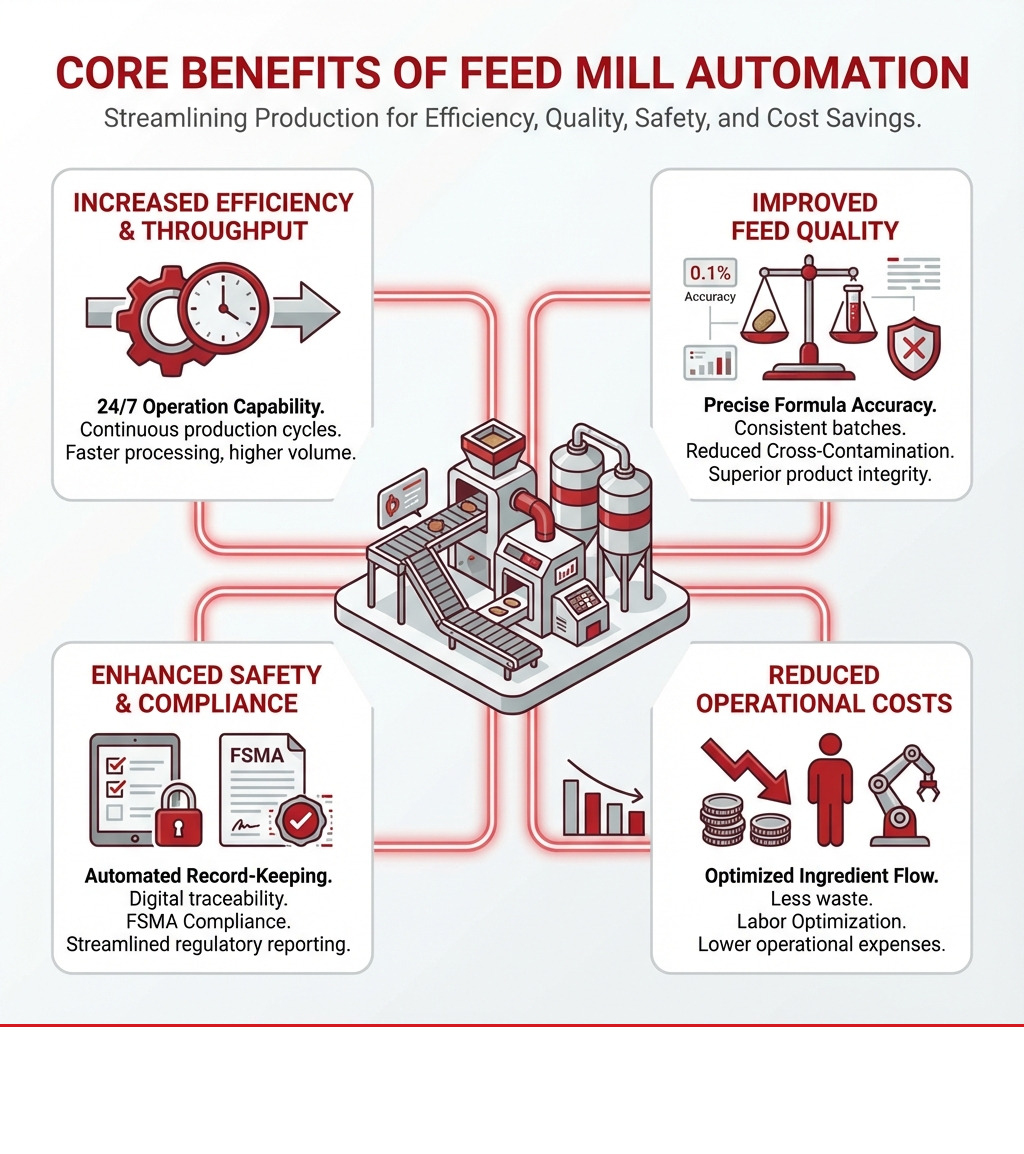
The Core Benefits of Automating Your Feed Mill
When we talk about feed mill automation, we’re not just discussing fancy gadgets; we’re talking about a fundamental shift in how feed is produced. It’s about moving from an art to a science, where every ingredient, every batch, and every process step is carefully controlled. This precision leads to a cascade of benefits that directly impact your bottom line and your reputation.
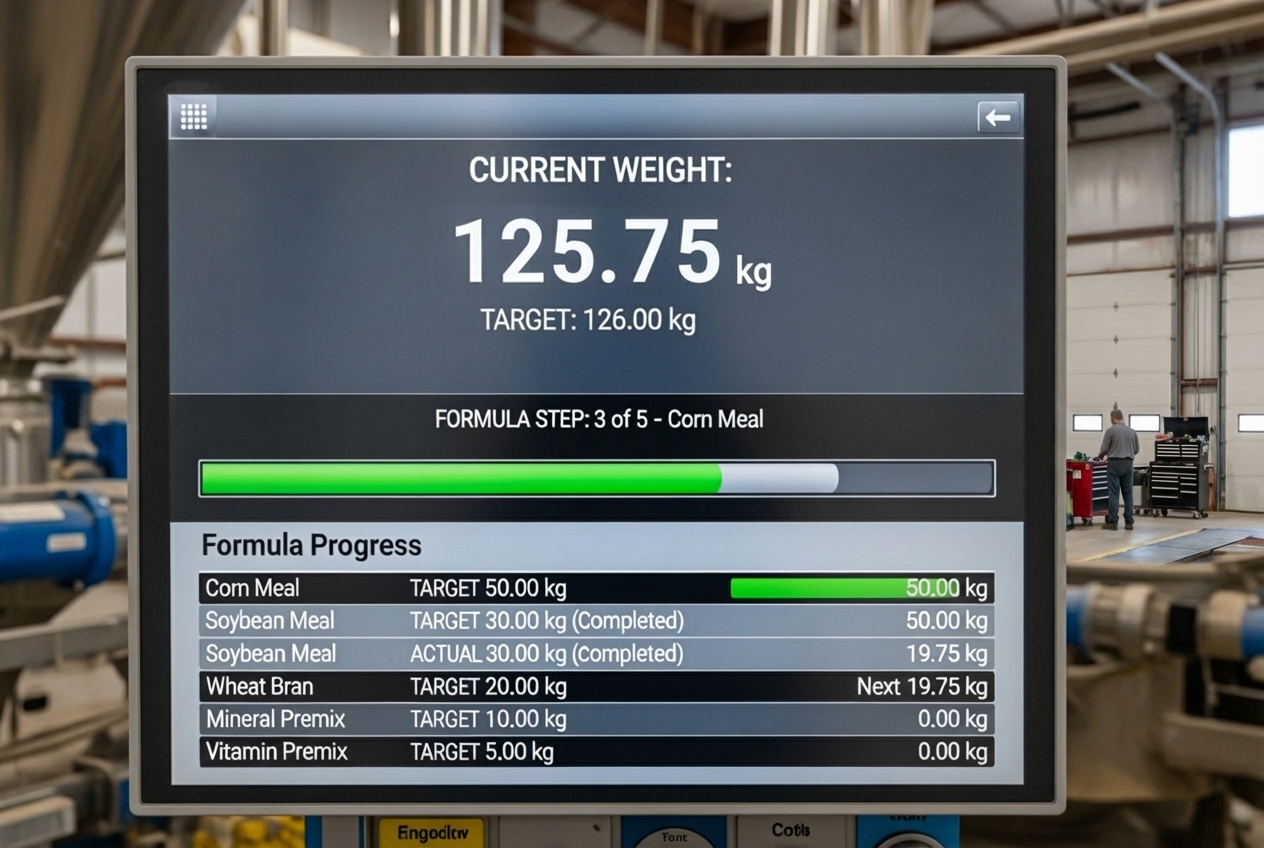
One of the most compelling reasons to accept automation is the promise of increased profitability. Manual operations are prone to human error, which can lead to costly re-batches, ingredient waste, and inconsistent product quality. With an automated system, these variables are drastically reduced. We’ve seen operations achieve significant reductions in operational costs, not just through labor optimization but also by minimizing ingredient shrinkage and energy consumption. Imagine consistently hitting your target formulation with unparalleled accuracy – that’s the power of automation. This precision directly translates to improved animal nutrition, as the animals receive exactly the nutrient profile intended, leading to better health outcomes and growth. The consistency and accuracy provided by automation are truly game-changers for any modern feed mill.
Improved Efficiency and Throughput
Efficiency is the heartbeat of any successful manufacturing operation, and feed milling is no exception. With automation, your feed mill can operate with an almost tireless rhythm. We’re talking about the capability for 24/7 operation, which dramatically increases your production capacity without necessarily expanding your physical footprint. Think of it: while your team might work in shifts, your automated system can keep chugging along, blending and processing, ensuring your output never falters.
This continuous operation leads to reduced batch cycle times. Instead of waiting for manual measurements or adjustments, the system executes each step with speed and precision. Ingredients flow seamlessly from storage to mixer, guided by intelligent controls that optimize the entire process. This optimized ingredient flow minimizes bottlenecks and ensures that your raw materials are always moving towards becoming finished feed. Furthermore, automation allows for significant labor optimization. While it might seem counterintuitive, automation doesn’t necessarily mean fewer jobs; it often means a shift in roles. Your team can move from repetitive, physically demanding tasks to more supervisory, analytical, and maintenance-focused positions, leveraging their skills in more valuable ways.
Improved Feed Quality and Consistency
For feed manufacturers, feed quality and consistency are paramount. After all, the health and productivity of livestock depend on it. Feed mill automation is the ultimate guardian of formula accuracy. Our systems ensure that each ingredient, down to the micro-level, is weighed and introduced into the batch precisely as specified in the formulation. This eliminates the guesswork and potential for human error that can lead to significant variations between batches.
Beyond mere accuracy, automation provides robust lot tracking and traceability capabilities. Imagine being able to trace every single ingredient in a finished batch back to its supplier, lot number, and even the exact time it was added. This level of detail is invaluable for quality control and, more importantly, for regulatory compliance. Speaking of compliance, automation significantly reduces the risk of cross-contamination. Dedicated ingredient lines, automated cleaning cycles, and precise material handling protocols minimize the chance of unwanted substances entering a batch, protecting both animal health and your reputation. This is especially crucial given strict guidelines like the FDA guidance on animal feed safety. By minimizing human error throughout the production process, we ensure that every bag or bulk load of feed meets the highest standards of quality and safety.
Increased Safety and Compliance
Safety isn’t just a buzzword; it’s a critical responsibility in any manufacturing environment, especially one dealing with large machinery, bulk materials, and potentially hazardous dust. Feed mill automation significantly improves worker safety by removing personnel from dangerous areas. Automated systems handle tasks like lifting heavy bags, operating mixers, and managing bulk ingredient transfers, reducing the risk of musculoskeletal injuries, falls, and accidents involving moving equipment. Dust control is also vastly improved through integrated ventilation systems and enclosed processes, creating a healthier working environment and reducing explosion risks. The ergonomic benefits are clear: fewer repetitive strain injuries and a more comfortable, safer workplace for your team.
Beyond physical safety, automation is a powerful tool for regulatory compliance. With the increasing scrutiny from bodies like the FDA, particularly concerning FSMA compliance, accurate record-keeping and audit trails are non-negotiable. Our automated systems provide comprehensive, tamper-proof automated record keeping for every aspect of production, from ingredient receipt to finished product shipment. This includes batch records, ingredient usage, process parameters, and even cleaning cycles. When an auditor comes knocking, you’ll have a complete, easily retrievable audit trail at your fingertips, demonstrating your commitment to safety and quality. This level of documentation not only protects your operation but also builds trust with your customers.
Key Components of an Automated System
Understanding the benefits of feed mill automation is one thing; understanding the “how” is another. A modern automated feed mill is a symphony of interconnected technologies, all working in harmony to create a seamless production process. At its heart, these systems rely on a robust architecture of hardware and software designed for precision and reliability.
When we design an automated solution, we integrate several key components. The Programmable Logic Controller (PLC) acts as the brain, executing instructions and managing the sequence of operations. The Supervisory Control and Data Acquisition (SCADA) system provides the overarching control and monitoring, allowing operators to oversee the entire plant from a central location. The Human-Machine Interface (HMI) is the operator’s window into the process, offering intuitive graphical displays to control equipment and view real-time data.
But it’s not just about the brains; it’s about the senses and muscles too. Sensors are the eyes and ears of the system, detecting levels, temperatures, pressures, and ingredient presence. Actuators are the muscles, performing physical actions like opening valves, starting motors, and positioning gates. And for precise control over motor speeds and energy efficiency, Variable Frequency Drives (VFDs) are essential, allowing us to fine-tune equipment performance based on real-time process needs.
Process Controls and Software
The true magic of feed mill automation lies in its sophisticated process controls and software. This is where all the data comes together, and decisions are made in milliseconds. Our systems provide centralized control, meaning an operator can manage and monitor the entire production process – from raw material intake to finished product loadout – from a single control room. This eliminates the need for personnel to be physically present at every station, streamlining operations and improving safety.
Data acquisition is another cornerstone. Every action, every measurement, every parameter is recorded. This constant stream of information allows for real-time monitoring of your process, enabling operators to identify and address issues immediately, preventing costly downtime or quality deviations. Beyond immediate reactions, this data is invaluable for reporting. Our software generates comprehensive reports on production volumes, ingredient usage, energy consumption, and more. This wealth of information empowers you to make informed decisions for continuous improvement. Furthermore, integrated inventory management features track raw materials, work-in-progress, and finished goods, providing accurate stock levels and reducing the risk of shortages or overstocking. For a deeper dive into how these systems work, you can explore more about our process controls & automation offerings.
Material Weighing and Batching Systems
At the core of consistent feed quality is accurate material weighing and batching. This is where feed mill automation truly shines. Whether you’re dealing with micro ingredients (like vitamins and minerals measured in grams), major ingredients (such as corn, soy, and wheat measured in tons), or liquid ingredients (like fats and molasses), our automated systems ensure unparalleled precision.
We use advanced weighing technologies, including both gain-in-weight and loss-in-weight systems. Gain-in-weight systems measure ingredients as they are added to a batch, ensuring each component reaches its target weight. Loss-in-weight systems, often used for continuous feeding or highly precise micro-ingredient dosing, measure the amount of material dispensed from a feeder by monitoring the weight loss of its supply hopper. This dual approach allows us to select the most appropriate and accurate weighing method for every ingredient type and process requirement. The result is feed that consistently meets its nutritional specifications, batch after batch. To learn more about how we achieve this precision, take a look at our specialized batching systems.
Automating Key Feed Mill Processes
While batching is critical, feed mill automation extends across virtually every stage of production. From the moment raw materials enter your facility to the final loading of finished feed, automation can optimize efficiency and quality.
Consider the grinding process: automated systems can precisely control particle size, ensuring optimal digestibility and consistency. In mixing, automated sequences ensure ingredients are thoroughly blended for a homogenous product. Pelleting, a high-energy process, benefits immensely from automation through optimized steam conditioning, die speed control, and temperature management, leading to durable, high-quality pellets with minimal energy waste. Even downstream processes like bagging are automated, with robotic or semi-robotic systems accurately filling, sealing, and palletizing bags. Finally, bulk loadout systems ensure accurate weighing and efficient loading of finished feed into trucks or railcars, minimizing spillage and maximizing throughput. Each of these processes, when automated, contributes to an integrated, highly efficient operation. For more information on precise material handling, you can explore our material weighing solutions.
Implementing Feed Mill Automation: A Step-by-Step Approach
Starting on a feed mill automation project can seem like a daunting task, but with a structured approach, it becomes a manageable and highly rewarding endeavor. It’s not just about installing new equipment; it’s about strategically changing your operations.
Our approach always begins with thorough project planning, where we sit down with you to understand your current setup, your challenges, and your aspirations. This leads into a detailed needs analysis, ensuring that the automation solution we propose is perfectly custom to your unique requirements. From there, we move into system design, crafting a blueprint for efficiency and future growth. Choosing a single-source supplier like us simplifies this entire journey. You benefit from a unified vision, seamless integration, and consistent support from a team that understands your entire system, rather than juggling multiple vendors.
Assessing Your Current Operations for feed mill automation
Before we can chart a course for automation, we need a clear understanding of your starting point. This involves a comprehensive assessment of your current operations. We’ll work with you to identify any bottlenecks in your production flow – those areas where things slow down, costs increase, or errors frequently occur. Perhaps it’s a manual weighing station, an inefficient mixing sequence, or a slow bagging line.
Next, we define your throughput goals. How much feed do you need to produce, and at what rate? Understanding these targets helps us design a system that not only meets but exceeds your future demands. We’ll also conduct a thorough existing equipment audit, evaluating what can be integrated into a new automated system and what might need upgrading or replacement. Finally, we’ll assist with budgeting and calculating the potential Return on Investment (ROI). This isn’t just about the initial cost; it’s about demonstrating the long-term savings and increased profitability that feed mill automation can bring to your operation in the United States or Canada.
Designing a Custom Solution
Every feed mill is unique, with its own layout, existing equipment, and specific production needs. That’s why a one-size-fits-all approach to feed mill automation simply doesn’t work. We specialize in custom engineering, designing solutions that are precisely custom to your facility. This isn’t about forcing your operation into a pre-made box; it’s about building a system that fits your exact requirements and optimizes your specific processes.
A key aspect of our design philosophy is scalability. We anticipate your future growth, ensuring that the automated system we install today can be expanded and adapted as your production demands increase. We also prioritize future-proofing, incorporating technologies that are robust, reliable, and capable of evolving with industry advancements. And, critically, we focus on equipment integration. Our expertise lies in seamlessly connecting diverse process equipment – from different manufacturers and generations – into a cohesive, centrally controlled system. This means you don’t necessarily have to replace everything; we can often make your existing, still-functional equipment work smarter.
Here are some key design considerations for a new system:
- Ingredient storage and handling capacity
- Desired batch sizes and production rates
- Existing infrastructure and space constraints
- Specific recipe requirements and number of formulas
- Regulatory compliance needs (e.g., FSMA, HACCP)
- Energy efficiency targets
- Future expansion plans
Integration, Commissioning, and Training
Once the design is finalized and the components are ready, the next critical phase is implementation. We often recommend a phased installation approach, especially for existing mills. This minimizes disruption to your ongoing production, allowing you to gradually transition to the new automated system while maintaining output. Our experienced team manages the entire installation process, ensuring everything is set up correctly and safely.
Following installation, we move into startup support and commissioning. This involves rigorous testing of every component and every sequence to ensure the system operates exactly as designed. We fine-tune parameters, calibrate sensors, and verify communication between all devices. But a sophisticated system is only as good as the operators who run it. That’s why comprehensive operator training is a cornerstone of our service. We ensure your team is proficient and comfortable using the new HMI, understanding the process flows, and troubleshooting minor issues. We also provide detailed maintenance planning to keep your system running optimally for years to come. Finally, system validation confirms that the automated process consistently meets all specified requirements and quality standards, giving you complete confidence in your investment.
Frequently Asked Questions
We often encounter common questions from mill operators considering the leap into automation. Let’s address a few of the most frequent ones.
What is the typical ROI for feed mill automation?
The Return on Investment (ROI) for feed mill automation can vary significantly based on the scale of the project, the current state of your mill, and your specific operational challenges. However, we typically see very strong returns. Mills often report improvements in several key areas that directly contribute to ROI:
- Reduced Ingredient Waste: Precision batching can cut ingredient shrinkage by 1-3%, a significant saving over time.
- Increased Throughput: Many operations experience a 10-30% increase in production capacity.
- Labor Optimization: While not always a direct reduction in headcount, automation allows for more efficient allocation of labor, reducing overtime and improving job satisfaction.
- Improved Quality Control: Fewer re-batches, less cross-contamination, and consistent product quality reduce losses and improve customer satisfaction.
- Energy Savings: Optimized processes and VFDs can lead to noticeable reductions in energy consumption.
- Regulatory Compliance: Avoiding fines and maintaining a strong reputation due to robust traceability and record-keeping also contributes to a positive ROI.
Generally, we’ve seen payback periods ranging from 2 to 5 years, often even faster for larger operations or those with significant initial inefficiencies. Our team can help you conduct a detailed ROI calculation custom to your specific situation.
Can I automate my existing feed mill, or do I need a new build?
Absolutely, you can automate your existing feed mill! In fact, many of our projects involve retrofitting and upgrading existing facilities. While a new build offers the advantage of designing an automated system from the ground up, we specialize in integrating our solutions with your current infrastructure.
Our custom engineering approach means we assess your existing equipment, layout, and processes to design an automation solution that works within your current footprint. We can often integrate new control systems, weighing equipment, and software with your existing mixers, grinders, and other machinery. This phased approach minimizes disruption and allows you to upgrade critical areas first, gradually expanding automation across your entire operation. The key is careful planning and a partner who understands how to blend new technology with established processes.
How does automation impact workforce requirements?
This is a common and important question. Feed mill automation doesn’t necessarily mean eliminating jobs; rather, it often transforms them. The goal isn’t to replace your skilled workforce but to empower them.
Automation typically shifts labor requirements from physically demanding, repetitive, and often hazardous tasks to more skilled, supervisory, and analytical roles. Operators become process managers, monitoring the HMI, analyzing data, and performing maintenance. There’s an increased need for technicians who can understand and maintain sophisticated control systems. We find that employees engaged in these new roles often report higher job satisfaction.
While there might be a reduction in manual labor in some areas, the overall impact is usually a more efficient, safer, and higher-quality operation that requires a different skill set. We provide comprehensive training to help your current workforce adapt to these new technologies, ensuring a smooth transition and maximizing the benefits of your automated system.
Conclusion
The landscape of animal feed production is continually evolving, driven by demands for higher quality, greater efficiency, and stringent safety standards. In this dynamic environment, feed mill automation is no longer a luxury but a strategic imperative. It represents the future of feed milling, offering a clear path to competitive advantage.
By embracing automation, you gain unparalleled control over your processes, ensuring consistent quality, maximizing throughput, and safeguarding your team. We’ve seen how these solutions transform operations, leading to reduced operational costs, improved animal nutrition, and robust compliance with regulatory requirements. The benefits — from improved efficiency and throughput to improved feed quality, increased safety, and seamless compliance — collectively create a more profitable and sustainable future for your feed mill.
At Sterling Systems & Controls, we pride ourselves on providing custom-engineered solutions that are carefully customized to your specific objectives. Our expertise lies in integrating diverse process equipment into a unified, intelligent system, ensuring that your investment delivers maximum value. We are committed to partnering with feed mills across the United States and Canada, helping them steer the complexities of modern production with innovative automation. We invite you to explore our custom feed milling solutions and discover how we can help you achieve your operational excellence goals.