
Compare Batching System Options: A Practical Guide
Core Capabilities of an Automated Batching System
Every successful processing facility relies on repeatability. When a recipe calls for specific amounts of raw materials, any deviation can compromise product quality, create waste, or cause downstream equipment issues. An automated batching system takes the guesswork out of recipe execution by orchestrating material movement, dosing, and weighing through centralized automation.
At the heart of these setups are two primary weighing methods: gain-in-weight and loss-in-weight. Selecting the right method depends on your throughput targets, raw material physical properties, and space constraints.
| Feature / Method | Gain-in-Weight (GIW) | Loss-in-Weight (LIW) |
|---|---|---|
| Operating Principle | Material feeds into a central scale hopper; the scale registers added weight. | Feed hoppers sit on load cells; the scale measures weight subtracted as material discharges. |
| Best Application | Multiple ingredients dosed sequentially into a shared scale hopper. | Continuous feeding or dedicated, high-speed simultaneous ingredient dosing. |
| Footprint | Compact, utilizing shared weighing vessels. | Requires dedicated scale structures for each material station. |
| Batch Cycle Speed | Sequential dosing can take longer per batch. | Rapid total batch times because multiple ingredients dispense simultaneously. |
| Relative Equipment Cost | Cost-effective for multi-material recipes. | Higher initial investment due to dedicated load cells on every bin. |
System capacity must always reflect your exact production goals. Rather than being restricted by rigid hardware constraints, Sterling Systems & Controls can design systems with any number of scales, rather than being limited to eight. This flexibility ensures your batch cycle times match mixer capacities perfectly.
High-precision load cells and programmable raw material tolerance verification prevent off-spec batches before they occur. If an ingredient feed falls outside the allowable window, the control platform pauses the sequence, alerting the operator instead of ruining a batch. You can explore our full range of custom batching systems to see how tailored architecture supports high-capacity processing.
Differentiating Major, Minor, and Micro Ingredient Feed Hardware
A common mistake in plant design is assuming one feeding mechanism fits all ingredients. Each ingredient weight classification has distinct challenges and design criteria, so major, minor, and micro ingredients cannot all necessarily use the same type of equipment. Materials behave differently based on particle size, bulk density, flowability, and environmental moisture sensitivity.
Sterling Systems & Controls offers solutions that mix and match hardware and equipment to meet differing ingredient-handling requirements:
- Major Ingredients: Typically delivered in bulk via silos, bulk bags, or large hoppers. These materials move rapidly through large augers, rotary airlocks, or pneumatic transfer lines to satisfy high-volume requirements quickly.
- Minor Ingredients: Stored in intermediate bins or day hoppers. These ingredients require balanced flow rates, often utilizing medium-diameter auger feeders or dedicated discharge gates to achieve both speed and accuracy.
- Micro Ingredients: Represent the smallest, most critical recipe additions, such as active chemicals, colors, or vitamins. Sterling Systems & Controls usually uses a vibratory feeder design for micro ingredients to ensure gentle, finely tuned dosing. However, a 2-inch screw is an option for certain situations where vibratory trays may not be ideal. Sterling Systems & Controls has used a 2-inch screw for micro ingredients only a couple of times, specifically when adhesive materials or unique physical layouts demanded positive displacement.
By matching the right mechanical feed device to each material, our minor and major weighing systems provide dependable accuracy across every ingredient weight class.
Automated Batching System Integration with Mixing and Data Platforms
An ingredient batching setup does not exist in isolation. Its value depends on how seamlessly it interacts with upstream storage, downstream processing, and plant management systems.

A well-designed system connects directly with downstream mixers, pneumatic conveying lines, mechanical bucket elevators, and packaging lines. Once a weighment sequence completes, the control platform verifies that the destination mixer is empty, confirms valve positions, and discharges the batch without operator intervention.
Sterling Systems & Controls offers proprietary software solutions that provide complete process visibility. Built on robust SQL Server data logging architectures, our control packages record every action, weight, and alarm. This data integrates bidirectionally with your Enterprise Resource Planning (ERP) or Manufacturing Execution System (MES). Production schedules flow down to the plant floor, while real-time material usage, finished batch weights, and lot numbers sync back to management. For comprehensive plant upgrades, our process controls & automation integrate every mechanical asset into a single, cohesive workflow.
How to Implement and Scale Batch Processing for Maximum Traceability
Comparing Manual, Semi-Automatic, and Hybrid Workflows
Not every plant requires full automation for every ingredient right away. Many operations balance automation on major bulk items with operator-assisted stations for minor and micro additions.
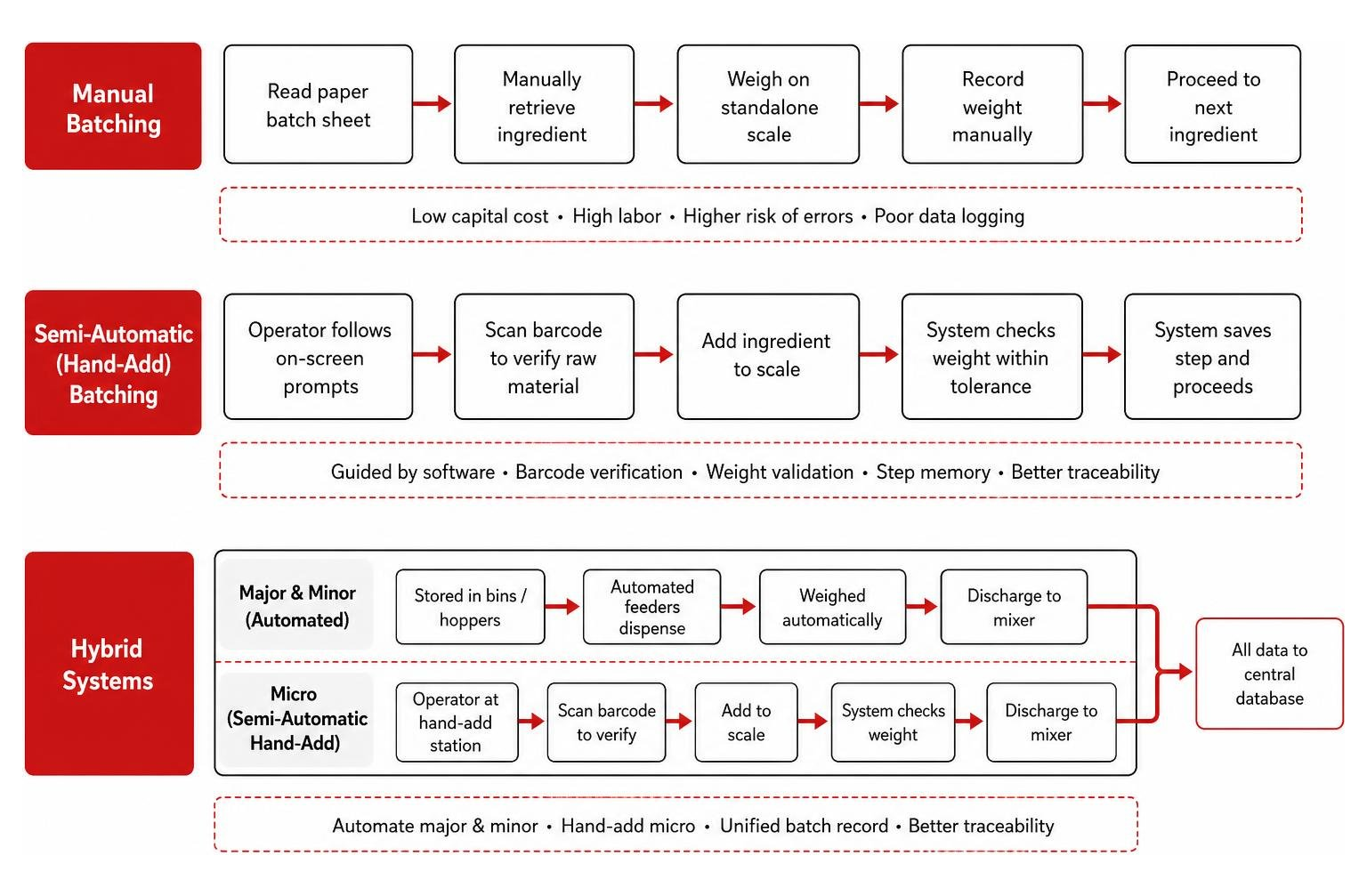
When weighing options, consider how each workflow manages human error, lot verification, and capital investment:
- Manual Batching: Relies entirely on operators reading paper batch sheets, scooping materials, and checking standalone scales. It carries low capital costs but suffers from high labor demands, potential formulation errors, and poor data logging.
- Semi-Automatic (Hand-Add) Batching: Combines operator handling with rigid software control. The operator follows on-screen prompts at an intelligent workstation. Barcode scanners verify that the operator is drawing from the correct raw material container, and the system refuses to let the operator proceed until the scale detects a weight within tolerance. If the operator is interrupted, the system remembers the exact step, preventing double additions or skipped materials.
- Hybrid Systems: Automate major and minor ingredients through dedicated bins and feeders while routing micro additions through an integrated semi-automatic hand-add station. Both streams report to the same central database, ensuring a single unified batch record.
To evaluate which approach matches your operational stage, reviewing semi-automatic vs fully automatic batching systems helps clarify labor and throughput trade-offs. Implementing a hybrid material weighing and batching system often serves as a practical, scalable middle ground.
Engineering a Modular System from Formula Review to Commissioning
Building a custom system requires a structured engineering roadmap to ensure the physical hardware and automation match your exact raw materials and plant floor environment.
- Formula and Material Flow Review: We evaluate your complete recipe portfolio, analyzing material safety data sheets, bulk densities, flow characteristics, and target batch cycle times.
- Hardware Selection and Layout Design: Engineering selects the appropriate bins, scales, and feed mechanisms. Sterling Systems & Controls creates custom systems that can handle virtually any combination of major, minor, and micro ingredients, tailored to the customer’s process and batching needs.
- Controls and Software Architecture: Electrical engineers design control panels and configure proprietary software with SQL Server databases, barcode verification routines, and ERP communication bridges.
- Factory Acceptance and Quality Testing: The system undergoes simulation and testing prior to shipment to verify sequencing, interlocks, and weight tolerance algorithms.
- On-Site Installation, Commissioning, and Training: Field engineers supervise mechanical and electrical installation, calibrate load cells, tune feeder dribble flows, and train operators and maintenance personnel.
Modular architecture allows you to scale up capacity over time. A plant can begin by automating high-use bulk ingredients and later incorporate automated minor hoppers or dedicated liquid handling systems without re-engineering the primary control architecture. This approach protects your initial capital investment while delivering precision, safety, and traceability.